Results by title
2 books match the query 'Brighouse, Harry'
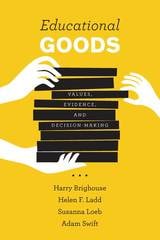
Educational Goods
Values, Evidence, and Decision-MakingHarry Brighouse, Helen F. Ladd, Susanna Loeb, and Adam Swift
University of Chicago Press, 2018
We spend a lot of time arguing about how schools might be improved. But we rarely take a step back to ask what we as a society should be looking for from education—what exactly should those who make decisions be trying to achieve?
In Educational Goods, two philosophers and two social scientists address this very question. They begin by broadening the language for talking about educational policy: “educational goods” are the knowledge, skills, and attitudes that children develop for their own benefit and that of others; “childhood goods” are the valuable experiences and freedoms that make childhood a distinct phase of life. Balancing those, and understanding that not all of them can be measured through traditional methods, is a key first step. From there, they show how to think clearly about how those goods are distributed and propose a method for combining values and evidence to reach decisions. They conclude by showing the method in action, offering detailed accounts of how it might be applied in school finance, accountability, and choice. The result is a reimagining of our decision making about schools, one that will sharpen our thinking on familiar debates and push us toward better outcomes.
In Educational Goods, two philosophers and two social scientists address this very question. They begin by broadening the language for talking about educational policy: “educational goods” are the knowledge, skills, and attitudes that children develop for their own benefit and that of others; “childhood goods” are the valuable experiences and freedoms that make childhood a distinct phase of life. Balancing those, and understanding that not all of them can be measured through traditional methods, is a key first step. From there, they show how to think clearly about how those goods are distributed and propose a method for combining values and evidence to reach decisions. They conclude by showing the method in action, offering detailed accounts of how it might be applied in school finance, accountability, and choice. The result is a reimagining of our decision making about schools, one that will sharpen our thinking on familiar debates and push us toward better outcomes.
[more]
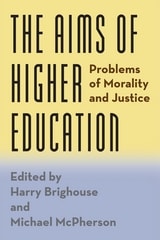
The Aims of Higher Education
Problems of Morality and JusticeEdited by Harry Brighouse and Michael McPherson
University of Chicago Press, 2015
In this book, philosopher Harry Brighouse and Spencer Foundation president Michael McPherson bring together leading philosophers to think about some of the most fundamental questions that higher education faces. Looking beyond the din of arguments over how universities should be financed, how they should be run, and what their contributions to the economy are, the contributors to this volume set their sights on higher issues: ones of moral and political value. The result is an accessible clarification of the crucial concepts and goals we so often skip over—even as they underlie our educational policies and practices.
The contributors tackle the biggest questions in higher education: What are the proper aims of the university? What role do the liberal arts play in fulfilling those aims? What is the justification for the humanities? How should we conceive of critical reflection, and how should we teach it to our students? How should professors approach their intellectual relationship with students, both in social interaction and through curriculum? What obligations do elite institutions have to correct for their historical role in racial and social inequality? And, perhaps most important of all: How can the university serve as a model of justice? The result is a refreshingly thoughtful approach to higher education and what it can, and should, be doing.
The contributors tackle the biggest questions in higher education: What are the proper aims of the university? What role do the liberal arts play in fulfilling those aims? What is the justification for the humanities? How should we conceive of critical reflection, and how should we teach it to our students? How should professors approach their intellectual relationship with students, both in social interaction and through curriculum? What obligations do elite institutions have to correct for their historical role in racial and social inequality? And, perhaps most important of all: How can the university serve as a model of justice? The result is a refreshingly thoughtful approach to higher education and what it can, and should, be doing.
[more]