Results by title
27 books match the query 'Broadway & Musicals'
"No Legs, No Jokes, No Chance"
A History of the American Musical TheaterSheldon Patinkin
Northwestern University Press, 2008
Patinkin writes about the infancy of the musical--the revues, operettas, and early musical comedies, as well as the groundbreaking shows like Oklahoma!, and Show Boat that brought the form to its "golden age" during World War II. With insightful references to how history, literature, theater, fashion, popular music, and movies influenced musical theater generally and certain shows in particular, he traces a direct lineage from older forms to contemporary musicals. The result is a broad, clear, and detailed picture of American musicals within both an aesthetic and a historical context. Patinkin conveys the pleasure of the ever-changing forms of musical theater even as he gives readers the analytical tools and terms to understand and better appreciate this uniquely American art. The book features a selection of black and white photographs from historical musical productions, and each chapter includes suggestions for materials to watch and listen to at home or in the classroom.
A Place for Us
“West Side Story” and New YorkJulia L. Foulkes
University of Chicago Press, 2016
That vision of postwar New York is at the heart of Julia L. Foulkes’s A Place for Us. A lifelong fan of the show, Foulkes became interested in its history when she made an unexpected discovery: scenes for the iconic film version were shot on the demolition site destined to become part of the Lincoln Center redevelopment area—a crowning jewel of postwar urban renewal. Foulkes interweaves the story of the creation of the musical and film with the remaking of the Upper West Side and the larger tale of New York’s postwar aspirations. Making unprecedented use of director and choreographer Jerome Robbins’s revelatory papers, she shows the crucial role played by the political commitments of Robbins and his fellow gay, Jewish collaborators, Leonard Bernstein and Arthur Laurents. Their determination to evoke life in New York as it was actually lived helped give West Side Story its unshakable sense of place even as it put forward a vision of a new, vigorous, determinedly multicultural American city.
Beautifully written and full of surprises for even the most dedicated West Side Story fan, A Place for Us is a revelatory new exploration of an American classic.
An Actor's Tale
Theater, Culture, and Everyday Life in the Nineteenth-Century United StatesAmy Hughes
University of Michigan Press, 2025
Ultimately, Hughes reveals how this actor’s tale illuminates the widespread tendency to ignore, deny, and forgive White male mediocrity in US culture, and how a deeper understanding of people like Watkins can transform our understanding of the past—and our understanding of ourselves.
Beyond Ridiculous
Making Gay Theatre with Charles Busch in 1980s New YorkKenneth Elliott
University of Iowa Press, 2023
In Beyond Ridiculous, Elliott narrates in first-person the company’s Cinderella tale of fun, heartbreak, and dishy drama. At the center of the book is a young Charles Busch, an unforgettable personality fighting to be seen, be heard, and express his unique style as a writer-performer in plays such as Psycho Beach Party and The Lady in Question. The tragedy of AIDS among treasured friends in the company, the struggle for mainstream acceptance of LGBTQ+ theatre during the reign of President Ronald Reagan, and the exploration of new ways of being a gay theatre artist make the book a bittersweet and joyous ride.
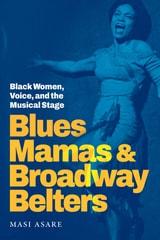
Blues Mamas and Broadway Belters
Black Women, Voice, and the Musical StageMasi Asare
Duke University Press, 2024
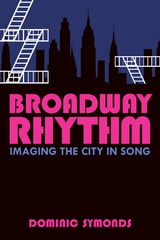
Broadway Rhythm
Imaging the City in SongDominic Symonds
University of Michigan Press, 2017
Through musicological analyses of works by Gershwin, Bernstein, Copland, Sondheim and others, the author proposes that performance cartography is a versatile methodology for urban theory, and establishes a methodological approach that uses the idea of the map in three ways: as an impetus, a metaphor, and a tool for exploring the city.
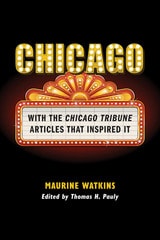
Chicago
With the Chicago Tribune Articles That Inspired ItMaurine Watkins, Edited by Thomas H. Pauly, Foreword by Charles H. Cosgrove
Southern Illinois University Press, 2025
In 1924, the murder trials of Beulah Annan and Belva Gaertner shocked the world, providing the real-life inspiration for Maurine Watkins’s unforgettable characters, Roxie Hart and Velma Kelly. Now, a century later, this reissue of Watkins’s play offers a fresh look at the origins of the story that has since become a household name.
From the silent film Chicago produced by Cecil B. DeMille in 1927 to the 1942 film Roxie Hart starring Ginger Rogers and the Broadway sensation created by Bob Fosse, Fred Ebb, and John Kander, this play has continuously evolved. It even inspired the 2002 Oscar-winning film Chicago starring Renée Zellweger, Catherine Zeta-Jones, and Richard Gere. But until recently, as editor Thomas H. Pauly writes in the book’s introduction, the real-life roots of the story were obscured.
While researching for a book on crime-as-entertainment during the 1920s, Pauly came across Maurine Watkins’s play, which was then out of print. After noticing similarities between the play and a series of articles Watkins penned for the Chicago Tribune prior to the creation of her play, Pauly knew he had stumbled upon a revelation: Watkins’s play was based on real people. His republication of the play, alongside substantial background material and a reprinting of Watkins’s news articles, has become an indispensable starting point for all subsequent interest in Watkins and Chicago, whose subject remains as topical as ever.
This special edition includes a new foreword by Charles H. Cosgrove, author of They Both Reached for the Gun: Beulah Annan, Maurine Watkins, and the Trial That Became Chicago. Cosgrove’s extensive research into the real-life cases provides deeper insight into the world that Watkins portrayed with such satirical brilliance. Additionally, the original editor, Thomas H. Pauly, has contributed a new preface, further enhancing understanding of the play and its inspiration, the thrilling true-crime story that captivated a nation and birthed a cultural phenomenon.
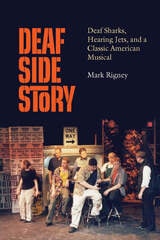
Deaf Side Story
Deaf Sharks, Hearing Jets, and a Classic American MusicalMark Rigney
Gallaudet University Press, 2003
The 1957 classic American musical West Side Story has been staged by countless community and school theater groups, but none more ambitious than the 2000 production by MacMurray College, a small school in Jacksonville, Illinois. Diane Brewer, the new drama head at the college, determined to add an extra element to the usual demands of putting on a show by having deaf students perform half of the parts. Deaf Side Story presents a fascinating narrative of Brewer and the cast’s efforts to mount this challenging play.
Brewer turned to the Illinois School for the Deaf (ISD) to cast the Sharks, the Puerto Rican gang at odds with the Anglo Jets in this musical version of Romeo and Juliet set in the slums of New York. Hearing performers auditioned to be the Jets, and once Brewer had cast her hearing Tony and deaf Maria, then came the challenge of teaching them all to sing/sign and dance the riveting show numbers for which the musical is renowned. She also had to manage a series of sensitive issues, from ensuring the seamless incorporation of American Sign Language into the play to reassuring ISD administrators and students that the production would not be symbolic of any conflict between Deaf and hearing people.
Author Mark Rigney portrays superbly the progress of the production, including the frustrations and triumphs of the leads, the labyrinthine campus and community politics, and the inevitable clashes between the deaf high school cast members and their hearing college counterparts. His representations of the many individuals involved are real and distinguished. The ultimate success of the MacMurray production reverberates in Deaf Side Story as a keen depiction of how several distinct individuals from as many cultures could cooperate to perform a classic American art form brilliantly together.
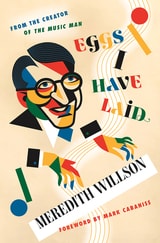
Eggs I Have Laid
Meredith Willson
University of Minnesota Press, 2025
Back in print: the playful and personal memoir of Meredith Willson’s creative tribulations and triumphs before The Music Man
Composer, musical director, writer, lecturer, and piccoloist Meredith Willson laid many eggs throughout his career—but not all those eggs would hatch quite so gloriously as his Broadway hit The Music Man. In Eggs I Have Laid, Willson genially chronicles the failures that he faced as he made his place in show business during the pivotal early 1950s, when radio was being overtaken by television.
From Hollywood to New York, London, and Paris, and back to his hometown of Mason City, Iowa, Willson sets each scene vividly, bringing to life his encounters with zeitgeist stars, from collaborators Tallulah Bankhead and Fred Allen to Orson Welles and Carmen Miranda. His signature wit excels as he relates his tales of eggs dropped, notable among them the lavishly produced variety program The Big Show, his ill-fated attempt to be a radio bulwark against the encroaching tide of television.
First published in 1955, Eggs I Have Laid features delightful curiosities, like an eight-page “platonic dialogue” about quitting smoking and the lyrics to a love song with the occupancy limits of the New York Fire Code as its central metaphor. It is at once a vivid chronicle and a trove of insight from the hilarious, perseverant mind of Meredith Willson.
Evita, Inevitably
Performing Argentina's Female Icons Before and After Eva PerónJean Graham-Jones
University of Michigan Press, 2014

Gender, Sex, and Sexuality in Musical Theatre
He/She/They Could Have Danced All NightEdited by Kelly Kessler
Intellect Books, 2023
Critics and fans alike often mistake theatrical song and dance as simplistic, heteronormative, and traditional. This collection troubles this over-idealized notion of musical theatre, tackling divas, chorus boys, and the Rockettes; hit shows such as Hamilton and Spring Awakening; and lesser-known but groundbreaking gems like Erin Markey’s A Ride on The Irish Cream and Kirsten Childs’s Bella: An American Tall Tale.
The book takes a broad look at musical theater across a range of intersecting lenses including race, nation, form, dance, casting, marketing, pedagogy, industry, stardom, politics, and platform. Undermining the musical form’s conservative façade, scholars drive home the fact that gender and desire have long been at the heart of the musical. This exciting and vibrant collection of articles takes sex, sexuality, and gendered complexity out of the musical’s liner notes and back above the marquee.
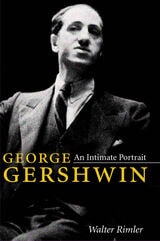
George Gershwin
An Intimate PortraitWalter Rimler
University of Illinois Press, 2009
He and his siblings received little love from their mother and no direction from their father. Older brother and lyricist Ira managed to create a home when he married Leonore Strunsky, a hard-edged woman who lived for wealth and status. The closest George came to domesticity was through his longtime relationship with Kay Swift. She was his lover, musical confidante, and fellow composer. But she remained married to another man while he went endlessly from woman to woman. Only in the final hours of his life, when they were separated by a continent, did he realize how much he needed her. Fatally ill, unprotected by (and perhaps estranged from) Ira, he was exiled by Leonore from the house she and the brothers shared, and he died horribly and alone at the age of thirty-eight.
Nor was Gershwin able to find a satisfying musical harbor. For years his songwriting genius could be expressed only in the ephemeral world of show business, as his brilliance as a composer of large-scale works went unrecognized by highbrow music critics. When he resolved this quandary with his opera Porgy and Bess, the critics were unable to understand or validate it. Decades would pass before this, his most ambitious composition, was universally regarded as one of music's lasting treasures and before his stature as a great composer became secure.
In George Gershwin: An Intimate Portrait, Walter Rimler makes use of fresh sources, including newly discovered letters by Kay Swift as well as correspondence between and interviews with intimates of Ira and Leonore Gershwin. It is written with spirited prose and contains more than two dozen photographs.
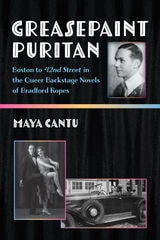
Greasepaint Puritan
Boston to 42nd Street in the Queer Backstage Novels of Bradford RopesMaya Cantu
University of Michigan Press, 2024
Greasepaint Puritan aims to find out and reclaim his story. Descended from Mayflower Pilgrims, Ropes rebelled against the “Proper Bostonian” life, in a career that touched upon the Jazz Age, American vaudeville, and theater censorship. We follow Ropes’s successful career as both a performer and the author of the trilogy of backstage novels: 42nd Street, Stage Mother, and Go Into Your Dance. Populated by scheming stage mothers, precocious stage children, grandiose bit players, and tart-tongued chorines, these novels centered on the lives and relationships of gay men on Broadway during the Jazz Age and Prohibition era. Rigorously researched, Greasepaint Puritan chronicles Ropes’s career as a successful screenwriter in 1930s and ’40s Hollywood, where he continued to be a part of a dynamic gay subculture within the movie industry before returning to obscurity in the 1950s. His legacy lives on in the Hollywood and Broadway incarnations of 42nd Street—but Greasepaint Puritan restores the “forgotten melody” of the man who first envisioned its colorful characters.
Here for the Hearing
Analyzing the Music in Musical TheaterMichael Buchler and Gregory J. Decker, Editors
University of Michigan Press, 2023
Winner of the Society for Music Theory's Outstanding Multi-Author Collection Award
This book offers a series of essays that show the integrated role that musical structure (including harmony, melody, rhythm, meter, form, and musical association) plays in making sense of what transpires onstage in musicals. Written by a group of music analysts who care deeply about musical theater, this collection provides new understanding of how musicals are put together, how composers and lyricists structure words and music to complement one another, and how music helps us understand the human relationships and historical and social contexts. Using a wide range of musical examples, representing the history of musical theater from the 1920s to the present day, the book explores how music interacts with dramatic elements within individual shows and other pieces within and outside of the genre. These essays invite readers to consider issues that are fundamental both to our understanding of musical theater and to the multiple ways we engage with music.
Historians on Hamilton
How a Blockbuster Musical Is Restaging America's PastRomano, Renee C
Rutgers University Press, 2018
Historians on Hamilton brings together a collection of top scholars to explain the Hamilton phenomenon and explore what it might mean for our understanding of America’s history. The contributors examine what the musical got right, what it got wrong, and why it matters. Does Hamilton’s hip-hop take on the Founding Fathers misrepresent our nation’s past, or does it offer a bold positive vision for our nation’s future? Can a musical so unabashedly contemporary and deliberately anachronistic still communicate historical truths about American culture and politics? And is Hamilton as revolutionary as its creators and many commentators claim?
Perfect for students, teachers, theatre fans, hip-hop heads, and history buffs alike, these short and lively essays examine why Hamilton became an Obama-era sensation and consider its continued relevance in the age of Trump. Whether you are a fan or a skeptic, you will come away from this collection with a new appreciation for the meaning and importance of the Hamilton phenomenon.
How Sondheim Found His Sound
Steve Swayne
University of Michigan Press, 2010
---Richard Crawford, author of America's Musical Life: A History
"Sondheim's career and music have never been so skillfully dissected, examined, and put in context. With its focus on his work as composer, this book is surprising and welcome."
---Theodore S. Chapin, President and Executive Director, The Rodgers & Hammerstein Organization
"What a fascinating book, full of insights large and small. An impressive analysis and summary of Sondheim's many sources of inspiration. All fans of the composer and lovers of Broadway in general will treasure and frequently refer to Swayne's work."
---Tom Riis, Joseph Negler Professor of Musicology and Director of the American Music Research Center, University of Colorado
Stephen Sondheim has made it clear that he considers himself a "playwright in song." How he arrived at this unique appellation is the subject of How Sondheim Found His Sound---an absorbing study of the multitudinous influences on Sondheim's work.
Taking Sondheim's own comments and music as a starting point, author Steve Swayne offers a biography of the artist's style, pulling aside the curtain on Sondheim's creative universe to reveal the many influences---from classical music to theater to film---that have established Sondheim as one of the greatest dramatic composers of the twentieth century.
Sondheim has spoken often and freely about the music, theater, and films he likes, and on occasion has made explicit references to how past works crop up in his own work. He has also freely acknowledged his eclecticism, seeing in it neither a curse nor a blessing but a fact of his creative life.
Among the many forces influencing his work, Sondheim has readily pointed to a wide field: classical music from 1850 to 1950; the songs of Tin Pan Alley, Broadway, and Hollywood; the theatrical innovations of Oscar Hammerstein II and his collaborators; the cinematic elements found in certain film schools; and the melodramatic style of particular plays and films. Ultimately, Sondheim found his sound by amalgamating these seemingly disparate components into his unique patois.
How Sondheim Found His Sound is the first book to provide an overview of his style and one of only a few to account for these various components, how they appear in Sondheim's work, and how they affect his musical and dramatic choices.
Lying in the Middle
Musical Theater and Belief at the Heart of AmericaJake Johnson
University of Illinois Press, 2021
Vibrant and strikingly original, Lying in the Middle discovers some of the most potent musical theater taking place in the hoping, beating hearts of Americans.
Masked
The Life of Anna Leonowens, Schoolmistress at the Court of SiamAlfred Habegger
University of Wisconsin Press, 2014
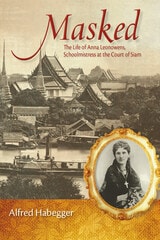
But who was Leonowens and why did her story take hold? Although it has been known for some time that she was of Anglo-Indian parentage and that her tales about the Siamese court are unreliable, not until now, with the publication of Masked, has there been a deeply researched account of her extraordinary life. Alfred Habegger, an award-winning biographer, draws on the archives of five continents and recent Thai-language scholarship to disclose the complex person behind the mask and the troubling facts behind the myth. He also ponders the curious fit between Leonowens’s compelling fabrications and the New World’s innocent dreams—in particular the dream that democracy can be spread through quick and easy interventions.
Exploring the full historic complexity of what it once meant to pass as white, Masked pays close attention to Leonowens’s midlevel origins in British India, her education at a Bombay charity school for Eurasian children, her material and social milieu in Australia and Singapore, the stresses she endured in Bangkok as a working widow, the latent melancholy that often afflicted her, the problematic aspects of her self-invention, and the welcome she found in America, where a circle of elite New England abolitionists who knew nothing about Southeast Asia gave her their uncritical support. Her embellished story would again capture America’s imagination as World War II ended and a newly interventionist United States looked toward Asia.
Best Books for General Audiences, selected by the American Association of School Librarians
Best Regional Special Interest Boosk, selected by the Public Library Reviewers
Mormons, Musical Theater, and Belonging in America
Jake Johnson
University of Illinois Press, 2019
On Broadway
Art and Commerce on the Great White WaySteven Adler
Southern Illinois University Press, 2004
At a critical, transitional moment in the history of Broadway—and, by extension, of American theatre itself—former Broadway stage manager Steven Adlerenlists insider perspectives from sixty-six practitioners and artists to chronicle the recent past and glimpse the near future of the Great White Way. From marquee names to behind-the-scenes power brokers, Adler has assembled a distinctly knowledgeable cast of theatre’s elite, including Stephen Sondheim, Arthur Laurents, Des McAnuff, Frank Rich, Robin Wagner, Rocco Landesman, Robert Longbottom, Todd Haimes, Bernard Gersten, and Alan Eisenberg.
On Broadway: Art and Commerce on the Great White Way spotlights the differing vantage points of performers, artists, writers, managers, producers, critics, lawyers, theatre owners, union leaders, city planners, and other influential players. Each details his or her firsthand account of the creative and economic forces that have wrought extraordinary changes in the way Broadway theatre is conceived, produced, marketed, and executed. Once the paramount site of American theatre, Broadway today is becoming a tourist-driven, family-friendly, middle-class entertainment oasis in Midtown, an enterprise inextricably bound to the larger mosaic of national and international professional theatre.
Accounting for this transformation and presaging Broadway’s identity for the twenty-first century, Adler and his interviewees assess the impact of the advent of corporate producers, the ascendance of not-for-profit theatres on Broadway, and the growing interdependence between regional and Broadway productions. Also critiqued are the important roles of the radical urban redevelopment staged in Times Square and the changing demographics and appetites of contemporary theatre audiences in New York and around the globe.
Actors and administrators, performers and producers, theatre students and theatregoers will all benefit from the perceptive insights in this authoritative account of theatre making for the new millennium.
Playing God
The Bible on the Broadway StageHenry Bial
University of Michigan Press, 2015
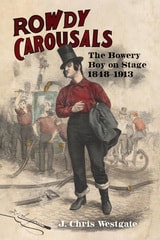
Rowdy Carousals
The Bowery Boy on Stage, 1848-1913J. Chris Westgate
University of Iowa Press, 2024
The book’s examination of working-class whiteness on stage, in the theatre, and in print culture invites theatre historians and critics to check the impulse to downplay or ignore questions about race and ethnicity in discussion of the Bowery Boy. J. Chris Westgate further explores links between the Bowery Boy’s rowdyism in the nineteenth century and the resurgence of white supremacy in the early twenty-first century.
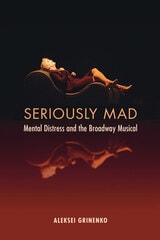
Seriously Mad
Mental Distress and the Broadway MusicalAleksei Grinenko
University of Michigan Press, 2023
Theatermakers in the United States have long been drawn to madness as a source of dramatic spectacle. During the Broadway musical’s golden age in the mid-twentieth century, creative teams used the currently in-vogue psychoanalytic ideas about mental life to construct troubled characters at odds with themselves and their worlds. As the clinical and cultural profile of madness transformed over the twentieth century, musicals continued to delve into the experience of those living with mental pain, trauma, and unhappiness.
Seriously Mad offers a dynamic account of stage musicals’ engagement with historically significant theories about mental distress, illness, disability, and human variance in the United States. By exploring who is considered mad and what constitutes madness at different moments in U.S. history, Aleksei Grinenko shows how, in attempts to bring the musicals closer to highbrow sophistication, theater dramatized serious medical conditions and social problems. Among the many Broadway productions discussed are Next to Normal, A Strange Loop, Sweeney Todd, Man of La Mancha, Gypsy, Oklahoma!, and Lady in the Dark.
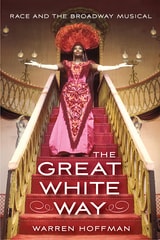
The Great White Way
Race and the Broadway MusicalHoffman, Warren
Rutgers University Press, 2014
Broadway musicals are one of America’s most beloved art forms and play to millions of people each year. But what do these shows, which are often thought to be just frothy entertainment, really have to say about our country and who we are as a nation?
The Great White Way is the first book to reveal the racial politics, content, and subtexts that have haunted musicals for almost one hundred years from Show Boat (1927) to The Scottsboro Boys (2011). Musicals mirror their time periods and reflect the political and social issues of their day. Warren Hoffman investigates the thematic content of the Broadway musical and considers how musicals work on a structural level, allowing them to simultaneously present and hide their racial agendas in plain view of their audiences. While the musical is informed by the cultural contributions of African Americans and Jewish immigrants, Hoffman argues that ultimately the history of the American musical is the history of white identity in the United States.
Presented chronologically, The Great White Way shows how perceptions of race altered over time and how musicals dealt with those changes. Hoffman focuses first on shows leading up to and comprising the Golden Age of Broadway (1927–1960s), then turns his attention to the revivals and nostalgic vehicles that defined the final quarter of the twentieth century. He offers entirely new and surprising takes on shows from the American musical canon—Show Boat (1927), Oklahoma! (1943), Annie Get YourGun (1946), The Music Man (1957), West Side Story (1957), A Chorus Line (1975), and 42nd Street (1980), among others.
New archival research on the creators who produced and wrote these shows, including Leonard Bernstein, Jerome Robbins, Stephen Sondheim, and Edward Kleban, will have theater fans and scholars rethinking forever how they view this popular American entertainment.
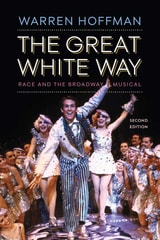
The Great White Way
Race and the Broadway MusicalWarren Hoffman
Rutgers University Press, 2020
Now in a new second edition, The Great White Way is the first book to reveal the racial politics, content, and subtexts that have haunted musicals for almost one hundred years from Show Boat (1927) to Hamilton (2015). This revised edition includes a new introduction and conclusion, updated chapters, as well as a brand-new chapter that looks at the blockbuster musicals The Book of Mormon and Hamilton.
Musicals mirror their time periods and reflect the political and social issues of their day. Warren Hoffman investigates the thematic content of the Broadway musical and considers how musicals work on a structural level, allowing them to simultaneously present and hide their racial agendas in plain view of their audiences. While the musical is informed by the cultural contributions of African Americans and Jewish immigrants, Hoffman argues that ultimately the history of the American musical is the history of white identity in the United States.
Presented chronologically, The Great White Way shows how perceptions of race altered over time and how musicals dealt with those changes. Hoffman focuses first on shows leading up to and comprising the Golden Age of Broadway (1927–1960s), then turns his attention to the revivals and nostalgic vehicles that defined the final quarter of the twentieth century. He offers entirely new and surprising takes on shows from the American musical canon—Show Boat (1927), Oklahoma! (1943), Annie Get Your Gun (1946), The Music Man (1957), West Side Story (1957), A Chorus Line (1975), and 42nd Street (1980), among others. In addition to a new chapter on Hamilton and The Book of Mormon, this revised edition brings The Great White Way fully into the twenty-first century with an examination of jukebox musicals and the role of off-Broadway and regional theaters in the development of the American musical.
New archival research on the creators who produced and wrote these shows, including Leonard Bernstein, Jerome Robbins, Stephen Sondheim, and Edward Kleban, will have theater fans and scholars rethinking forever how they view this popular American entertainment.
The Theater Will Rock
A History of the Rock Musical, from Hair to HedwigElizabeth L. Wollman
University of Michigan Press, 2010
"A much-needed study of the impact of rock music on the musical theater and its resulting challenges, complexities, failures, and successes. Anyone interested in Broadway will learn a great deal from this book."
---William Everett, author of The Musical: A Research Guide to Musical Theatre
"As Wollman weaves her historical narrative, she compellingly returns to . . . the conflict between the aesthetics and ideologies of rock music and the disciplined and commercial practices of the musical stage."
---Theatre Research International
"This well-written account puts the highs and lows of producing staged rock musicals in New York City into perspective and is well worth reading for the depth of insight it provides."
---Studies in Musical Theatre
Despite the genre’s influence and fame, there are still some critics who claim that the term “rock musical” is an oxymoron. The relationship between rock and the musical theater has been stormy from the start, and even the comparatively recent success of Rent has done little to convince theater producers that rock musicals are anything but highly risky ventures. Elizabeth L. Wollman explores the reasons behind these problematic connections and looks at the socioeconomic forces that underlie aesthetic decisions. She weighs the influence on the rock musical by mass media, sound, and recording technology, and the economic pressures that have affected New York theater in general over the past three decades. Finally, Wollman offers a meditation on the state of the musical, its relation to rock, and, ultimately, its future.
Packed with candid commentary by members of New York's vibrant theater community, The Theater Will Rock traces the rock musical’s evolution over nearly fifty years, in popular productions such as Hair, The Who's Tommy, Jesus Christ Superstar, The Rocky Horror Picture Show, Little Shop of Horrors, Rent, and Mamma Mia!—and in notable flops such as The Capeman.
Elizabeth L. Wollman is Assistant Professor of Music at Baruch College of the City University of New York.
Unfinished Show Business
Broadway Musicals as Works-in-ProcessBruce Kirle
Southern Illinois University Press, 2005
In this fresh approach to musical theatre history, Bruce Kirle challenges the commonly understood trajectory of the genre. Drawing on the notion that the world of the author stays fixed while the world of the audience is ever-changing, Kirle suggests that musicals are open, fluid products of the particular cultural moment in which they are performed. Incomplete as printed texts and scores, musicals take on unpredictable lives of their own in the complex transformation from page to stage.
Using lenses borrowed from performance studies, cultural studies, queer studies, and ethnoracial studies, Unfinished Show Business: Broadway Musicals as Works-in-Process argues that musicals are as interesting for the provocative issues they raise about shifting attitudes toward American identity as for their show-stopping song-and-dance numbers and conveniently happy endings. Kirle illustrates how performers such as Ed Wynn, Fanny Brice, and the Marx Brothers used their charismatic personalities and quirkiness to provide insights into the struggle of marginalized ethnoracial groups to assimilate. Using examples from favorites including Oklahoma!, Fiddler on the Roof, A Chorus Line, and Les Misérables, Kirle demonstrates Broadway’s ability to bridge seemingly insoluble tensions in society, from economic and political anxiety surrounding World War II to generational conflict and youth counterculture to corporate America and the “me” generation. Enlivened by a gallery of some of Broadway’s most memorable moments—and some amusing, obscure ones as well—this study will appeal to students, scholars, and lifelong musical theatre enthusiasts.