Results by title
23 books match the query 'Brothers'
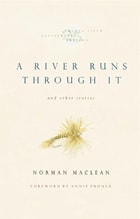
A River Runs Through It and Other Stories, Twenty-fifth Anniversary Edition
Norman Maclean
University of Chicago Press, 2001
Maclean grew up in the western Rocky Mountains in the first decades of the twentieth century. As a young man he worked many summers in logging camps and for the United States Forest Service. The two novellas and short story in this collection are based on his own experiences—the experiences of a young man who found that life was only a step from art in its structures and beauty. The beauty he found was in reality, and so he leaves a careful record of what it was like to work in the woods when it was still a world of horse and hand and foot, without power saws, "cats," or four-wheel drives. Populated with drunks, loggers, card sharks, and whores, and set in the small towns and surrounding trout streams and mountains of western Montana, the stories concern themselves with the complexities of fly fishing, logging, fighting forest fires, playing cribbage, and being a husband, a son, and a father.
By turns raunchy, poignant, caustic, and elegiac, these are superb tales which express, in Maclean's own words, "a little of the love I have for the earth as it goes by." A first offering from a 70-year-old writer, the basis of a top-grossing movie, and the first original fiction published by the University of Chicago Press, A River Runs through It and Other Stories has sold more than a million copies. As Proulx writes in her foreword to this new edition, "In 1990 Norman Maclean died in body, but for hundreds of thousands of readers he will live as long as fish swim and books are made."
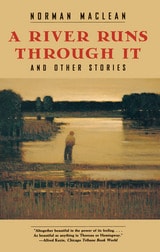
A River Runs Through It, and Other Stories
Norman Maclean
University of Chicago Press, 1976
Based on Norman Maclean's childhood experiences, the title novella has established itself as one of the most moving stories of our time; it captivates readers with vivid descriptions of life along Montana's Big Blackfoot River and its near magical blend of fly fishing with the troubling affections of the heart.
The paperback edition is now available with an evocative new cover by acclaimed Montana painter Russell Chatham.
"A masterpiece. . . . This is more than stunning fiction: It is a lyric record of a time and a life, shining with Maclean's special gift for calling the reader's attention to arts of all kinds—the arts that work in nature, in personality, in social intercourse, in fly-fishing."—Kenneth M. Pierce, Village Voice
Norman Maclean (1902-90), woodsman, scholar, teacher, and storyteller, grew up in the Western Rocky Mountains of Montana and worked for many years in logging camps and for the United States Forestry Service before beginning his academic career. He retired from the University of Chicago in 1973.

A River Runs through It
Norman Maclean
University of Chicago Press, 1989
Based on Norman Maclean's childhood experiences, A River Runs through It has established itself as one of the most moving stories of our time; it captivates readers with vivid descriptions of life along Montana's Big Blackfoot River and its near magical blend of fly fishing with the troubling affections of the heart.
This handsome edition is designed and illustrated by Barry Moser. There are thirteen two-color wood engravings.
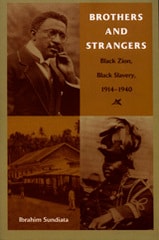
Brothers and Strangers
Black Zion, Black Slavery, 1914–1940Ibrahim Sundiata
Duke University Press, 2003
In an account based on extensive archival research, including work in the Liberian National Archives, Sundiata explains how Garvey’s plan collapsed when faced with opposition from the Liberian elite, opposition that belied his vision of a unified Black World. In 1930 the League of Nations investigated labor conditions and, damningly, the United States, land of lynching and Jim Crow, accused Liberia of promoting “conditions analogous to slavery.” Subsequently various plans were put forward for a League Mandate or an American administration to put down slavery and “modernize” the country. Threatened with a loss of its independence, the Liberian government turned to its “brothers beyond the sea” for support. A varied group of white and black anti-imperialists, among them W. E. B. Du Bois, took up the country’s cause. In revealing the struggle of conscience that bedeviled many in the black world in the past, Sundiata casts light on a human rights predicament which, he points out, continues in twenty-first-century African nations as disparate as Sudan, Mauritania, and the Ivory Coast.
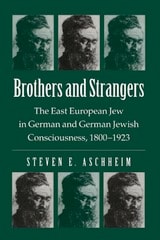
Brothers and Strangers
The East European Jew in German and German Jewish Consciousness, 1800–1923Steven E. Aschheim
University of Wisconsin Press, 1983
Brothers and Strangers traces the history of German Jewish attitudes, policies, and stereotypical images toward Eastern European Jews, demonstrating the ways in which the historic rupture between Eastern and Western Jewry developed as a function of modernism and its imperatives. By the 1880s, most German Jews had inherited and used such negative images to symbolize rejection of their own ghetto past and to emphasize the contrast between modern “enlightened” Jewry and its “half-Asian” counterpart. Moreover, stereotypes of the ghetto and the Eastern Jew figured prominently in the growth and disposition of German anti-Semitism. Not everyone shared these negative preconceptions, however, and over the years a competing post-liberal image emerged of the Ostjude as cultural hero. Brothers and Strangers examines the genesis, development, and consequences of these changing forces in their often complex cultural, political, and intellectual contexts.
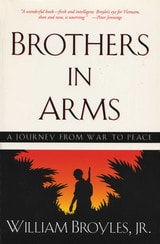
Brothers in Arms
A Journey from War to PeaceBy William Broyles, Jr.
University of Texas Press, 1996
Reviews of the Knopf edition:
"A wonderful book—fresh and intelligent. Broyles's eye for Vietnam, then and now, is unerring." —Peter Jennings
"[A] superbly written, often moving story of Broyles' journey back to the killing ground in Vietnam where he once served as a Marine lieutenant. A cool, clear meditation that stings the heart." —Kirkus Reviews
"A first-rate piece of work, infused with an ideal American common decency and common sense." —Kurt Vonnegut
"Exceptional and memorable." —Gay Talese
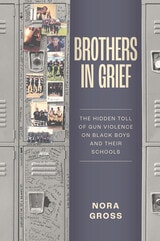
Brothers in Grief
The Hidden Toll of Gun Violence on Black Boys and Their SchoolsNora Gross
University of Chicago Press, 2024
JahSun, a dependable, much-loved senior at Boys’ Prep was just hitting his stride in the fall of 2017. He had finally earned a starting position on the varsity football team and was already weighing two college acceptances. Then, over Thanksgiving, tragedy struck. An altercation at his older sister’s home escalated into violence, killing the unarmed teenager in a hail of bullets. JahSun’s untimely death overwhelmed his entire community, sending his family, friends, and school into seemingly insurmountable grief. Worse yet, that spring two additional Boys’ Prep students would be shot to death in their neighborhood. JahSun and his peers are not alone in suffering the toll of gun violence, as every year in the United States teenagers die by gunfire in epidemic numbers, with Black boys most deeply affected.
Brothers in Grief closely attends to the neglected victims of youth gun violence: the suffering friends and classmates who must cope, mostly out of public view, with lasting grief and hidden anguish. Set at an ambitious urban high school for boys during the heartbreaking year following the death of JahSun, the book chronicles the consequences of untimely death on Black teen boys and on a school community struggling to recover. Sociologist Nora Gross tells the story of students attempting to grapple with unthinkable loss, inviting readers in to observe how they move through their days at school and on social media in the aftermath of their friends’ and classmates’ deaths. Gross highlights the discrepancy between their school’s educational mission and teachers’ and administrators’ fraught attempts to care for students’ emotional wellbeing. In the end, the school did not provide adequate space for grief, making it more difficult for students to heal, reengage with school, and imagine hopeful futures. Even so, supportive relationships deepened among students and formed across generations, offering promising examples of productive efforts to channel student grief into positive community change.
A searing testimony of our collective failure to understand the inner lives of our children in crisis, Brothers in Grief invites us all to wrestle with the hidden costs of gun violence on racial and educational inequity.
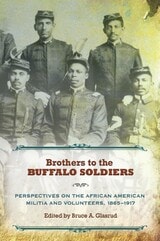
Brothers to the Buffalo Soldiers
Perspectives on the African American Militia and Volunteers, 1865-1917Bruce A. Glasrud
University of Missouri Press, 2011
Many black Americans continued to serve in times of military need. Nearly 180,000 African Americans served in units of the U.S. Colored Troops during the Civil War, and others, from states such as Massachusetts, Rhode Island, Missouri, and Kansas, participated in state militias organized to protect local populations from threats of Confederate invasion. As such, the Civil War was a turning point in the acceptance of black soldiers for national defense. By 1900, twenty-two states and the District of Columbia had accepted black men into some form of military service, usually as state militiamen—brothers to the “buffalo soldiers” of the regular army regiments, but American military men regardless.
Little has been published about them, but Brothers to the Buffalo Soldiers: Perspectives on the African American Militia and Volunteers, 1865–1919, offers insights into the varied experiences of black militia units in the post–Civil War period. The book includes eleven articles that focus either on “Black Participation in the Militia” or “Black Volunteer Units in the War with Spain.” The articles, collected and introduced by author and scholar Bruce A. Glasrud, provide an overview of the history of early black citizen-soldiers and offer criticism from prominent academics interested in that experience.
Brothers to the Buffalo Soldiers discusses a previously little-known aspect of the black military experience in U.S. history, while deliberating on the discrimination these men faced both within and outside the military. Chosen on the bases of scholarship, balance, and readability, these articles provide a rare composite picture of the black military man’s life during this period. Brothers to the Buffalo Soldiers offers both a valuable introductory text for students of military studies and a solid source of material for African American historians.
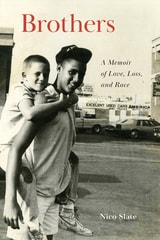
Brothers
A Memoir of Love, Loss, and RaceNico Slate
Temple University Press, 2023
Brothers is Nico Slate’s poignant memoir about Peter Slate, aka XL, a Black rapper and screenwriter whose life was tragically cut short. Nico and Peter shared the same White American mother but had different fathers. Nico’s was White; Peter’s was Black. Growing up in California in the 1980s and 1990s, Nico often forgot about their racial differences until one night in March 1994 when Peter was attacked by a White man in a nightclub in Los Angeles.
Nico began writing Brothers with the hope that investigating the attack would bring him closer to Peter. He could not understand that night, however, without grappling with the many ways race had long separated him from his brother.
This is a memoir of loss—the loss of a life and the loss at the heart of our racial divide—but it is also a memoir of love. The love between Nico and Peter permeates every page of Brothers. This achingly beautiful memoir presents one family’s resilience on the fault lines of race in contemporary America.

Brothers
Male Dominance and Technological ChangePluto Press, 1991

Country Songs for Alice
Emma Binder
Tupelo Press, 2024
In Country Songs for Alice, a nonbinary, queer narrator passes through the crucible of love, romance, and heartbreak against the backdrop of rural America—a landscape which offers luminous belonging, even as the hazards of homophobia, loneliness, and isolation loom large. Part roadtrip, part mixtape, these poems are explorations of love, music, romance, pageantry, loneliness, and belonging in the rural places and small towns that seem to preclude queer culture. Country Songs for Alice not only tells the story of a relationship and its dissolution but reclaims country western imagery and aesthetics for a queer audience, dousing the narrator’s experience in the language of cowboys, horses, rodeos, trucks, and desert skies.
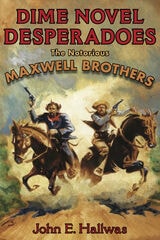
Dime Novel Desperadoes
The Notorious Maxwell BrothersJohn Hallwas
University of Illinois Press, 2011

Good Knights
Ralph McInerny
St. Augustine's Press, 2010
These stories represent an intermediate stage in the evolution of the Knight brothers in Ralph McInerny’s fiction. In The Noonday Devil, Phil, in his capacity as private detective, was fairly close to the action, but by no means the major character. Roger, his blimp-sized brother, entered obliquely into the story but ended by starring in the finale.
Readers liked them, in particular Roger. So McInerny brought them back in Easeful Death, where they are far more central and Roger occupies much space, physically and narratively. And so it might have remained. When McInerny was asked to do a Notre Dame series of mysteries, he decided to bring Roger to South Bend as the Huneker Professor of Catholic Studies, accompanied by the semi-retired Phil, who has the full menu of Notre Dame sports to keep him occupied. Prior to starting the series, McInerny wanted to reacquaint himself with the Knights and hit upon the idea of doing a series of Knight brothers stories in Crisis, a magazine he founded with Michael Novak. Before moving them to South Bend, he wanted to see them in action, working out of New York, always driving in the specially designed van, never flying, to the cities were their client lived.
Good Knights is the result of putting these eight Knights brothers’ stories together. Call them finger exercises in character. The response to them in the magazine was gratifying, and with them behind him, McInerny launched the Notre Dame series, with On This Rockne in 1996, thirteen years and thirteen novels ago. But the origins of that successful series is seen here.

Mark Twain and Orion Clemens
Brothers, Partners, StrangersPhilip Ashley Fanning
University of Alabama Press, 2003
One became America’s greatest writer. The other died in obscurity and failure. As brothers, they shaped each other's lives and work.
In a compelling way, Philip Fanning traces the fraternal relationship of Orion and Samuel Clemens from its beginning in Hannibal, Missouri, in the 1830s to Orion's death in Iowa in 1897. He demonstrates that Orion’s influence on the writer known as Mark Twain was profound, pervasive, and prolonged.
In some respects, Samuel defined himself against Orion’s formidable background. It was Orion who became the chief financial and spiritual support of the Clemens family following the father's controversial death in 1847. It was Orion who led the way for his brother into printing, journalism, and mine speculation. And it was Orion who served as Sam’s first real editor and literary mentor, recognizing and encouraging his younger brother’s talents as a writer.
The two siblings had much in common, and they often appeared to be codependent, so much so that their attitudes veered sharply from mutual admiration to mutual disdain and rivalry. Whereas Orion was self-effacing, easygoing, humble, and adventurous in his politics and progressive in his views, Twain was often ill-tempered and antagonistic toward those around him and conservative in his outlook. He frequently portrayed his older brother in autobiographical writings and letters as a buffoon and a laughingstock.
Fanning—who drew upon extensive archival sources, unpublished letters between the two brothers, and the Mark Twain Papers at the University of California, Berkeley—charts these divergences in their characters and in their fortunes. As Twain rose to become a national celebrity and a financial success, Orion's finances and self-esteem disintegrated, and Twain’s treatment of his brother became evermore harsh and mocking. Fanning’s study stands as both a biography of a fractious fraternal relationship and a work of scholarship that highlights for the first time how significantly Orion Clemens influenced Twain’s psychic and artistic economy.
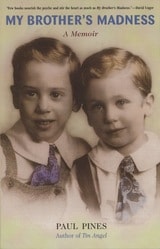
My Brother's Madness
A MemoirPaul Pines
Northwestern University Press, 2007
My Brother's Madness is part thriller, part exploration that not only describes the causes, character, and journey of mental illness, but also makes sense of it. It is ultimately a story of our own humanity, and answers the question, Am I my brother's keeper?
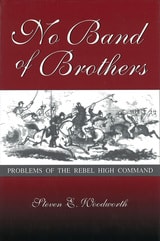
No Band of Brothers
Problems of the Rebel High CommandSteven E. Woodworth
University of Missouri Press, 1999
The Civil War was barely over before Southerners and other students of the war began to examine the Confederate high command in search of an explanation for the South's failure. Although years of research failed to show that the South's defeat was due to a single, overriding cause, the actions of the Southern leaders during the war were certainly among the reasons the South lost the war.
In No Band of Brothers, Steven Woodworth explores, through a series of essays, various facets of the way the Confederacy waged its unsuccessful war for secession. He examines Jefferson Davis and some of his more important generals, including Pierre G. T. Beauregard, Leonidas Polk, Joseph E. Johnston, Robert E. Lee, James Longstreet, and Thomas J. "Stonewall" Jackson; the Confederacy's strategic plans; and the South's success in making competent officers out of men with very little military preparation.
Woodworth particularly looks at the personalities and personal relationships that affected the course and outcome of the war. What made a good general? What could make an otherwise able man a failure as a general? What role did personal friendships or animosities play in the Confederacy's top command assignments and decisions? How successful was the Confederacy in making competent generals out of its civilian leaders? In what ways did Jefferson Davis succeed or fail in maximizing the chances for the success of his cause?
In analyzing the Confederate leadership, Woodworth reveals some weaknesses, many strengths, and much new information. No Band of Brothers will be an important addition to Civil War scholarship and will be welcomed by professional historians, amateur historians, students, and the general reader alike.
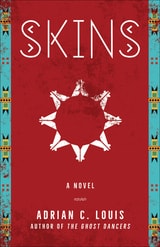
Skins
A NovelAdrian C. Louis
University of Nevada Press, 2022
It’s the early 1990s and Rudy Yellow Shirt and his brother, Mogie, are living on the Pine Ridge Reservation in South Dakota, home of the legendary Oglala Sioux warrior Crazy Horse. Both Vietnam veterans, the men struggle with daily life on the rez. Rudy, a criminal investigator with the Pine Ridge Public Safety Department, must frequently arrest his neighbors and friends, including his brother, who has become a rez wino.
But when Rudy falls and hits his head on a rock while pursuing a suspected murderer, Iktome the trickster enters his brain. Iktome restores Rudy’s youthful sexual vigor—long-lost to years of taking high blood pressure pills—and ignites his desire for political revenge via an alter ego, the “Avenging Warrior.” As the Avenging Warrior, Rudy takes direct action to punish local criminals. In a violent act, he torches the local liquor store, nearly burning Mogie alive while he is hiding on the store’s roof, plotting to steal booze. Although the brothers reconcile before Mogie dies, he leaves the Avenging Warrior with one final mission: go to Mount Rushmore and blow the nose off George Washington’s face.
Louis’s critically acclaimed novel was made into a movie in 2002, directed by Chris Eyre.
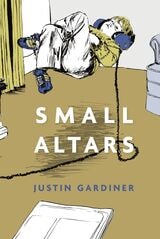
Small Altars
Justin Gardiner
Tupelo Press, 2024
In Small Altars, Justin Gardiner delves into the world of comic books and superheroes as a means for coming to terms with the many struggles of his brother’s life, as well as his untimely death, offering a lyric and honest portrayal of the tolls of mental illness, the redemptive powers of art and familial love, and the complex workings of grief.
The Comedy of Errors
William Shakespeare
Arizona Center for Medieval and Renaissance Studies, 2022
One of Shakespeare’s earliest plays, The Comedy of Errors is a farcical tale of separated twins and mistaken identities. This slapstick play is a staple of the genre, including madcap bawdiness, love at first sight, reunions, and happily-ever-afters. Christina Anderson’s translation dives deep into the joy of the original text, reinterpreting the metaphor, antiquated slang, and double and triple entendre for a contemporary audience.
This translation of The Comedy of Errors was written as part of the Oregon Shakespeare Festival’s Play On! project, which commissioned new translations of thirty-nine Shakespeare plays. These translations present work from “The Bard” in language accessible to modern audiences while never losing the beauty of Shakespeare’s verse. Enlisting the talents of a diverse group of contemporary playwrights, screenwriters, and dramaturges from diverse backgrounds, this project reenvisions Shakespeare for the twenty-first century. These volumes make these works available for the first time in print—a new First Folio for a new era.
The Resurrectionists
Collins, Michael
University of Iowa Press, 2021
Haunted by the deaths of his parents and uncle, Frank Cassidy journeys north to dispute a cousin's claim to the family farm, where he meets a stranger who might resolve mysteries about Frank's past.
The Tallons
William March
University of Alabama Press, 1964
In The Tallons, the second novel in the "Pearl County" series, March tells the story of two farm boys, Andrew and Jim Tallon. Their placid and predictable life is upended by a girl from Georgia, Myrtle Bickerstaff. The conflict which engulfs these three arises from a series of carefully chosen and extraordinarily telling incidents to a dramatic climax which will be remembered long after the book is set aside. March framed the novel as "a study in paranoia" and to the end of his life considered it one of his strongest works.
Wm & H'ry
Literature, Love, and the Letters between Wiliam and Henry JamesJ. C. Hallman
University of Iowa Press, 2013
William and Henry James served as each other’s muse and critic. For instance, the event of the death of Mrs. Sands illustrates what H’ry never stated: even if the “matter” of his fiction was light, the minds behind it lived and died as though it was very heavy indeed. He seemed to best understand this himself only after Wm fully fleshed out his system. “I can’t now explain save by the very fact of the spell itself . . . that [Pragmatism] cast upon me,” H’ry wrote in 1907. “All my life I have . . . unconsciously pragmatised.”
Wm was never able to be quite so gracious in return. In 1868, he lashed out at the “every day” elements of two of H’ry’s early stories, and then explained: “I have uttered this long rigmarole in a dogmatic manner, as one speaks, to himself, but of course you will use it merely as a mass to react against in your own way, so that it may serve you some good purpose.” He believed he was doing H’ry a service as he criticized a growing tendency toward “over-refinement” or “curliness” of style. “I think it ought to be of use to you,” he wrote in 1872, “to have any detailed criticism fm even a wrong judge, and you don’t get much fm. any one else.” For the most part, H’ry agreed. “I hope you will continue to give me, when you can, your free impression of my performance. It is a great thing to have some one write to one of one’s things as if one were a 3d person & you are the only individual who will do this.”
Yours
The Civil War, a Love Triangle, and the Steamboat SultanaLila Jeanne Elliott Sybesma
Indiana Historical Society Press, 2019