Results by title
4 books match the query 'Brown, Wendy'
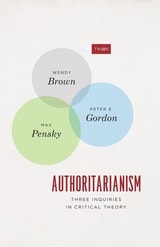
Authoritarianism
Three Inquiries in Critical TheoryWendy Brown, Peter E. Gordon, and Max Pensky
University of Chicago Press, 2018
In this volume, three distinguished scholars draw on critical theory to address our current predicament. Wendy Brown, Peter E. Gordon, and Max Pensky share a conviction that critical theory retains the power to illuminate the forces producing the current political constellation as well as possible paths away from it. Brown explains how “freedom” has become a rallying cry for manifestly un-emancipatory movements; Gordon dismantles the idea that fascism is rooted in the susceptible psychology of individual citizens and reflects instead on the broader cultural and historical circumstances that lend it force; and Pensky brings together the unlikely pair of Tocqueville and Adorno to explore how democracies can buckle under internal pressure. These incisive essays do not seek to smooth over the irrationality of the contemporary world, and they do not offer the false comforts of an easy return to liberal democratic values. Rather, the three authors draw on their deep engagements with nineteenth–and twentieth–century thought to investigate the historical and political contradictions that have brought about this moment, offering fiery and urgent responses to the demands of the day.

Feminist Theory and the Frankfurt School, Volume 17
Wendy Brown
Duke University Press, 0
Left Legalism/Left Critique
Wendy Brown and Janet Halley, eds.
Duke University Press, 2002
Brown and Halley have assembled essays from diverse contributors—law professors, philosophers, political theorists, and literary critics—united chiefly by their willingness to think critically from the left about left legal projects. The essays themselves vary by topic, by theoretical approach, and by conclusion. While some contributors attempt to rework particular left legal projects, others insist upon abandoning or replacing those projects. Still others leave open the question of what is to be done as they devote their critical attention to understanding what we are doing. Above all, Left Legalism/Left Critique is a rare contemporary argument and model for the intellectually exhilarating and politically enriching dimensions of left critique—dimensions that persist even, and perhaps especially, when critique is unsure of the intellectual and political possibilities it may produce.
Contributors: Lauren Berlant, Wendy Brown, Judith Butler, Drucilla Cornell, Richard T. Ford, Katherine M. Franke, Janet Halley, Mark Kelman, David Kennedy, Duncan Kennedy, Gillian Lester, Michael Warner
Women's Studies on the Edge
Joan Wallach Scott, ed.
Duke University Press, 2008
The contributors to Women’s Studies on the Edge embrace feminism not as a set of prescriptions but as a critical stance, one that seeks to interrogate and disrupt prevailing systems of gender. Refusing to perpetuate and protect orthodoxies, they ask tough questions about the impact of institutionalization on the once radical field of women’s studies; about the ongoing difficulties of articulating women’s studies with ethnic, queer, and race studies; and about the limits of liberal concepts of emancipation for understanding non-Western women. They also question the viability of continuing to ground women’s studies in identity politics authorized by personal experience. The multiple interpretations in Women’s Studies on the Edge sometimes overlap and sometimes stand in opposition to one another. The result is a collection that embodies the best aspects of critique: the intellectual and political stance that the contributors take to be feminism’s ethos and its aim.
Contributors
Wendy Brown
Beverly Guy-Sheftall
Evelynn M. Hammonds
Saba Mahmood
Biddy Martin
Afsaneh Najmabadi
Ellen Rooney
Gayle Salamon
Joan Wallach Scott
Robyn Wiegman