Results by title
23 books match the query 'Buenos Aires'

Buenos Aires
400 YearsEdited by Stanley R. Ross and Thomas F. McGann
University of Texas Press, 1982

Care without Pathology
How Trans- Health Activists Are Changing MedicineChristoph Hanssmann
University of Minnesota Press, 2023
Examining trans- healthcare as a key site through which struggles for health and justice take shape
Over the past two decades, medical and therapeutic approaches to transgender patients have changed radically, from treating a supposed pathology to offering gender-affirming care. Based on ethnographic fieldwork in New York City and Buenos Aires, Care without Pathology moves across the Americas to show how trans- health activists have taken on the project of depathologization.
In New York, Christoph Hanssmann examines activist attempts to overturn bans on using public health dollars to fund trans- health care. In Argentina, he traces how trans- activists marshaled medical statistics and personal biographies to reveal state violence directed against trans- people and travestis. Hanssmann also demonstrates the importance of understanding transphobia in the broader context of gendered racism, ableism, and antipoverty, arguing for the rise of a thoroughly coalition-based mass mobilization.
Care without Pathology highlights the distributive arguments activists made to access state funding for health care, combating state arguments that funding trans- health care is too specialized, too expensive, and too controversial. Hanssmann situates trans- health as a crucible within which sweeping changes are taking place—with potentially far-reaching effects on the economic and racial barriers to accessing care.
Chasing World-Class Urbanism
Global Policy versus Everyday Survival in Buenos AiresJacob Lederman
University of Minnesota Press, 2020
Questions increasingly dominant urban planning orthodoxies and whether they truly serve everyday city dwellers
What makes some cities world class? Increasingly, that designation reflects the use of a toolkit of urban planning practices and policies that circulates around the globe. These strategies—establishing creative districts dedicated to technology and design, “greening” the streets, reinventing historic districts as tourist draws—were deployed to build a globally competitive Buenos Aires after its devastating 2001 economic crisis. In this richly drawn account, Jacob Lederman explores what those efforts teach us about fast-evolving changes in city planning practices and why so many local officials chase a nearly identical vision of world-class urbanism.
Lederman explores the influence of Northern nongovernmental organizations and multilateral agencies on a prominent city of the global South. Using empirical data, keen observations, and interviews with people ranging from urban planners to street vendors he explores how transnational best practices actually affect the lives of city dwellers. His research also documents the forms of resistance enacted by everyday residents and the tendency of local institutions and social relations to undermine the top-down plans of officials. Most important, Lederman highlights the paradoxes of world-class urbanism: for instance, while the priorities identified by international agencies are expressed through nonmarket values such as sustainability, inclusion, and livability, local officials often use market-centric solutions to pursue them. Further, despite the progressive rhetoric used to describe urban planning goals, in most cases their result has been greater social, economic, and geographic stratification.
Chasing World-Class Urbanism is a much-needed guide to the intersections of culture, ideology, and the realities of twenty-first-century life in a major Latin American city, one that illuminates the tension between technocratic aspirations and lived experience.
Concrete Dreams
Practice, Value, and Built Environments in Post-Crisis Buenos AiresNicholas D'Avella
Duke University Press, 2019
Genres of Listening
An Ethnography of Psychoanalysis in Buenos AiresXochitl Marsilli-Vargas
Duke University Press, 2022
Impure Migration
Jews and Sex Work in Golden Age ArgentinaMir Yarfitz
Rutgers University Press, 2019
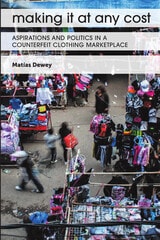
Making It at Any Cost
Aspirations and Politics in a Counterfeit Clothing MarketplaceBy Matías Dewey
University of Texas Press, 2020
La Salada is South America’s largest marketplace for fraudulently labeled clothing, a sprawling and dangerous bazaar on the fringes of Buenos Aires where counterfeit goods are bought and sold, armed thieves roam the nearby streets, and corrupt police and politicians turn a blind eye to widespread unlawful behaviors. Despite conditions traditionally considered inhospitable to economic growth—including acute interpersonal distrust, pervasive personal insecurity, and rampant violence—business in La Salada is booming under an established order completely detached from the state.
Matías Dewey dives deep into the world of La Salada to examine how market exchanges function outside the law and how agreements and norms develop in the economy for counterfeit clothing. Drawing on seven months of ethnographic research and more than a hundred interviews, Dewey argues that aspirations for a better future shape garment workers’ everyday practices, from their home-based sweatshops to the market stalls. The book unearths a new configuration of garment production and commercialization detached from global supply chains, submerged in the shadows of informality and illegality, and rooted in aspiration and opportunity.
Memories of Buenos Aires
Signs of State Terrorism in ArgentinaMax Page
University of Massachusetts Press, 2013
In the 1970s, Argentina was the leader in the “Dirty War,” a violent campaign by authoritarian South American regimes to repress left-wing groups and any others who were deemed subversive. Over the course of a decade, Argentina's military rulers tortured and murdered upwards of 30,000 citizens. Even today, after thirty years of democratic rule, the horror of that time continues to roil Argentine society.
Argentina has also been in the vanguard in determining how to preserve sites of torture, how to remember the “disappeared,” and how to reflect on the causes of the Dirty War. Across the capital city of Buenos Aires are hundreds of grassroots memorials to the victims, documenting the scope of the state's reign of terror. Although many books have been written about this era in Argentina's history, the original Spanish-language edition of Memories of Buenos Aires was the first to identify and interpret all of these sites. It was published by the human rights organization Memoria Abierta, which used interviews with survivors to help unearth that painful history.
This translation brings this important work to an English-speaking audience, offering a comprehensive guidebook to clandestine sites of horror as well as innovative sites of memory. The book divides the 48 districts of the city into 9 sectors, and then proceeds neighborhood-by-neighborhood to offer descriptions of 202 known “sites of state terrorism” and 38 additional places where people were illegally detained, tortured, and killed by the government.
Memories of Buenos Aires
Signs of State Terrorism in ArgentinaMax Page
University of Massachusetts Press, 2013
In the 1970s, Argentina was the leader in the “Dirty War,” a violent campaign by authoritarian South American regimes to repress left-wing groups and any others who were deemed subversive. Over the course of a decade, Argentina's military rulers tortured and murdered upwards of 30,000 citizens. Even today, after thirty years of democratic rule, the horror of that time continues to roil Argentine society.
Argentina has also been in the vanguard in determining how to preserve sites of torture, how to remember the “disappeared,” and how to reflect on the causes of the Dirty War. Across the capital city of Buenos Aires are hundreds of grassroots memorials to the victims, documenting the scope of the state's reign of terror. Although many books have been written about this era in Argentina's history, the original Spanish-language edition of Memories of Buenos Aires was the first to identify and interpret all of these sites. It was published by the human rights organization Memoria Abierta, which used interviews with survivors to help unearth that painful history.
This translation brings this important work to an English-speaking audience, offering a comprehensive guidebook to clandestine sites of horror as well as innovative sites of memory. The book divides the 48 districts of the city into 9 sectors, and then proceeds neighborhood-by-neighborhood to offer descriptions of 202 known “sites of state terrorism” and 38 additional places where people were illegally detained, tortured, and killed by the government.
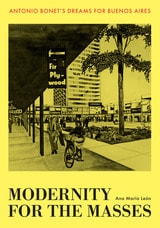
Modernity for the Masses
Antonio Bonet's Dreams for Buenos AiresBy Ana María León
University of Texas Press, 2021
2022 PROSE Award Finalist in Architecture and Urban Planning
2022 Association for Latin American Art Arvey Foundation Book Award, Honorable Mention
Throughout the early twentieth century, waves of migration brought working-class people to the outskirts of Buenos Aires. This prompted a dilemma: Where should these restive populations be situated relative to the city’s spatial politics? Might housing serve as a tool to discipline their behavior?
Enter Antonio Bonet, a Catalan architect inspired by the transatlantic modernist and surrealist movements. Ana María León follows Bonet's decades-long, state-backed quest to house Buenos Aires's diverse and fractious population. Working with totalitarian and populist regimes, Bonet developed three large-scale housing plans, each scuttled as a new government took over. Yet these incomplete plans—Bonet's dreams—teach us much about the relationship between modernism and state power.
Modernity for the Masses finds in Bonet's projects the disconnect between modern architecture’s discourse of emancipation and the reality of its rationalizing control. Although he and his patrons constantly glorified the people and depicted them in housing plans, Bonet never consulted them. Instead he succumbed to official and elite fears of the people's latent political power. In careful readings of Bonet's work, León discovers the progressive erasure of surrealism's psychological sensitivity, replaced with an impulse, realized in modernist design, to contain the increasingly empowered population.
Poor People's Politics
Peronist Survival Networks and the Legacy of EvitaJavier Auyero
Duke University Press, 2000
Looking closely at the slum-dwellers’ informal problem-solving networks, which are necessary for material survival, and the different meanings of Peronism within these networks, Auyero presents the first ethnography of urban clientelism ever carried out in Argentina. Revealing a deep familiarity with the lives of the urban poor in Villa Paraíso, a stigmatized and destitute shantytown of Buenos Aires, Auyero demonstrates the ways in which local politicians present their vital favors to the poor and how the poor perceive and evaluate these favors. Having penetrated the networks, he describes how they are structured, what is traded, and the particular way in which women facilitate these transactions. Moreover, Auyero proposes that the act of granting favors or giving food in return for votes gives the politicians’ acts a performative and symbolic meaning that flavors the relation between problem-solver and problem-holder, while also creating quite different versions of contemporary Peronism. Along the way, Auyero is careful to situate the emergence and consolidation of clientelism in historic, cultural, and economic contexts.
Poor People’s Politics reexamines the relationship between politics and the destitute in Latin America, showing how deeply embedded politics are in the lives of those who do not mobilize in the usual sense of the word but who are far from passive. It will appeal to a wide range of students and scholars of Latin American studies, sociology, anthropology, political science, history, and cultural studies.
Routine Crisis
An Ethnography of DisillusionSarah Muir
University of Chicago Press, 2021
Anthropologist Sarah Muir offers a cogent meditation on the limits of critique at this historical moment, drawing on deep experience in Argentina but reflecting on a truly global condition. If we feel things are being upended in a manner that is ongoing, tumultuous, and harmful, what would we need to do—and what would we need to give up—to usher in a revitalized critique for today's world? Routine Crisis is an original provocation and a challenge to think beyond the limits of exhaustion and reimagine a form of criticism for the twenty-first century.
Sideways Selves
Travesti and Jotería Struggles Across the AméricasPJ DiPietro
University of Texas Press, 2025
2026 Sylvia Rivera Award in Transgender Studies, The Center for LGBTQ Studies (CLAGS), CUNY
How trans and non-binary networks engage in decoloniality across hemispheres.
A deeply informed, theoretically rich work of inquiry and critique, Sideways Selves learns from two communities of migrants as they contest their marginalization under the colonial regime of gender—colonial because, as PJ DiPietro affirms, Indigenous and Afro-diasporic conceptions of embodiment have been displaced by the European-Christian order of gender. Following gender-nonconforming Aymara, Kolla, and mixed-race exiles in Buenos Aires and K’iche’, Nahua, and Central American migrants in the San Francisco Bay Area, DiPietro takes stock of a collective, transnational effort to reimagine ideas of personhood and kinship that gender makes unthinkable.
The communities DiPietro studies create new kinds of identities, collective and genderless in nature. Their ways of thinking and doing, though radical, are motivated by old wisdom, storytelling, healing, and religion—brujería, curanderismo, Voudoun, and other practices that colonialism, capitalism, and the nation-state have unsuccessfully tried to erase. In equal measures philosophical and ethnographic, Sideways Selves witnesses and listens as these displaced people—displaced from their homes and from the moral geography of the West—show us what a just, decolonial world could actually be.
Specular City
The Transformation Of Culture, ConsumptionLaura Podalsky
Temple University Press, 2004
Squatter Life
Persistence at the Urban Margins of Buenos AiresJavier Auyero and Sofía Servián
Duke University Press, 2025
Temples of the Earthbound Gods
Stadiums in the Cultural Landscapes of Rio de Janeiro and Buenos AiresBy Christopher Thomas Gaffney
University of Texas Press, 2008
In Rio de Janeiro, the spiritual home of world football, and Buenos Aires, where a popular soccer club president was recently elected mayor, the game is an integral part of national identity. Using the football stadium as an illuminating cultural lens, Temples of the Earthbound Gods examines many aspects of urban culture that play out within these monumental architectural forms, including spirituality, violence, rigid social norms, anarchy, and also expressions of sexuality and gender.
Tracing the history of the game in Brazil and Argentina through colonial influences as well as indigenous ball courts in Mayan, Aztec, Zapotec, Mixtec, and Olmec societies, Christopher Gaffney's study spans both ancient and contemporary worlds, linking the development of stadiums to urbanization and the consolidation of nation building in two of Latin America's most intriguing megacities.
The Ailing City
Health, Tuberculosis, and Culture in Buenos Aires, 1870–1950Diego Armus
Duke University Press, 2011

The Bureaucrats of Buenos Aires, 1769-1810
Amor al Real ServicioSusan Migden Socolow
Duke University Press, 1988
The late eighteenth century was a critical time for the southernmost regions of Latin America, for in this period they became a separate political entity, the Viceroyalty of the Rio de la Plata. Socolow's work, part of a continuing study of the political, economic, and social elites of the emerging city of Buenos Aires, here considers the bureaucracy put into place by the Bourbon reforms. The author examines the professional and personal circumstances of all bureaucrats, from the high-ranking heads of agencies to the more lowly clerks, contrasting their expectations and their actual experiences. She pays particular attention to their recruitment, promotion, salary, and retirement, as well as their marriage and kinship relationships in the local society.
The People's Hotel
Working for Justice in ArgentinaKatherine Sobering
Duke University Press, 2022

The Struggle for an Enlightened Republic
Buenos Aires and RivadaviaKlaus Gallo
University of London Press, 2006

Vida Zoo-cial
The Buenos Aires Zoo and the Making of Argentine Society, 1875–1924Ashley Elizabeth Kerr
Vanderbilt University Press, 2025
Premio al Mejor Libro en Humanidades, Latin American Studies Association, Nineteenth-Century Section, 2026
In late nineteenth- and early twentieth‑century Buenos Aires, elites attempted to tackle growing poverty and social problems with a suite of social, educational, and medical reforms, hoping to make the city and larger nation more “modern” and “progressive” on the world stage. Known as the “social question,” this turn-of-the-century preoccupation with the future of the city and nation was undergirded by a larger set of social Darwinist beliefs about the biological and racial inferiority of immigrants and the working class, linking them to higher susceptibility to alcoholism, sexual deviancy, insanity, and disease.
In Vida Zoo-cial, Ashley Elizabeth Kerr argues that the Buenos Aires Zoo and its many animal species were an important tool in attempts to remake Argentinian society. Elites used the zoo’s physical spaces, programming, and visual and literary representations of its animals to try to educate and “improve” the masses, especially immigrants and the poor, but stopped short of supporting more radical social transformations. Drawing upon extensive archival research from the zoo’s archive, including correspondence, municipal reports, receipts, and employment records, as well as a range of literary and popular culture sources, Kerr records these efforts, which included enlisting lionesses as object lessons in proper motherhood and elephants as model immigrants. Although some projects were successful, Kerr also documents the many ways others went awry when the zoo's animals and the humans who came to see them failed to cooperate.
Vida Zoo-cial is not only a story about how the poor and working class resisted elite efforts for social reform founded upon racialized beliefs and pseudoscience, but also one that challenges readers to rethink the relationship between humans and non‑humans.
Workshop of Revolution
Plebeian Buenos Aires and the Atlantic World, 1776–1810Lyman L. Johnson
Duke University Press, 2011

World Film Locations
Buenos AiresEdited by Santiago Oyarzabal and Michael Pigott
Intellect Books, 2014