Results by title

21 books match the query 'Bulgaria'
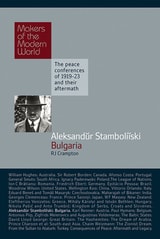
cover of Aleksandur Stamboliiski: Bulgaria

Aleksandur Stamboliiski

Bulgaria

Richard Crampton

Haus Publishing, 2009

Aleksandur Stamboliiski was one of the most original politicians of the 20th century. His tragedy was that he came to power at the end of the First World War in which Bulgaria had been defeated. It fell to him, therefore, to accept and apply the peace settlement. This created tensions between him and traditional Bulgarian nationalism, tensions which ended with his murder in 1923. The book will examine the origins of this traditional nationalism from the foundation of the Bulgarian state in 1878, and of the agrarian movement which came to represent the social aspirations of the majority of the peasant population. It will also illustrate Stamboliiski's rise to power and examine his ideology. Emphasis will be placed on how this ideology clashed with the monarchy, the military, and the nationalists. Stamboliiski's policies in the Balkan wars and the First World War will be described before the details of the 1919 peace settlement are examined. The implementation of those terms will then be discussed as will the coup of 1923. The legacy of the peace treaty in the inter-war period and of Stamboliiski's image in the years after his downfall will form the final section of the book.
[more]
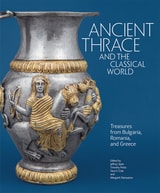
cover of Ancient Thrace and the Classical World: Treasures from Bulgaria, Romania, and Greece

Ancient Thrace and the Classical World

Treasures from Bulgaria, Romania, and Greece

Jeffrey Spier

J. Paul Getty Trust, The, 2024

A captivating examination of the profound impact Thracian art and culture had on the Greeks and the entire northern Aegean region.

The Thracians—a collection of tribal peoples who inhabited territories north of ancient Greece, an area that comprises present-day Bulgaria, much of Romania, and parts of Greece and Turkey—were renowned for their skill as warriors and horsemen, as well as for their wealth in precious metals. Thracians left few written records, and knowledge of their history and customs has long been dependent on brief accounts from ancient Greek authors. They appeared in Greek myth as formidable adversaries in the Trojan War, cruel kings, and followers of the ecstatic god Dionysos. Spectacular archaeological discoveries made in Thracian lands during modern times, however, have provided firsthand evidence of this remarkable culture, illuminating Thrace’s interactions with Greece, Persia, and Rome.

Ancient Thrace and the Classical World reproduces more than two hundred glorious objects dating from the end of the Bronze Age, around 1200 BC, to the end of the first century AD, when Thrace became part of the Roman Empire. Experts explore topics such as Thracian royal tombs, the Greek colonization of the Black Sea coast, Thracian religion, and more, placing Thracian culture in a broader historical context that highlights its complex relationships with the surrounding region.

This volume is published to accompany an exhibition on view at the J. Paul Getty Museum at the Getty Villa from November 6, 2024, to March 3, 2025.
[more]
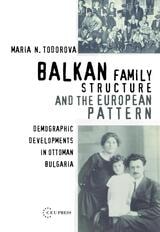
cover of Balkan Family Structure and the European Pattern: Demographic Developments in Ottoman Bulgaria

Balkan Family Structure and the European Pattern

Demographic Developments in Ottoman Bulgaria

Maria Todorova

Central European University Press, 2006
This study, which is an updated, extended, and revised version of the out-of-print 1993 edition, reassesses the traditional stereotype of the place of the Balkans in the model of the European family in the nineteenth century on the basis of new source material and by synthesizing existing research. The work first analyzes family structure and demographic variables as they appear in population registers and other sources, and the impact of these findings on theoretical syntheses of the European family pattern. On most features, such as population structure, marriage and nuptiality, birth and fertility, death and mortality rates, family and household size and structure, as well as inheritance patterns, the Balkans show an enormous deal of internal variety. This variability is put in a comparative European context by matching the quantifiable results with comparable figures and patterns in other parts of Europe. The second section of the book is a contribution to the long-standing debate over the zadruga, the complex, collective, joint or extended family in the Balkans. Finally, the book considers ideology and mythology and the ways it has adversely affected scholarship on the family, and broadly on population history.
[more]
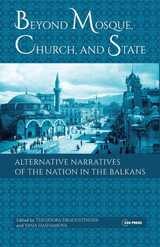
cover of Beyond Mosque, Church, and State: Alternative Narratives of the Nation in the Balkans

Beyond Mosque, Church, and State

Alternative Narratives of the Nation in the Balkans

Yana Hashamova

Central European University Press, 2016
Journalists and policy-makers in the West have often assumed that the religious and ethno-national heterogeneity of the Balkans is the underlying reason for the numerous problems the area has faced throughout the twentieth century. The multiple and turbulent political transitions in the area, the dynamics of the interaction between Christianity and Islam, the contradictory and constantly shifting nationality policies, and the fluctuating identities of the diverse populations continue to be seen as major challenges to the stability of the region. By exploring the development of intricate religious, linguistic, and national dynamics in a variety of case studies throughout the Balkans, this volume demonstrates the existence of alternatives and challenges to nationalism in the area. The authors analyze a variety of national, non-national, and anti-national(ist) encounters in four areas—Bosnia, Bulgaria, Macedonia, and Albania—traditionally seen as “hot-beds” of nationalist agitation and tension resulting from their populations' religious or ethno-national diversity. In their entirety, the contributions in this volume chart a more complex picture of the national dynamics. The authors recognize the existence of national tensions both in historical perspective and in contemporary times, but also suggest the possibility of different paths to the nation that did not involve violence but allowed for national accommodation and reconciliation.
[more]
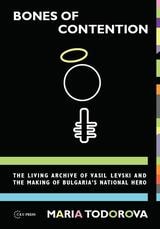
cover of Bones of Contention: The living archive of Vasil Levski and the making of Bulgaria's national hero

Bones of Contention

The living archive of Vasil Levski and the making of Bulgaria's national hero

Maria Todorova

Central European University Press, 2009

This book is about documenting and analyzing the living archive around the figure of Vasil Levski (1837–1873), arguably the major and only uncontested hero of the Bulgarian national pantheon. The processes described, although with a chronological depth of almost two centuries, are still very much in the making, and the living archive expands not only in size but constantly adding surprising new forms. The monograph is a historical study, taking as its narrative focus the life, death and posthumous fate of Levski. By exploring the vicissitudes of his heroicization, glorification, appropriations, reinterpretation, commemoration and, finally, canonization, it seeks to engage in several broad theoretical debates, and provide the basis for subsequent regional comparative research. The analysis of Levski's consecutive and simultaneous appropriations by different social platforms, political parties, secular and religious institutions, ideologies, professional groups, and individuals, demonstrates how boundaries within the framework of the nation are negotiated around accepted national symbols.
[more]
cover of Communist Gourmet: The Curious Story of Food in the People’s Republic of Bulgaria

Communist Gourmet

The Curious Story of Food in the People’s Republic of Bulgaria

Albena Shkodrova

Central European University Press, 2021

Communist Gourmet presents a lively, detailed account of how the communist regime in Bulgaria determined people’s everyday food experience between 1944 and 1989. It examines the daily routines of acquiring food, cooking it, and eating out at restaurants through the memories of Bulgarians and foreigners, during communism.

In looking back on a wide array of issues and events, Albena Shkodrova attempts to explain the paradoxes of daily existence. She reports human stories that are touching, sometimes dark, but often full of humor and anecdotes from nearly one hundred people: some of them are Bulgarians who were involved in the communist food industry, whether as consumers or employees, while others are visitors from the United States and Western Europe who report culinary highlights and disappointments. The author made use of the national press, officially published cookbooks, Communist Party documents, and other previously unstudied sources.

An appendix containing recipes of dishes typical of the period and an extensive set of archival photographs are special features of the volume.
[more]
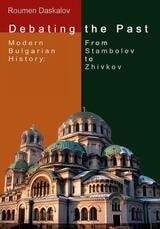
cover of Debating the Past: Modern Bulgarian Historiography—From Stambolov to Zhivkov

Debating the Past

Modern Bulgarian Historiography—From Stambolov to Zhivkov

Roumen Daskalov

Central European University Press, 2011
The book is comprised of the four major debates on modern Bulgarian history from Independence in 1878 to the fall of communism in 1989. The debates are on the Bulgarian–Russian/Soviet relations, on the relations between Agrarians and Communists, on Bulgarian Fascism, and on Communism. They are associated with the rule of key political personalities in Bulgarian history: Stambolov (1887–1894), Stamboliiski (1919–1923), Tsar Boris III (1918–1943), and the communist leaders Georgi Dimitrov and Todor Zhivkov (1956–1989). The debates are traced through their various articulations and dramatic turns from their beginnings to the present day.
[more]
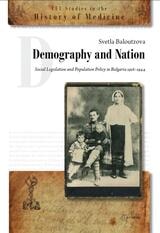
cover of Demography and Nation: Social Legislation and Population Policy in Bulgaria

Demography and Nation

Social Legislation and Population Policy in Bulgaria

Svetla Baloutzova

Central European University Press, 2011
The monograph investigates the origins of state policy toward population and the family in Bulgaria. Reconstructs the evolution of state legislation in the field of social policy toward the family between the two World Wars, colored by concerns about the national good and demographic considerations. It sets the laws regarding family welfare in their framework of a distinctively cultural, historical and political discourse to follow the motives behind the legislative initiatives.
[more]
cover of Entangled Paths Toward Modernity: Contextualizing Socialism and Nationalism in the Balkans

Entangled Paths Toward Modernity

Contextualizing Socialism and Nationalism in the Balkans

Augusta Dimou

Central European University Press, 2009
The book is a study in comparative intellectual history and discusses how socialist ideology emerged as an option of political modernity in the Balkans of the late nineteenth and early twentieth century.Focusing on how technologies of ideological transfer and adaptation work, the book examines the introduction and contextualization of international socialist paradigms in the Southeast European periphery. At its core is the presentation of three case studies (Serbia, Bulgaria and Greece), intertwined at times through similar, but also divergent paths. Each case aspires to tell a different and yet complementary story with respect to the issue of modernity and socialism. The book analyses the introduction of socialism against the background and in conjunction to other prominent options of political modernity such as nationalism, liberalism and agrarianism.
[more]
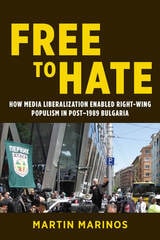
cover of Free to Hate: How Media Liberalization Enabled Right-Wing Populism in Post-1989 Bulgaria

Free to Hate

How Media Liberalization Enabled Right-Wing Populism in Post-1989 Bulgaria

Martin Marinos

University of Illinois Press, 2023

Linking neoliberalism with the Right’s global rise

Bulgaria’s media-driven pivot to right-wing populism parallels political developments taking place around the world. Martin Marinos applies a critical political economy approach to place Bulgarian right-wing populism within the structural transformation of the country’s media institutions. As Marinos shows, media concentration under Western giants like Westdeutsche Allgemeine Zeitung and News Corporation have led to a neoliberal turn of commercialization, concentration, and tabloidization across media. The Right have used the anticommunism and racism bred by this environment to not only undermine traditional media but position their own outlets to boost new political entities like the nationalist party Ataka. Marinos’s ethnographic observations and interviews with local journalists, politicians, and media experts add on-the-ground detail to his account. He also examines several related issues, including the performative appeal of populist media and the money behind it.

A timely and innovative analysis, Free to Hate reveals where structural changes in media intersect with right-wing populism.
[more]
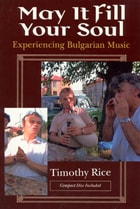
cover of May It Fill Your Soul: Experiencing Bulgarian Music

May It Fill Your Soul

Experiencing Bulgarian Music

Timothy Rice

University of Chicago Press, 1994

In this vivid musical ethnography, Timothy Rice documents and interprets the history of folk music, song, and dance in Bulgaria over a seventy-year period of dramatic change. From 1920 to 1989, Bulgaria changed from a nearly medieval village society to a Stalinist planned industrial economy to a chaotic mix of capitalist and socialist markets and cultures.

In the context of this history, Rice brings Bulgarian folk music to life by focusing on the biography of the Varimezov family, including the musician Kostadin and his wife Todora, a singer. Combining interviews with his own experiences of learning how to play, sing and dance Bulgarian folk music, Rice presents one of the most detailed accounts of traditional, aural learning processes in the ethnomusicological literature.

Using a combination of traditionally dichotomous musicological and ethnographic approaches, Rice tells the story of how individual musicians learned their tradition, how they lived it during the pre-Communist era of family farming, how the tradition changed with industrialization brought under Communism, and finally, how it flourished and evolved in the recent, unstable political climate.

This work—complete with a compact disc and numerous illustrations and musical examples—contributes not only to ethnomusicological theory and method, but also to our understanding of Slavic folklore, Eastern European anthropology, and cultural processes in Socialist states.
[more]
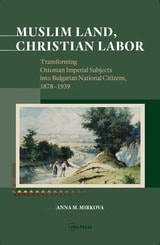
cover of Muslim Land, Christian Labor: Transforming Ottoman Imperial Subjects into Bulgarian National Citizens, c. 1878-1939

Muslim Land, Christian Labor

Transforming Ottoman Imperial Subjects into Bulgarian National Citizens, c. 1878-1939

Anna M. Mirkova

Central European University Press, 2017
Focusing upon a region in Southern Bulgaria, a region that has been the crossroads between Europe and Asia for many centuries, this book describes how former Ottoman Empire Muslims were transformed into citizens of Balkan nation-states. This is a region marked by shifting borders, competing Turkish and Bulgarian sovereignties, rival nationalisms, and migration. Problems such as these were ultimately responsible for the disintegration of the dynastic empires into nation-states. Land that had traditionally belonged to Muslims—individually or communally—became a symbolic and material resource for Bulgarian state building and was the terrain upon which rival Bulgarian and Turkish nationalisms developed in the wake of the dissolution of the late Ottoman Empire and the birth of early republican Turkey and the introduction of capitalism. By the outbreak of World War II, Turkish Muslims had become a polarized national minority. Their conflicting efforts to adapt to post-Ottoman Bulgaria brought attention to the increasingly limited availability of citizenship rights, not only to Turkish Muslims, but to Bulgarian Christians as well.
[more]
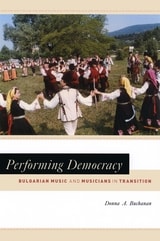
cover of Performing Democracy: Bulgarian Music and Musicians in Transition

Performing Democracy

Bulgarian Music and Musicians in Transition

Donna A. Buchanan

University of Chicago Press, 2005

The fall of the Berlin Wall in 1989 signaled the onset of tumultuous political, economic, and social reforms throughout Eastern Europe. In Czechoslovakia, Poland, and the Soviet Union these changes were linked to the activities and philosophies of political figures such as Václav Havel, Lech Walesa, and Mikhail Gorbachev. In Bulgaria, however, these changes were first heralded and even facilitated by particular musicians and shifting musical styles.

Based on fieldwork conducted between 1988 and 1996 with professional Bulgarian folk musicians, Donna A. Buchanan's PerformingDemocracy argues that the performances of traditional music groups may be interpreted not only as harbingers but as agents of Bulgaria's political transition. Many of the musicians in socialist Bulgaria's state folk ensembles served as official cultural emissaries for several decades. Through their reminiscences and repertoires, Buchanan reveals the evolution of Bulgarian musical life as it responded to and informed the political process. By modifying their art to accommodate changing political ideologies, these musicians literally played out regime change on the world's stages, performing their country's democratization musically at home and abroad.

Performing Democracy
and its accompanying CD-ROM, featuring traditional Bulgarian music, lyrics, notation, and photos, will fascinate any reader interested in the many ways art echoes and influences politics.
[more]
cover of Remembering Communism: Private and Public Recollections of Lived Experience in Southeast Europe

Remembering Communism

Private and Public Recollections of Lived Experience in Southeast Europe

Contributors: Simina Bădica, Iskra Baeva, Tanya Boneva, Corina Cimpoieru, Liliana Deyanova, Albena Hranova, Nataliya Hristova, Petya Kabakchieva, Evgenia Kalinova, Anny Kirilova, Thomas Lindenberger, Tamás Lőnhárt, Izabella Main, Tsvetana Manova, Iliiana Marcheva, Vasil Markov, Andi Mihalache, Cătălina Mihalache, Milla Mineva, Cristina Petrescu, Dragoş Petrescu, Vania Stoyanova, Virgiliu Ţârău, Nikolai Vukov, Smaranda Vultur

Central European University Press, 2014

Remembering Communism examines the formation and transformation of the memory of communism in the post-communist period. The majority of the articles focus on memory practices in the post-Stalinist era in Bulgaria and Romania, with occasional references to the cases of Poland and the GDR. Based on an interdisciplinary approach, including history, anthropology, cultural studies and sociology, the volume examines the mechanisms and processes that influence, determine and mint the private and public memory of communism in the post-1989 era. The common denominator to all essays is the emphasis on the process of remembering in the present, and the modalities by means of which the present perspective shapes processes of remembering, including practices of commemoration and representation of the past.

The volume deals with eight major thematic blocks revisiting specific practices in communism such as popular culture and everyday life, childhood, labor, the secret police, and the perception of “the system”.
[more]
cover of Second World, Second Sex: Socialist Women's Activism and Global Solidarity during the Cold War

Second World, Second Sex

Socialist Women's Activism and Global Solidarity during the Cold War

Kristen Ghodsee

Duke University Press, 2019
Women from the state socialist countries in Eastern Europe—what used to be called the Second World—once dominated women’s activism at the United Nations, but their contributions have been largely forgotten or deemed insignificant in comparison with those of Western feminists. In Second World, Second Sex Kristen Ghodsee rescues some of this lost history by tracing the activism of Eastern European and African women during the 1975 United Nations International Year of Women and the subsequent Decade for Women (1976-1985). Focusing on case studies of state socialist Bulgaria and nonaligned but socialist-leaning Zambia, Ghodsee examines the feminist networks that developed between the Second and Third Worlds and shows how alliances between socialist women challenged American women’s leadership of the global women’s movement. Drawing on interviews and archival research across three continents, Ghodsee argues that international ideological competition between capitalism and socialism profoundly shaped the world women inhabit today.
[more]
cover of Stefan Stambolov and the Emergence of Modern Bulgaria, 1870-1895

Stefan Stambolov and the Emergence of Modern Bulgaria, 1870-1895

Duncan M. Perry

Duke University Press, 1993

Little known in the United States but increasingly important in the affairs of southeastern Europe, Bulgaria is a land with a stormy history. No less stormy is the story of Stefan Stambolov, who ruled the country during some of its most turbulent years. Duncan M. Perry's biography of Stambolov, the first in English in the twentieth century, illuminates the life, motives, and personality of this major figure.
Perry begins with Bulgaria in the tumultuous years immediately following its founding in 1878. After the ousting of the country's first prince, Stambolov enters the stage as the fiery young lawyer who restored him to the throne. Although the prince promptly abdicated, Stambolov stepped into the breach and led the nation during the interregnum. Perry traces this patriotic politician's transformation into an authoritarian prime minister. He shows how Stambolov stabilized the Bulgarian economy and brought relative security to the land—but not without cost to himself and his regime. Perry depicts a man whose promotion of Bulgaria's independence exacted its price in individual rights, a ruler whose assassination in 1895 was the cause of both rejoicing and sorrow.
Stambolov thus emerges from these pages as a complex historical figure, an authoritarian ruler who protected his country's liberty at the cost of the people's freedom and whose dictatorial policies set Bulgaria upon a course of stability and modernization. An afterword compares the Bulgarian liberation era of Stambolov with the communist-era dictator, Todor Zhikov, analyzing similarities and differences.
[more]
cover of The Evolution of Agrarian Institutions: A Comparative Study of Post-Socialist Hungary and Bulgaria

The Evolution of Agrarian Institutions

A Comparative Study of Post-Socialist Hungary and Bulgaria

Mieke Meurs

University of Michigan Press, 2001

The Evolution of Agrarian Institutions studies the unexpectedly slow and uneven growth of private agriculture in postsocialist East-Central Europe. Comparing developments in Hungary and Bulgaria, Mieke Meurs offers an explanation for this slow growth and examines its implications for efficiency and income distribution in postsocialist agriculture. With the collapse of the state socialist regimes in East-Central Europe, it was widely expected that collectivized agriculture would quickly be remade in the glowing image of China--a patchwork of small, privately run farms yielding rapid increases in output and incomes. However, the European experience has been quite different; while socialist collective farms have disappeared, collective forms of organization have persisted, and private farming has been slow to emerge. Meurs argues that an understanding of the causes of the slow emergence of private farming is essential to effective policy intervention in agriculture. This book contributes to such an understanding through analyzing variations in farm organization and rural market development and comparing agricultural restructuring in Hungary and Bulgaria. The Evolution of Agrarian Institutions is unique in its combination of original survey data, published data on land use, and published historical data. It also tests two institutionalist explanations for the pace and direction of change in agricultural organization. This book will be of interest to economists, political scientists, sociologists, scholars working in the area of rural development in emerging countries, and anyone with an interest in transitional economics. Mieke Meurs is Associate Professor of Economics, American University.
[more]
cover of The Left Side of History: World War II and the Unfulfilled Promise of Communism in Eastern Europe

The Left Side of History

World War II and the Unfulfilled Promise of Communism in Eastern Europe

Kristen Ghodsee

Duke University Press, 2015
In The Left Side of History Kristen Ghodsee tells the stories of partisans fighting behind the lines in Nazi-allied Bulgaria during World War II: British officer Frank Thompson, brother of the great historian E.P. Thompson, and fourteen-year-old Elena Lagadinova, the youngest female member of the armed anti-fascist resistance. But these people were not merely anti-fascist; they were pro-communist, idealists moved by their socialist principles to fight and sometimes die for a cause they believed to be right. Victory brought forty years of communist dictatorship followed by unbridled capitalism after the fall of the Berlin Wall in 1989. Today in democratic Eastern Europe there is ever-increasing despair, disenchantment with the post-communist present, and growing nostalgia for the communist past. These phenomena are difficult to understand in the West, where “communism” is a dirty word that is quickly equated with Stalin and Soviet labor camps. By starting with the stories of people like Thompson and Lagadinova, Ghodsee provides a more nuanced understanding of how communist ideals could inspire ordinary people to make extraordinary sacrifices.
[more]
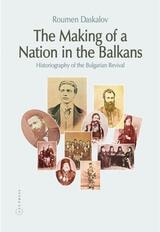
cover of The Making of a Nation in the Balkans

The Making of a Nation in the Balkans

Roumen Daskalov

Central European University Press, 2004

The nineteenth century was the epoch of nation building for the Bulgarians under Ottoman rule. In this book, comparisons and analogies are made between the Bulgarian Revival and other regions, epochs, ideological trends, and events. These latter are taken from two major areas—Western Europe ("Renaissance," "Enlightenment," "Romanticism," the French Revolution, and national liberation movements), and Russia (the "agrarian question," "populism" and "utopian socialism," "revolutionary democrats," and the Russian Revolution of 1905). Historical facts about the Revival were instrumentalized for political purposes, such as the fostering of national and state loyalties through the reproduction of identities, or, directly, as the legitimating/contesting of a current political regime under the guise of disputes over historical legacy. Ideological mobilization took place in the form of nationalism, right-wing authoritarianism (shading into fascism), and communism. The author sets in relief some of the mechanisms and logic of the two grand narratives under the sign of nationalism, and of Marxism.
[more]
cover of The Red Riviera: Gender, Tourism, and Postsocialism on the Black Sea

The Red Riviera

Gender, Tourism, and Postsocialism on the Black Sea

Kristen Ghodsee

Duke University Press, 2005

This compelling ethnography of women working in Bulgaria’s popular sea and ski resorts challenges the idea that women have consistently fared worse than men in Eastern Europe’s transition from socialism to a market economy. For decades western European tourists have flocked to Bulgaria’s beautiful beaches and mountains; tourism is today one of the few successful—and expanding—sectors of the country’s economy. Even at the highest levels of management, employment in the tourism industry has long been dominated by women. Kristen Ghodsee explains why this is and how women working in the industry have successfully negotiated their way through Bulgaria’s capitalist transformation while the fortunes of most of the population have plummeted. She highlights how, prior to 1989, the communist planners sought to create full employment for all at the same time that they steered women into the service sector. The women given jobs in tourism obtained higher educations, foreign language skills, and experiences working with Westerners, all of which positioned them to take advantage of the institutional changes eventually brought about by privatization.

Interspersed throughout The Red Riviera are vivid examinations of the lives of Bulgarian women, including a waitress, a tour operator, a chef, a maid, a receptionist, and a travel agent. Through these women’s stories, Ghodsee describes their employment prior to 1989 and after. She considers the postsocialist forces that have shaped the tourist industry over the past fifteen years: the emergence of a new democratic state, the small but increasing interest of foreign investors and transnational corporations, and the proliferation of ngos. Ghodsee suggests that many of the ngos, by insisting that Bulgarian women are necessarily disenfranchised, ignore their significant professional successes.
[more]
cover of The Village Project: Rural Revitalization in Contemporary Bulgaria

The Village Project

Rural Revitalization in Contemporary Bulgaria

Sarah Craycraft

University of Wisconsin Press, 2026

Since the collapse of socialism, Bulgaria’s population has been on the move—out of rural regions and into cities, or out of the country altogether. Yet today there is a countermovement of young, urban Bulgarians, born around 1989, seeking to repopulate rural villages and reclaim traditional Bulgarian folklife. Though many of these young Bulgarians have no direct experience with a rural lifestyle nor memories of thriving village life, their actions and movements are inspired by a nostalgic vision of the past. And so, beyond a spatial return, this rural revitalization movement speaks to visions of an alternate future, one sparked by dismay with the conditions of contemporary life.

Using ethnographic and folkloristic methods, Sarah Craycraft paints a complex, detailed picture of responses to Europeanization, carried out through neoliberal folklife projects as they collide with ongoing efforts to build a revitalized rural Bulgaria in the ruins of the past. Contextualized within a particular Southeast European nation, the study speaks to broader questions of rural revival, public-facing culture work, intergenerational folklore, and the imbrication of folklore with politics and culture.

[more]