Results by title
8 books match the query 'Burk, Drew S.'
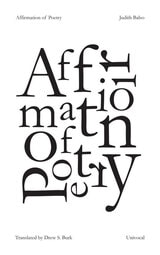
Affirmation of Poetry
Judith Balso
University of Minnesota Press, 2014
Since the times of Plato and Aristotle, the relation of poetry to philosophy has been controversial. For certain scholars, poetry should in no way be confused with philosophy. For others, poetry is at the heart of the possibility of thinking itself. In Affirmation of Poetry, Judith Balso defends the significance of poetry as a necessary practice for thinking. For Balso, if reading poetry properly has become an obscure task, poetry itself still carries with it a power of thinking: the efforts of the poets must continue. In analyzing the affirmation of thought found within the work of such poets as Osip Mandelstam, Wallace Stevens, Alberto Caeiro, and Giacomo Leopardi, Balso reestablishes poetry’s place as a site of thought.
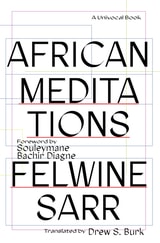
African Meditations
Felwine Sarr
University of Minnesota Press, 2022
An influential thinker’s fascinating reflections and meditations on reacclimating to his native Senegal as a young academic after years of study abroad
The call to morning prayer. A group run at daybreak along the Corniche in Dakar. A young woman shedding tears on a beach as her friends take a boat to Europe. In African Meditations, paths to enlightenment collide with tales of loss and ruminations, musical gatherings, and the everyday sights and sounds of life in West Africa as a young philosopher and creative writer seeks to establish himself as a teacher upon his return to Senegal, his homeland, after years of study abroad.
A unique contemporary portrait of an influential, multicultural thinker on a spiritual quest across continents—reflecting on his multiple literary influences along with French, African Francophone, and Senegalese tribal cultural roots in a homeland with a predominantly Muslim culture—African Meditations is a seamless blend of autobiography, journal entries, and fiction; aphorisms and brief narrative sketches; humor and Zen reflections.
Taking us from Saint-Louis to Dakar, Felwine Sarr encounters the rhythms of everyday life as well as its disruptions such as teachers’ strikes and power outages while traversing a semi-surrealistic landscape. As he reacclimates to his native country after a life in France, we get candid glimpses, both vibrant and hopeful, sublime and mundane, into his Zen journey to resecure a foothold in his roots and to navigate academia, even while gleaning something of the good life, of joy, amid the struggles of life in Senegal.
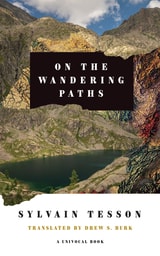
On the Wandering Paths
Sylvain Tesson
University of Minnesota Press, 2022
A walking journey through France’s vast interior becomes a meditation on both personal recovery and the role of history in the present—more than 425,000 copies sold in France
After a free-climbing accident lands him in a coma and a hospital for four months, the French writer Sylvain Tesson makes a promise to himself: if he’s ever able to walk again, he will traverse the entire country of France on foot.
Part literary adventure, part philosophical reflection on our contemporary consumer culture, On the Wandering Paths takes us deep into the heart of what Tesson terms France’s “hyperrural” zones. Tracing the obscure paths peasants once followed throughout the countryside, Tesson embarks on a three-month journey of solitude and personal contemplation as he walks along vast stretches of mountain ranges and rivers, encountering ancient Roman stone bridges and walkways, the French Foreign Legion, pagan prayer sites, Provençal villages, and the majestic Mont-Saint-Michel. Connecting deeply with the places he visits, his experiences inspire reflection on the essential need to disengage from the digital and immerse oneself in natural beauty.
Rich with humor, historical insight, and literary power, On the Wandering Paths is both a meditation on the act of recovery and a potent recognition of the traces of our past in the present. Asking us to reassess our values and our relationship to the land, Tesson’s exquisite chronicle through landscapes that continue to resist urbanization and technology is a thoughtful—and thought-provoking—glimpse into a poet’s adventurous life. Les Chemins de Pierre, a film based on the book starring Jean Dujardin, is due to release in 2022.
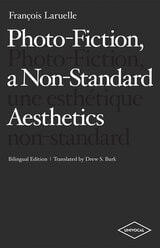
Photo-Fiction, a Non-Standard Aesthetics
François Laruelle
University of Minnesota Press, 2012
Twenty years after cultivating a new orientation for aesthetics via the concept of non-photography, François Laruelle returns, having further developed his notion of a non-standard aesthetics. Published for the first time in a bilingual edition, Photo-Fiction, a Non-Standard Aesthetics expounds on Laruelle’s current explorations into a photographic thinking as an alternative to the worn-out notions of aesthetics based on an assumed domination of philosophy over art. He proposes a new philosophical photo-fictional apparatus, or philo-fiction, that strives for a discursive mimesis of the photographic apparatus and the flash of the Real entailed in its process of image making. “A bit like if an artisan, to use a Socratic example, instead of making a camera based off of diagrams found in manuals, on the contrary had as his or her project the designing of a completely new apparatus of philo-fiction, thus capable of producing not simply photos, but photo-fictions.” One must enter into a space for seeing the vectorial and the imaginary number. Laruelle’s philo-fictions become not art installations, but “theoretical installations” calling for the consideration of the possibility of a non-standard aesthetics being of an equal or superior power to art and philosophy, an aesthetics in-the-last-instance that is itself an inventive and creative act of the most contemporary kind.
Struggle and Utopia at the End Times of Philosophy
François Laruelle
University of Minnesota Press, 2012
Very few thinkers have traveled the heretical path that François Laruelle walks between philosophy and non-philosophy. For Laruelle, the future of philosophy is problematic, but a mutation of its functions is possible. Up until now, philosophy has merely been a utopia concerned with the past and only provided the services of its conservation. We must introduce a rigorous and nonimaginary practice of a utopia in action, a philo-fiction—a close relative to science fiction. From here we can see the double meaning of the watchword, a tabula rasa of the future. This new destination is imposed by a specifically human messianism, an eschatology within the limits of the Man-in-person as antihumanist ultimatum addressed to the History of Philosophy. This book elucidates some of the fundamental problems of non-philosophy and takes on its detractors.

Telemorphosis
Jean Baudrillard
University of Minnesota Press, 2015
The art of living today has shifted to a continuous state of the experimental. In one of his last texts, Telemorphosis, renowned thinker and anti-philosopher Jean Baudrillard takes on the task of thinking and reflecting on the coming digital media architectures of the social. While “the social” may have never existed, according to Baudrillard, his analysis at the beginning of the twenty-first century of the coming social media–networked cultures cannot be ignored. One need not look far in order to find oneself snared within some sort of screenification of a techno-social community. “What the most radical critical critique, the most subversive delirious imagination, what no Situationist drift could have done . . . television has done.” Collective reality has entered a realm of telemorphosis.
The Arachnean and Other Texts
Fernand Deligny
University of Minnesota Press, 2013
The network as a mode of being
In 1968, Fernand Deligny established a “network” for informally taking care of children with autism that was more than a mere site of living; it was a milieu created out of a reflection on the mode of being autistic. What is a space perceived outside of language? What is the form of a movement without perspective or goal? How do we engage with a world that is not our own, a world turned upside down yet truly common, where acting cohabitates with our actions and the unknown with our forms of knowledge? Such is the mythical web of the “Arachnean,” made of lines, holes, traces, enigmas, and questions without answers that demand to see that which cannot be seen. The Arachnean and Other Texts is a collection of Deligny’s writings from the second half of the 1970s. Long before the digital age of social networks, meshworks, and digital webs, Deligny speaks to us in his own autobiographical and aphoristic manner. For him, life was always experienced in the form of “the network as a mode of being.”g.”
Two Lessons on Animal and Man
Gilbert Simondon
University of Minnesota Press, 2011
Simondon is a secret password among certain discussions within philosophy today. As a philosopher of technology, Simondon’s work has a place at the forefront of current thinking in media, technology, psychology, and philosophy with complex accounts of man’s relationship to technology and the realm that continues to form itself via this tension between man and his technical universe. In this introduction to Simondon’s oeuvre, the reader has access to the grounding of one of the most fundamental and critical questions that has been the focus of philosophy for millennia: the relationship between man and animal.