Results by title
14 books match the query 'Business Communication'
All Edge
Inside the New Workplace NetworksClay Spinuzzi
University of Chicago Press, 2015
Spinuzzi offers for the first time a comprehensive framework for understanding how these new groups function and thrive. His rigorous analysis tackles both the pros and cons of this evolving workflow and is based in case studies of real all-edge adhocracies at work. His provocative results will challenge our long-held assumptions about how we should be doing work.
Brazilians Working With Americans/Brasileiros que trabalham com americanos
Cultural Case Studies/Estudos de casos culturaisBy Orlando R. Kelm and Mary E. Risner
University of Texas Press, 2006
Doing business internationally requires understanding not only other languages, but even more so the business practices and cultures of other countries. In the case of Brazilians working with Americans, a fundamental difference for all parties to understand is that Brazilian business culture is based on developing personal relationships between business partners, while American businesspeople often prefer to get down to hard "facts and figures" quickly, with fewer personal preliminaries. Negotiating such differences is crucial to creating successful business relationships between the two countries, and this book is designed to help businesspeople do just that.
Brazilians Working With Americans presents ten short case studies that effectively illustrate many of the cultural factors that come into play when North American business professionals work in Brazil. The authors summarize each case and the aspects of culture it involves, and American and Brazilian executives comment on the cultural differences highlighted by that case. A list of topics and questions for discussion also help draw out the lessons of each business situation. To make the book equally useful to Brazilians and Americans (whether businesspeople or language students), the entire text is presented in both English and Portuguese. In addition, Apple QuickTime movies of the executives' comments, which allow viewers to see and hear native speakers of both languages, are available on the Internet at www.laits.utexas.edu/orkelm/casos/intro.html.
Crisis Leadership in Higher Education
Theory and PracticeRalph A. Gigliotti
Rutgers University Press, 2020
Effective Difficult Conversations
Catherine B. Soehner
American Library Association, 2017
Engaging Diverse Communities
A Guide to Museum Public RelationsMelissa A. Johnson
University of Massachusetts Press, 2020
Melissa A. Johnson interviews communicators at cultural heritage museums to understand the challenges of representing communities based on racial and ethnic, generational, immigrant, and language identities. Exploring how communications professionals function as cultural intermediaries by negotiating competing and intersecting identities and mastering linguistic and visual code-switching, she presents an analysis of the communication tactics of more than two hundred art, history, African American, American Indian, and other diverse museums. Engaging Diverse Communities illuminates best public relations practices, especially in media relations, digital press relations, website content production, social media, and event planning. This essential text for museum professionals also addresses visual aesthetics, cultural expression, and counter-stereotypes, and offers guidance on how to communicate cultural attractiveness.

How to Communicate in Business
A handbook for engineersDavid Silk
The Institution of Engineering and Technology, 1995
Make the Connection
Improve Your Communication at Work and at HomeAdubato, Steve
Rutgers University Press, 2006
In this collection of compelling and practical essays, Emmy Award–winning broadcaster, newspaper columnist, and motivational speaker Steve Adubato shares concrete tips and tools that will help you connect more effectively at work, at home, under pressure, in leadership roles, and in high-tech environments. From avoiding unnecessary arguments with your spouse to coaching a valuable, yet difficult employee, Adubato’s essays delve into the key factors that motivate people to act and respond the way that they do.
You will find answers to some of the most common questions about public speaking as well as advice on overcoming its anxieties. Whether the forum is a PTA meeting or a large professional function, essays explore topics such as:
- Why even practiced speakers sometimes experience stage fright
- How to keep your audience awake and interested in what you are saying
You will learn essential skills for interacting in the workplace, including:
- How to negotiate a good deal and still be honest and straight
- How to keep team projects from falling apart
- How to conduct yourself in confrontational situations, such as receiving a public insult
Drawing on examples set by public figures, including Bill Clinton, Rudy Giuliani, Mario Cuomo, Martha Stewart, Jack Welch, Joe Torre, and many others, Adubato addresses the unique communication challenges that those in leadership positions face. Essays examine:
· What ordinary people can learn from leaders in high-profile positions
· Why so many leaders have difficulty taking responsibility and apologizing for their actions
As technology continues to provide opportunities for quicker and more visual communication, Adubato also lets you know when hi-tech bells and whistles get in the way of making a more personal and human connection. For instance,
· Why do we hide behind e-mail messages when we have something very difficult to say?
· How does communication deteriorate when cell phones and e-mail are competing for our attention?
Finally, Adubato reminds us that communicating at home is no less important or any less difficult than communicating in public or at work. From contemporary challenges to age-old questions, essays explore:
· How you can more effectively talk with your kids about war and terrorism
· What forms of persuasion are more effective than nagging
Filled with timely examples and practical suggestions, Make the Connection is a must-read for everyone looking to improve their professional and personal relationships.
Post-Crisis Leadership
Resilience, Renewal, and Reinvention in the Aftermath of DisruptionRalph A. Gigliotti
Rutgers University Press, 2025
Rhetorical Memory
A Study of Technical Communication and Information ManagementStewart Whittemore
University of Chicago Press, 2015
In Rhetorical Memory, Stewart Whittemore demonstrates that strategies we use to manage information—techniques often acquired through trial and error, rarely studied, and generally invisible to us—are as important to our success as the end products of our work. First, he situates information management within the larger field of rhetoric, showing that both are tied to purpose, audience, and situation. He then dives into an engaging and tightly focused workplace study, presenting three cases from a team of technical communicators making use of organizational memory during their everyday work. By examining which techniques succeed and which fail, Whittemore illuminates the challenges faced by technical communicators. He concludes with a number of practical strategies to better organize information, that will help employees, managers, and anyone else suffering from information overload.
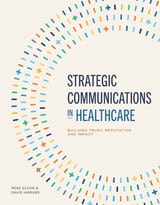
Strategic Communications in Healthcare
Building Trust, Reputation, and ImpactEdited by Rose Glenn and David Jarrard
Michigan Publishing Services, 2027
Strategic Communications in Healthcare: Building Trust, Reputation and Impact is a landmark textbook that combines innovative approaches to communication with the enduring principles that drive effectiveness, influence, and results. Drawing on the real-world expertise of nationally recognized leaders Rose Glenn and David Jarrard—along with a who’s who of senior healthcare communicators and educators—this hands-on guide brings together trust-building, messaging, crisis response, culture, brand, patient experience, research, measurement, AI, and more foundational elements into a cohesive framework for students and professionals alike.
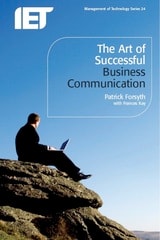
The Art of Successful Business Communication
Patrick Forsyth
The Institution of Engineering and Technology, 2008
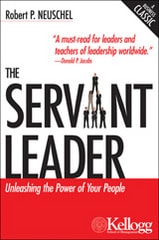
The Servant Leader
Unleashing the Power of Your PeopleRobert P. Neuschel
Northwestern University Press, 2005
He asks: what steps might we take to revitalize the quality and strength of our leadership? He then forcefully and straightforwardly gives an outline of what he believes are the major changes in leadership we must bring about. As a professor of management and strategy, and earlier, as a director and senior partner at a major consulting firm, and as a captain in the U. S. Army, Neuschel observed the best of leadership, and practiced it. He shares his insights with us in The Servant Leader.
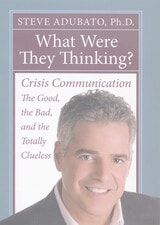
What Were They Thinking?
Crisis Communication: The Good, the Bad, and the Totally CluelessSteve Adubato, Ph.D.
Rutgers University Press, 2008
Nationally recognized communication coach and four-time Emmy Awardûwinning broadcaster Steve Adubato has been teaching, writing, and thinking about comm¡unication, leadership, and crisis communication for nearly two decades. In What Were They Thinking? Adubato examines twenty-two controversial and complex public relations and media mishaps, many of which were played out in public. Among cases and people discussed are:
- The Johnson & Johnson Tylenol scare: Perhaps the best crisis management ever
- Don Imus: Sometimes saying "sorry" is too little too late
- Former Attorney General Alberto Gonzales: Authority does not put you above questioning
- Bill O'Reilly: Know when to stop defending yourself and save face
- Former EPA Administrator Christie Whitman: Proof that your written words can come back to haunt you
- Hurricane Katrina: A natural disaster that led to a larger governmental disaster
- The Catholic Church's pedophilia scandal: Denial won't get rid of the skeletons in your closet
Arranged in short chapters detailing each case individually, the book provides a brief history of the topics and answers the questions: Who got it right? Who got it wrong? What can the rest of us learn from them?

You Are the Brand
Adubato, Steve
Rutgers University Press, 2011
Let's face it--it's a tough economic world today and there's cutthroat competition. Dive into Adubato's book and get ready to turn a powerful page in life.
Steve Adubato's entire professional life has been about branding--learning it, living it, making mistakes at it, teaching it at several universities, while discovering how to find the fine line between shameless self-promotion and smart, strategic branding--first for himself, then for others, and now for readers interested in an honest analysis of the good and bad in practiced branding.
So, what's really in this book for you? Adubato profiles the brands of more than thirty people and companies and skillfully analyzes and dissects their strategies. His sage advice and on-target approach will help readers who:
- Feel they have something of value to offer,
- Are in a market-driven or aggressive environment in which their name, reputation, and persona hold the keys to their success,
- Want their customers to buy products and services again and again,
- Feel unappreciated in their current job,
- Have recently lost a job or are seeking their first job out of college,
- Are trying to get back into the workforce after years of being "out of it."