Results by title
2 books match the query 'Business failures'

International Bankruptcy
The Challenge of Insolvency in a Global EconomyJodie Adams Kirshner
University of Chicago Press, 2018
With International Bankruptcy, Jodie Adams Kirshner explores the issues involved in determining which courts should have jurisdiction and which laws should apply in addressing problems within. Kirshner brings together theory with the discussion of specific cases and legal developments to explore this developing area of law. Looking at the key issues that arise in cross-border proceedings, International Bankruptcy offers a guide to this legal environment. In addition, she explores how globalization has encouraged the creation of new legal practices that bypass national legal systems, such as the European Insolvency Framework and the Model Law on Cross-Border Insolvency of the United Nations Commission on International Trade Law. The traditional comparative law framework misses the nuances of these dynamics. Ultimately, Kirshner draws both positive and negative lessons about regulatory coordination in the hope of finding cleaner and more productive paths to wind down or rehabilitate failing international companies.
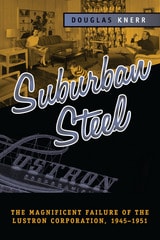
SUBURBAN STEEL
The Magnificent Failure of the Lustron Corporation, 1945–1951Douglas Knerr
The Ohio State University Press, 2004
Suburban Steel chronicles the rise and fall of the Lustron Corporation, once the largest and most completely industrialized housing company in U.S. history. Beginning in 1947, Lustron manufactured porcelain-enameled steel houses in a one-million-square-foot plant in Columbus, Ohio. With forty million dollars in federal funds and support from the highest levels of the Truman administration, the company planned to produce one hundred houses per day, each neatly arranged on specially designed tractor-trailers for delivery throughout the country. Lustron’s unprecedented size and scope of operations attracted intense scrutiny. The efficiencies of uninterrupted production, integrated manufacturing, and economies of scale promised to lead the American housing industry away from its decentralized, undercapitalized, and inefficient past toward a level of rationalization and organization found in other sectors of the industrial economy.
The company’s failure marked a watershed in the history of the American housing industry. Although people did not quit talking about industrialized housing, enthusiasm for its role in the transformation of the housing industry at large markedly waned. Suburban Steel considers Lustron’s magnificent failure in the context of historical approaches to the nation’s perpetual shortage of affordable housing, arguing that had Lustron’s path not been interrupted, affordable and desirable housing for America’s masses would be far more prevalent today.