Results by title
4 books match the query 'Calloway, Colin G.'
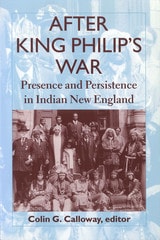
After King Philip’s War
Presence and Persistence in Indian New EnglandEdited by Colin G. Calloway
Dartmouth College Press, 1997
The 1676 killing of Metacomet, the tribal leader dubbed "King Philip" by colonists, is commonly seen as a watershed event, marking the end of a bloody war, dissolution of Indian society in New England, and even the disappearance of Native peoples from the region. This collection challenges that assumption, showing that Indians adapted and survived, existing quietly on the fringes of Yankee society, less visible than before but nonetheless retaining a distinct identity and heritage. While confinement on tiny reservations, subjection to increasing state regulation, enforced abandonment of traditional dress and means of support, and racist policies did cause dramatic changes, Natives nonetheless managed to maintain their Indianness through customs, kinship, and community.
[more]
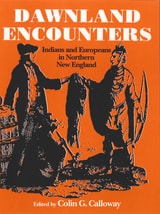
Dawnland Encounters
Indians and Europeans in Northern New EnglandEdited by Colin G. Calloway
University Press of New England, 1991
Colin G. Calloway collects, for the first time, documents describing the full range of encounters of Indians and Europeans in northern New England during the Colonial era. His comprehensive and highly readable introduction to the subject of Indian and European interaction in northern New England covers early encounters, missionary efforts, diplomacy, war, commerce, and cultural interchange and features a wide range of primary sources, including narratives, letters, account books, treaties, and council proceedings. Together with period illustrations, the documents testify to the richness and variety of the inter-ethnic relations in northern New England. They also show that while conflict certainly occurred, the encounters were also marked by cooperation and accommodation.
[more]
North Country Captives
Selected Narratives of Indian Captivity from Vermont and New HampshireEdited by Colin G. Calloway
University Press of New England, 1992
Revealing firsthand narratives of Indian captivity from eighteenth-century New Hampshire and Vermont. Narratives of Europeans who experienced Indian captivity represent one of the oldest genres of American literature. They are often credited with establishing the stereotype of Indians as cruel and bloodthirsty. While early southern New England accounts were heavily influenced by a dominant Puritan interpretation which had little room for individual and cultural distinctions, later northern New England narratives show growing independence from this influence. The eight narratives selected for this book challenge old stereotypes and provide a clearer understanding of the nature of captive taking. Indians used captives to replace losses in their tribes and families, and also to participate in the French and British ransom market. These stories portray Indian captors as individuals with a unique culture and offer glimpses of daily life in frontier communities. Calloway complements them with valuable historical background material. His book will appeal especially to readers interested in Native American peoples and life on the north country frontier of Vermont and New Hampshire.
[more]
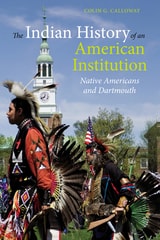
The Indian History of an American Institution
Native Americans and DartmouthColin G. Calloway
Dartmouth College Press, 2010
Dartmouth College began life as an Indian school, a pretense that has since been abandoned. Still, the institution has a unique, if complicated, relationship with Native Americans and their history. Beginning with Samson Occom’s role as the first “development officer” of the college, Colin G. Calloway tells the entire, complex story of Dartmouth’s historical and ongoing relationship with Native Americans. Calloway recounts the struggles and achievements of Indian attendees and the history of Dartmouth alumni’s involvements with American Indian affairs. He also covers more recent developments, such as the mascot controversies, the emergence of an active Native American student organization, and the partial fulfillment of a promise deferred. This is a fascinating picture of an elite American institution and its troubled relationship— at times compassionate, at times conflicted—with Indians and Native American culture.
[more]