Results by title
4 books match the query 'Canning, Charlotte M.'
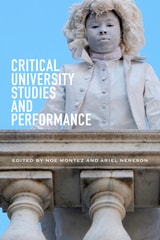
Critical University Studies and Performance
Edited by Noe Montez and Ariel Nereson
Vanderbilt University Press, 2026
Critical University Studies and Performance explores how we contend with issues of power, race, class, and gender in higher education, specifically as they relate to the complexities of theater and performance studies programs. In what ways might the fields of theater, performance, and dance studies, as they operate in institutions of higher education, support hegemonic logics as well as model reparative practices, given their perhaps unique disciplinary relationships to staging representation and their shared emphasis on embodiment as a practical and theoretical area of engagement?
Montez and Nereson bring together scholars with a diverse range of career experiences and embodied positions inside of higher learning in order to deepen the field’s theoretical inquiry using an ethnic studies framework. By participating in the interdisciplinary discourse of critical university studies, the volume aims to explore how to conduct ethical research that critiques the university while remaining mindful of our always contingent place within it. The contributors examine the ways the university commodifies minoritarian knowledge, tokenizes the arts, and reproduces inequality. This book offers strategic ways to build liberatory communities and revolutionary networks among students and faculty alike in order to envision futures within and beyond the academy.
Representing the Past
Essays in Performance HistoriographyCharlotte M. Canning
University of Iowa Press, 2010
How do historians represent the past? How do theatre historians represent performance events? The fifteen challenging essays in Representing the Past: Essays in Performance Historiography focus on the fundamental epistemological conditions and procedures that serve as the foundational ideas that guide all historians in their endeavors. Unified by their investigations into how best to understand and then represent the past, this diverse group of scholars in the field of theatre history and performance studies offers insights into the abiding issues that all historians face in the task of representing human events and actions.
Five primary ideas provide the topics as well as the intellectual parameters for this book: archive, time, space, identity, and narrative. Taking these as the conceptual framework for historical research and analysis, the essayists cover an expansive range of case studies and problems in the historical study of performance from the Americas to Africa and from Europe to India and China. Considering not only how historians think about these concepts in their research and writing but more pointedly—and historiographically—how they think with them, the essayists demonstrate the power and centrality of each of these five ideas in historical scholarship from initial research to the writing of essays and books.
Performance history has a diversity of identities, locations, sources, and narratives. This compelling engagement with the concepts essential to historical understanding is a valuable contribution to the historiography of performance—for students, teachers, and the future of the discipline itself. Expanding upon its classic predecessor, Interpreting the Theatrical Past: Essays in the Historiography of Performance, this exciting new collection illustrates the contemporary richness of historical thinking and writing in the field of performance history.
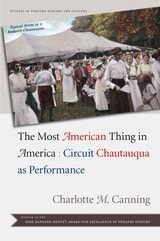
The Most American Thing in America
Circuit Chautauqua as PerformanceCanning, Charlotte M.
University of Iowa Press, 2005
Between 1904 and the Great Depression, Circuit Chautauquas toured the rural United States, reflecting and reinforcing its citizens’ ideas, attitudes, and politics every summer through music (the Jubilee Singers, an African American group, were not always welcome in a time when millions of Americans belonged to the KKK), lectures (“Civic Revivalist” Charles Zueblin speaking on “Militancy and Morals”), elocutionary readers (Lucille Adams reading from Little Lord Fauntleroy), dramas (the Ben Greet Players’ cleaned-up version of She Stoops to Conquer), orations (William Jennings Bryan speaking about the dangers of greed), and special programs for children (parades and mock weddings).
Theatre historians have largely ignored Circuit Chautauquas since they did not meet the conventional conditions of theatrical performance: they were not urban; they produced no innovative performance techniques, stage material, design effects, or dramatic literature. In this beautifully written and illustrated book, Charlotte Canning establishes an analytical framework to reveal the Circuit Chautauquas as unique performances that both created and unified small-town America.
One of the last strongholds of the American traditions of rhetoric and oratory, the Circuits created complex intersections of community, American democracy, and performance. Canning does not celebrate the Circuit Chautauquas wholeheartedly, nor does she describe them with the same cynicism offered by Sinclair Lewis. She acknowledges their goals of community support, informed public thinking, and popular education but also focuses on the reactionary and regressive ideals they sometimes embraced. In the true interdisciplinary spirit of Circuit Chautauquas, she reveals the Circuit platforms as places where Americans performed what it meant to be American.
Theatre Symposium, Vol. 28
Theatre and CitizenshipEdited by Andrew Gibb
University of Alabama Press, 2020
A collection of essays whose authors reach beyond simple definitions of citizenship as determined by documents and legal rights
The scholarly conference from which this publication emerged was circulated in the waning months of 2018, following a summer of urgent and emotional debate surrounding new US immigration policies regarding immigrant family separations, arguments fueled on one side by fears about the loss of social cohesion, and on the other by photographs of incarcerated children. Given the then-prevailing political atmosphere, editor Andrew Gibb anticipated that a good number of submissions might draw connections between the patterns, policies, and histories of immigration on the one hand, and theatrical or otherwise performance-centered expressions of citizenship, whether inclusive or exclusionary, on the other. In retrospect, what could have been foreseen is that theatre scholars, educators, and professionals would interpret recent events against a wider and more complex backdrop. The ultimate result of that initial call is this volume, a collection of essays whose authors reach beyond simple definitions of citizenship as determined by documents and legal rights, and who engage in larger conversations about what citizenship can mean, and how such meanings are expressed through theatre and performance.
Interestingly, while none of the authors published herein take up immigration as a central issue, they all make use of some combination of three particular analytical frameworks, all of which happen to be pertinent to the current immigrant experience and attempts to regulate it: bodies, institutions, and technologies.