Results by title
8 books match the query 'Cape Town'

A Bed Called Home
Life In The Migrant Labour Hostels of Cape TownMamphela Ramphele
Ohio University Press, 1993
In this challenging study, Dr. Mamphela Ramphele documents the life of the hostel dwellers of Cape Town, for whom a bed is literally a home for both themselves and their families. Elaborating the concept of space in its many dimensions—not just physical, but political, ideological, social, and economic as well—she emphasizes the constraints exerted on hostel dwellers by the limited spaces they inhabit. At the same time, she argues that within these constraints people have managed to find room for manoeuvre, and in her book explores the emancipatory possibilities of their environment.
The text is illustrated with a number of black-and-white photographs taken by Roger Meintjes in the townships and hostels.

Amy Biehl’s Last Home
A Bright Life, a Tragic Death, and a Journey of Reconciliation in South AfricaSteven D. Gish
Ohio University Press, 2018
In 1993, white American Fulbright scholar Amy Biehl was killed in a racially motivated attack near Cape Town, after spending months working to promote democracy and women’s rights in South Africa. The ironic circumstances of her death generated enormous international publicity and yielded one of South Africa’s most heralded stories of postapartheid reconciliation. Amy’s parents not only established a humanitarian foundation to serve the black township where she was killed, but supported amnesty for her killers and hired two of the young men to work for the Amy Biehl Foundation. The Biehls were hailed as heroes by Nelson Mandela, Desmond Tutu, and many others in South Africa and the United States—but their path toward healing was neither quick nor easy.
Granted unrestricted access to the Biehl family’s papers, Steven Gish brings Amy and the Foundation to life in ways that have eluded previous authors. He is the first to place Biehl’s story in its full historical context, while also presenting a gripping portrait of this remarkable young woman and the aftermath of her death across two continents.
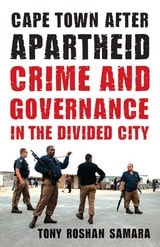
Cape Town after Apartheid
Crime and Governance in the Divided CityTony Roshan Samara
University of Minnesota Press, 2010
Cape Town after Apartheid focuses on urban renewal and urban security policies and practices in the city center and townships as this aspiring world-class city actively pursues a neoliberal approach to development. The city’s attempt to escape its past is, however, constrained by crippling inequalities, racial and ethnic tensions, political turmoil, and persistent insecurity. Samara shows how governance in Cape Town remains rooted in the perceived need to control dangerous populations and protect a somewhat fragile and unpopular economic system. In urban areas around the world, where the affluent minority and poor majority live in relative proximity to each other, aggressive security practices and strict governance reflect and reproduce the divided city.
A critical case for understanding a transnational view of urban governance, especially in highly unequal, majority-poor cities, this closely observed study of postapartheid Cape Town affords valuable insight into how security and governance technologies from the global North combine with local forms to create new approaches to social control in cities across the global South.
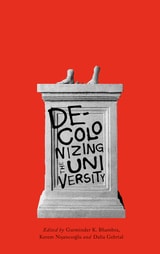
Decolonizing the University
Edited by Gurminder K. Bhambra, Kerem Nisancioglu and Dalia Gebrial
Pluto Press, 2018
In 2015, students at the University of Cape Town demanded the removal of a statue of Cecil Rhodes, the imperialist, racist business magnate, from their campus. Their battle cry, #RhodesMustFall, sparked an international movement calling for the decolonization of universities all over the world.
Today, as the movement develops beyond the picket line, how might it go on to radically transform the terms upon which universities exist? In this book, students, activists, and scholars discuss the possibilities and the pitfalls of doing decolonial work in the heart of the establishment. Subverting curricula, demanding diversity, and destroying old boundaries, this is a radical call for a new era of education. Chapters include:
*Rhodes Must Fall: Oxford and Movements for Change (Dalia Febrial)
*Race and the Neoliberal University ((John Holmwood)
*Black/Academia (Robbie Shilliam)
*The Challenge for Black Studies in the Neoliberal University (Kehinde Andrews)
*Open Initiatives for Decolonising the Curriculum (Pat Lockley)
*Decolonising Education: A Pedagogic Intervention (Carol Azumah Dennis)
*Understanding Eurocentrism as a Structural Problem of Undone Science (William Jamal Richardson)
As the book’s insightful Introduction states, "Taking colonialism as a global project as a starting point, it becomes difficult to turn away from the Western university as a key site through which colonialism—and colonial knowledge in particular—is produced, consecrated, institutionalized and naturalized." Offering resources for students and academics to challenge and resist colonialism inside and outside the classroom, Decolonizing the University provides the tools for radical change in educational disciplines, pedagogies, and institutions.
Desire Work
Ex-Gay and Pentecostal Masculinity in South AfricaMelissa Hackman
Duke University Press, 2018
Gangs, Politics and Dignity in Cape Town
Steffen Jensen
University of Chicago Press, 2008
After nearly fifty years of rigid segregation, the demise of the apartheid regime in South Africa and the African National Congress’s relatively peaceful assumption of power in 1994 were hailed as a miracle. But a few years into the transition, this miracle appeared increasingly threatened by crime and violence. In this compelling ethnography, Steffen Jensen focuses on a single township in Cape Town in order to explore how residents have negotiated the intersecting forces of political change and violent crime.
Jensen spent years closely observing the actions of residents both male and female, young and old, as well as gang members, police officers, and local government officials. The poisonous legacy of apartheid also comes under Jensen’s lens, as he examines the lasting effects that an official policy of racist stereotyping has had on the residents’ conceptions of themselves and their neighbors. While Gangs, Politics, and Dignity in Cape Town brims with insights into ongoing debates over policing, gangs, and local politics, Jensen also shows how people in the townships maintain their dignity in the face of hardship and danger.
Making Freedom
Apartheid, Squatter Politics, and the Struggle for HomeAnne-Maria Makhulu
Duke University Press, 2015
Making Uncertainty
Tuberculosis, Substance Use, and Pathways to Health in South AfricaAnna Versfeld
Rutgers University Press, 2023