343 books match the query 'Capitalism' and 25 start with a
cover of A Civil Economy: Transforming the Marketplace in the Twenty-First Century

A Civil Economy

Transforming the Marketplace in the Twenty-First Century

Severyn T. Bruyn

University of Michigan Press, 2000
A civil society is one in which a democratic government and a market economy operate together. The idea of the civil economy--encompassing a democratic government and a market economy--presumes that people can solve social problems within the market itself. This book explores the relationship between the two, examining the civil underpinnings of capitalism and investigating the way a civil economy evolves in history and is developed for the future by careful planning.
Severyn T. Bruyn describes how people in three sectors--government, business, and the Third Sector (nonprofits and civil groups)--can develop an accountable, self-regulating, profitable, humane, and competitive system of markets that could be described as a civil economy. He examines how government officials can organize markets to reduce government costs; how local leaders deal with global corporations that would unfairly exploit their community resources; and how employees can become coparticipants in the development of human values in markets.
A Civil Economy is oriented to interdiciplinary studies of the economy, assisting scholars in diverse fields, such as business management, sociology, political science, and economics, in developing a common language to examine civic problems in the marketplace.
As an undergraduate text, it evokes a mode of thought about the development of a self-accountable system of markets. Students learn to understand how the market economy becomes socially accountable and self-reliant, while remaining productive, competitive, and profitable.
Sveryn T. Bruyn is Professor of Sociology, Boston College.
[more]
cover of A Confluence of Transatlantic Networks: Elites, Capitalism, and Confederate Migration to Brazil

A Confluence of Transatlantic Networks

Elites, Capitalism, and Confederate Migration to Brazil

Laura Jarnagin

University of Alabama Press, 2013

Examines the qualitative nature of capitalism’s processes through the lens of social networks

A Confluence of Transatlantic Network demonstrates how portions of interconnected trust-based kinship, business, and ideational transatlantic networks evolved over roughly a century and a half and eventually converged to engender, promote, and facilitate the migration of southern elites to Brazil in the post–Civil War era. Placing that migration in the context of the Atlantic world sharpens our understanding of the transborder dynamic of such mainstream nineteenth-century historical currents as international commerce, liberalism, Protestantism, and Freemasonry. The manifestation of these transatlantic forces as found in Brazil at midcentury provided disaffected Confederates with a propitious environment in which to try to re-create a cherished lifestyle.
[more]
cover of A Contest of Ideas: Capital, Politics and Labor

A Contest of Ideas

Capital, Politics and Labor

Nelson Lictenstein

University of Illinois Press, 2013

For more than thirty years Nelson Lichtenstein has deployed his scholarship--on labor, politics, and social thought--to chart the history and prospects of a progressive America. A Contest of Ideas collects and updates many of Lichtenstein's most provocative and controversial essays and reviews.

These incisive writings link the fate of the labor movement to the transformations in the shape of world capitalism, to the rise of the civil rights movement, and to the activists and intellectuals who have played such important roles. Tracing broad patterns of political thought, Lichtenstein offers important perspectives on the relationship of labor and the state, the tensions that sometimes exist between a culture of rights and the idea of solidarity, and the rise of conservatism in politics, law, and intellectual life. The volume closes with portraits of five activist intellectuals whose work has been vital to the conflicts that engage the labor movement, public policy, and political culture.
[more]
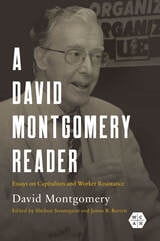
cover of A David Montgomery Reader: Essays on Capitalism and Worker Resistance

A David Montgomery Reader

Essays on Capitalism and Worker Resistance

David Montgomery. Edited by Shelton Stromquist and James R. Barrett

University of Illinois Press, 2024

A foundational figure in modern labor history, David Montgomery both redefined and reoriented the field. This collection of Montgomery’s most important published and unpublished articles and essays draws from the historian’s entire five-decade career.

Taken together, the writings trace the development of Montgomery’s distinct voice and approach while providing a crucial window into an era that changed the ways scholars and the public understood working people’s place in American history. Three overarching themes and methods emerge from these essays: that class provided a rich reservoir of ideas and strategies for workers to build movements aimed at claiming their democratic rights; that capital endured with the power to manage the contours of economic life and the capacities of the state but that workers repeatedly and creatively mounted challenges to the terms of life and work dictated by capital; and that Montgomery’s method grounded his gritty empiricism and the conceptual richness of his analysis in the intimate social relations of production and of community, neighborhood, and family life.
[more]
cover of A Master on the Periphery of Capitalism: Machado de Assis

A Master on the Periphery of Capitalism

Machado de Assis

Roberto Schwarz

Duke University Press, 2001

A Master on the Periphery of Capitalism is a translation (from the original Portuguese) of Roberto Schwarz’s renowned study of the work of Brazilian novelist Machado de Assis (1839–1908). A leading Brazilian theorist and author of the highly influential notion of “misplaced ideas,” Schwarz focuses his literary and cultural analysis on Machado’s The Posthumous Memoirs of Brás Cubas, which was published in 1880. Writing in the Marxist tradition, Schwarz investigates in particular how social structure gets internalized as literary form, arguing that Machado’s style replicates and reveals the deeply embedded class divisions of nineteenth-century Brazil.
Widely acknowledged as the most important novelist to have written in Latin America before 1940, Machado had a surprisingly modern style. Schwarz notes that the unprecedented wit, sarcasm, structural inventiveness, and mercurial changes of tone and subject matter found in The Posthumous Memoirs of Brás Cubas marked a crucial moment in the history of Latin American literature. He argues that Machado’s vanguard narrative reflects the Brazilian owner class and its peculiar status in both national and international contexts, and shows why this novel’s success was no accident. The author was able to confront some of the most prestigious ideologies of the nineteenth century with some uncomfortable truths, not the least of which was that slavery remained the basis of the Brazilian economy.
A Master on the Periphery of Capitalism will appeal to those with interests in Latin American literature, nineteenth century history, and Marxist literary theory.
[more]
cover of A Philosopher's Economist: Hume and the Rise of Capitalism

A Philosopher's Economist

Hume and the Rise of Capitalism

Margaret Schabas and Carl Wennerlind

University of Chicago Press, 2020

Reconsiders the centrality and legacy of Hume’s economic thought and serves as an important springboard for reflections on the philosophical underpinnings of economics.
Although David Hume’s contributions to philosophy are firmly established, his economics has been largely overlooked. A Philosopher’s Economist offers the definitive account of Hume’s “worldly philosophy” and argues that economics was a central preoccupation of his life and work. Margaret Schabas and Carl Wennerlind show that Hume made important contributions to the science of economics, notably on money, trade, and public finance.  Hume’s astute understanding of human behavior provided an important foundation for his economics and proved essential to his analysis of the ethical and political dimensions of capitalism. Hume also linked his economic theory with policy recommendations and sought to influence people in power. While in favor of the modern commercial world, believing that it had and would continue to raise standards of living, promote peaceful relations, and foster moral refinement, Hume was not an unqualified enthusiast. He recognized many of the underlying injustices of capitalism, its tendencies to promote avarice and inequality, as well as its potential for political instability and absolutism.
 
Hume’s imprint on modern economics is profound and far-reaching, whether through his close friend Adam Smith or later admirers such as John Maynard Keynes and Friedrich Hayek. Schabas and Wennerlind’s book compels us to reconsider the centrality and legacy of Hume’s economic thought—for both his time and ours—and thus serves as an important springboard for reflections on the philosophical underpinnings of economics.
[more]
cover of A Political Economy of Justice

A Political Economy of Justice

Edited by Danielle Allen, Yochai Benkler, Leah Downey, Rebecca Henderson, and Josh Simons

University of Chicago Press, 2022

Defining a just economy in a tenuous social-political time.
 
If we can agree that our current social-political moment is tenuous and unsustainable—and indeed, that may be the only thing we can agree on right now—then how do markets, governments, and people interact in this next era of the world? A Political Economy of Justice considers the strained state of our political economy in terms of where it can go from here. The contributors to this timely and essential volume look squarely at how normative and positive questions about political economy interact with each other—and from that beginning, how to chart a way forward to a just economy.
 
A Political Economy of Justice collects fourteen essays from prominent scholars across the social sciences, each writing in one of three lanes: the measures of a just political economy; the role of firms; and the roles of institutions and governments. The result is a wholly original and urgent new benchmark for the next stage of our democracy.
[more]
cover of A Postcapitalist Politics

A Postcapitalist Politics

J. K. Gibson-Graham

University of Minnesota Press, 2006

Is there life after capitalism? In this creatively argued follow-up to their book The End of Capitalism (As We Knew It), J. K. Gibson-Graham offer already existing alternatives to a global capitalist order and outline strategies for building alternative economies.

A Postcapitalist Politics reveals a prolific landscape of economic diversity—one that is not exclusively or predominantly capitalist—and examines the challenges and successes of alternative economic interventions. Gibson-Graham bring together political economy, feminist poststructuralism, and economic activism to foreground the ethical decisions, as opposed to structural imperatives, that construct economic “development” pathways. Marshalling empirical evidence from local economic projects and action research in the United States, Australia, and Asia, they produce a distinctive political imaginary with three intersecting moments: a politics of language, of the subject, and of collective action. In the face of an almost universal sense of surrender to capitalist globalization, this book demonstrates that postcapitalist subjects, economies, and communities can be fostered. The authors describe a politics of possibility that can build different economies in place and over space. They urge us to confront the forces that stand in the way of economic experimentation and to explore different ways of moving from theory to action.

J. K. Gibson-Graham is the pen name of Katherine Gibson and Julie Graham, feminist economic geographers who work, respectively, at the Australian National University in Canberra and the University of Massachusetts Amherst.
[more]
cover of A Social Ecology of Capital

A Social Ecology of Capital

Éric Pineault

Pluto Press, 2022

An original theory of contemporary capitalist growth and its socio-ecological contradictions

Capital is pushing into motion ever larger global material flows. In doing so it has come to depend on massive expenditures of energy, putting to work fossil fuels and the machines they animate to transform the world, accumulate power and grow the economy. The ecological relations and crises of today’s societies are driven by the processes of extraction of the elements that come together as a throughput of material and energy flows controlled by capital and shaped by its imperative of valorization.

In A Social Ecology of Capital, Éric Pineault proposes an original model of the fossil social metabolism that has sustained the growth of advanced capitalism in the last century.

Drawing on ecological economics and critical political economy, the book analyses how the social structures of accumulation, production, consumption and waste determine and regulate the material flow and the accumulation of material artifacts. Showing how social relations shape the ecology of capital, the book highlights the contradictions humanity now faces.
[more]
cover of A Thousand Plateaus: Capitalism and Schizophrenia

A Thousand Plateaus

Capitalism and Schizophrenia

Gilles Deleuze

University of Minnesota Press, 1987
A Thousand Plateaus continues the work Gilles Deleuze and Félix Guattari began in Anti-Oedipus and has now become established as one of the classic studies of the development of critical theory in the late twentieth century. It occupies an important place at the center of the debate reassessing the works of Freud and Marx, advancing an approach that is neither Freudian nor Marxist but which learns from both to find an entirely new and radical path. It presents an attempt to pioneer a variety of social and psychological analyses free of the philosophical encumbrances criticized by postmodern writers. A Thousand Plateaus is an essential text for feminists, literary theorists, social scientists, philosophers, and others interested in the problems of contemporary Western culture.
[more]
cover of Accounting for Capitalism: The World the Clerk Made

Accounting for Capitalism

The World the Clerk Made

Michael Zakim

University of Chicago Press, 2018

The story of how everyday nineteenth-century clerks helped to articulate modern capitalism.

The clerk attended his desk and counter at the intersection of two great themes of modern historical experience: the development of a market economy and a society governed from below. Who better illustrates the daily practice and production of this modernity than someone of no particular account assigned with overseeing all the new buying and selling? In Accounting for Capitalism, Michael Zakim has written their story, a social history of capital that seeks to explain how the “bottom line” became a synonym for truth in an age shorn of absolutes, grafted onto our very sense of reason and trust.

This is a big story, told through an ostensibly marginal event: the birth of a class of “merchant clerks” in the United States in the middle of the nineteenth century. The personal trajectory of these young men from farm to metropolis, homestead to boarding house, and, most significantly, from growing things to selling them exemplified the enormous social effort required to domesticate the profit motive and turn it into the practical foundation of civic life. As Zakim reveals in his highly original study, there was nothing natural or preordained about the stunning ascendance of this capitalism and its radical transformation of the relationship between “Man and Mammon.” 
 

[more]
cover of After Capitalism: Horizons of Finance, Culture, and Citizenship

After Capitalism

Horizons of Finance, Culture, and Citizenship

Ferguson, Kennan

Rutgers University Press, 2016
From Thomas Piketty to David Harvey, scholars are increasingly questioning whether we are entering into a post-capitalist era. If so, does this new epoch signal the failure of capitalism and emergence of alternative systems? Or does it mark the ultimate triumph of capitalism as it evolves into an unstoppable entity that takes new forms as it engulfs its opposition? 
 
After Capitalism brings together leading scholars from across the academy to offer competing perspectives on capitalism’s past incarnations, present conditions, and possible futures.  Some contributors reassess classic theorizations of capitalism in light of recent trends, including real estate bubbles, debt relief protests, and the rise of a global creditocracy. Others examine Marx’s writings, unemployment, hoarding, “capitalist realism,” and coyote (trickster) capitalism, among many other topics. Media and design trends locate the key ideologies of the current economic moment, with authors considering everything from the austerity aesthetics of reality TV to the seductive smoothness of liquid crystal. 
 
Even as it draws momentous conclusions about global economic phenomena, After Capitalism also pays close attention to locales as varied as Cuba, India, and Latvia, examining the very different ways that economic conditions have affected the relationship between the state and its citizens. Collectively, these essays raise provocative questions about how we should imagine capitalism in the twenty-first century. Will capitalism, like all economic systems, come to an end, or does there exist in history or elsewhere a hidden world that is already post-capitalist, offering alternative possibilities for thought and action?  
 
[more]
cover of Against Capital in the Twenty-First Century: A Reader of Radical Undercurrents

Against Capital in the Twenty-First Century

A Reader of Radical Undercurrents

John Asimakopoulos

Temple University Press, 2018

The problems of capitalism have been studied from Karl Marx to Thomas Piketty. The latter has recently confirmed that the system of capital is deeply bound up in ever-growing inequality without challenging the continuance of that system. Against Capital in the Twenty-First Century presents a diversity of analyses and visions opposed to the idea that capital should have yet another century to govern human and non-human resources in the interest of profit and accumulation. The editors and contributors to this timely volume present alternatives to the whole liberal litany of administered economies, tax policy recommendations, and half-measures. They undermine and reject the logic of capital, and the foregone conclusion that the twenty-first century should be given over to capital just as the previous two centuries were.

Providing a deep critique of capitalism, based on assessment from a wide range of cultural, social, political, and ecological thinking, Against Capital in the Twenty-First Century insists that transformative, revolutionary, and abolitionist responses to capital are even more necessary in the twenty-first century than they ever were.
[more]
cover of Alien Capital: Asian Racialization and the Logic of Settler Colonial Capitalism

Alien Capital

Asian Racialization and the Logic of Settler Colonial Capitalism

Iyko Day

Duke University Press, 2016

In Alien Capital Iyko Day retheorizes the history and logic of settler colonialism by examining its intersection with capitalism and the racialization of Asian immigrants to Canada and the United States. Day explores how the historical alignment of Asian bodies and labor with capital's abstract and negative dimensions became one of settler colonialism's foundational and defining features. This alignment allowed white settlers to gloss over and expunge their complicity with capitalist exploitation from their collective memory. Day reveals this process through an analysis of a diverse body of Asian North American literature and visual culture, including depictions of Chinese railroad labor in the 1880s, filmic and literary responses to Japanese internment in the 1940s, and more recent examinations of the relations between free trade, national borders, and migrant labor. In highlighting these artists' reworking and exposing of the economic modalities of Asian racialized labor, Day pushes beyond existing approaches to settler colonialism as a Native/settler binary to formulate it as a dynamic triangulation of Native, settler, and alien populations and positionalities.
 
[more]
cover of Alt-Right: From 4Chan to the White House

Alt-Right

From 4Chan to the White House

Mike Wendling

Pluto Press, 2018

Aside from the election of Donald Trump, the most surprising political development of the past few years has been the rapid rise of the Alt-Right—the white nationalist, anti-feminist, far-right movement that provided much of the ground-level energy for Trump’s campaign and has been a focus of international media attention ever since. Yet we still rarely get a clear sense of who and what the Alt-Right actually are, and what their long-term effect is likely to be.
            Journalist Mike Wendling knows. He’s been following the Alt-Right closely for years, and with this book he shares the deep knowledge he’s gleaned. Media accounts to the contrary, the Alt-Right didn’t just burst out of nowhere in 2016—rather, they have been building their network quietly for years, using bulletin boards and social media to spread a toxic hybrid of technological utopianism, reactionary philosophy, and racial hatred. Wendling traces clearly the rise of the movement and the evolution of its ideas, and he introduces us to some of its key figures—many of whom he interviewed personally for the book. He explores links between Alt-Right rhetoric and hate crimes and terrorism, showing that the evidence connecting them is undeniable. Ultimately, however, he builds a strong case that the movement’s lack of a coherent base and its contradictory tendencies are already sapping its strength and will lead to its downfall.
            A shocking exposé of a movement whose emergence stunned the world, Alt-Right presents a disturbing picture of our current political moment.

 
[more]
cover of Anti-Oedipus: Capitalism and Schizophrenia

Anti-Oedipus

Capitalism and Schizophrenia

Gilles Deleuze

University of Minnesota Press, 1983
[more]
cover of Antinomies of Modernity: Essays on Race, Orient, Nation

Antinomies of Modernity

Essays on Race, Orient, Nation

Vasant Kaiwar and Sucheta Mazumdar, eds.

Duke University Press, 2003

Antinomies of Modernity asserts that concepts of race, Orient, and nation have been crucial to efforts across the world to create a sense of place, belonging, and solidarity in the midst of the radical discontinuities wrought by global capitalism. Emphasizing the continued salience at the beginning of the twenty-first century of these supposedly nineteenth-century ideas, the essays in this volume stress the importance of tracking the dynamic ways that race, Orient, and nation have been reworked and used over time and in particular geographic locations.

Drawing on archival sources and fieldwork, the contributors explore aspects of modernity within societies of South Asia, the Middle East, and Africa. Whether considering how European ideas of Orientalism became foundational myths of Indian nationalism; how racial caste systems between blacks, South Asians, and whites operate in post-apartheid South Africa; or how Indian immigrants to the United States negotiate their identities, these essays demonstrate that the contours of cultural and identity politics did not simply originate in metropolitan centers and get adopted wholesale in the colonies. Colonial and postcolonial modernisms have emerged via the active appropriation of, or resistance to, far-reaching European ideas. Over time, Orientalism and nationalist and racialized knowledges become indigenized and acquire, for all practical purposes, a completely "Third World" patina. Antinomies of Modernity shows that people do make history, constrained in part by political-economic realities and in part by the categories they marshal in doing so.

Contributors.
Neville Alexander, Andrew Barnes, Vasant Kaiwar, Sucheta Mazumdar, Minoo Moallem, Mohamad Tavakoli-Targhi, A. R. Venkatachalapathy, Michael O. West

[more]
cover of Archaism and Actuality: Japan and the Global Fascist Imaginary

Archaism and Actuality

Japan and the Global Fascist Imaginary

Harry Harootunian

Duke University Press, 2023
In Archaism and Actuality eminent Marxist historian Harry Harootunian explores the formation of capitalism and fascism in Japan as a prime example of the uneven development of capitalism. He applies his theorization of subsumption to examine how capitalism integrates and redirects preexisting social, cultural, and economic practices to guide the present. This subsumption leads to a global condition in which states and societies all exist within different stages and manifestations of capitalism. Drawing on Japanese philosophers Miki Kiyoshi and Tosaka Jun, Marxist theory, and Gramsci’s notion of passive revolution, Harootunian shows how the Meiji Restoration of 1868 and its program dedicated to transforming the country into a modern society exemplified a unique path to capitalism. Japan’s capitalist expansion in the nineteenth and twentieth centuries, rise as an imperial power, and subsequent transition to fascism signal a wholly distinct trajectory into modernity that forecloses any notion of a pure or universal development of capitalism. With Archaism and Actuality, Harootunian offers both a retheorization of capitalist development and a reinterpretation of epochal moments in modern Japanese history.
[more]
cover of Art and Postcapitalism: Aesthetic Labour, Automation and Value Production

Art and Postcapitalism

Aesthetic Labour, Automation and Value Production

Dave Beech

Pluto Press, 2019

Artistic labour was exemplary for Utopian Socialist theories of 'attractive labour', and Marxist theories of 'nonalienated labour', but the rise of the anti-work movement and current theories of 'fully automated luxury communism' have seen art topple from its privileged place within the left's political imaginary as the artist has been reconceived as a prototype of the precarious 24/7 worker. Art and Postcapitalism argues that art remains essential for thinking about the intersection of labour, capitalism and postcapitalism not insofar as it merges work and pleasure but as an example of noncapitalist production. Reassessing the contemporary politics of work by revisiting debates about art, technology and in the nineteenth and twentieth century, Dave Beech challenges the aesthetics of labour in John Ruskin, William Morris and Oscar Wilde with a value theory of the supersession of capitalism that sheds light on the anti-work theory by Silvia Federici, Andre Gorz, Kathi Weeks and Maurizio Lazzarato, as well as the technological Cockayne of Srnicek and Williams and Paul Mason. Formulating a critique of contemporary postcapitalism, and developing a new understanding of art and labour within the political project of the supersession of value production, this book is essential for activists, scholars and anyone interested in the real and imagined escape routes from capitalism.
[more]
cover of Art beyond Borders: Artistic Exchange in Communist Europe (1945-1989)

Art beyond Borders

Artistic Exchange in Communist Europe (1945-1989)

Jérôme Bazin

Central European University Press, 2016
This book presents and analyzes artistic interactions both within the Soviet bloc and with the West between 1945 and 1989. During the Cold War the exchange of artistic ideas and products united Europe’s avant-garde in a most remarkable way. Despite the Iron Curtain and national and political borders there existed a constant flow of artists, artworks, artistic ideas and practices. The geographic borders of these exchanges have yet to be clearly defined. How were networks, centers, peripheries (local, national and international), scales, and distances constructed? How did (neo)avant-garde tendencies relate with officially sanctioned socialist realism? The literature on the art of Eastern Europe provides a great deal of factual knowledge about a vast cultural space, but mostly through the prism of stereotypes and national preoccupations. By discussing artworks, studying the writings on art, observing artistic evolution and artists’ strategies, as well as the influence of political authorities, art dealers and art critics, the essays in Art beyond Borders compose a transnational history of arts in the Soviet satellite countries in the post war period.
[more]
cover of As if the Future Mattered: Translating Social and Economic Theory into Human Behavior

As if the Future Mattered

Translating Social and Economic Theory into Human Behavior

Neva R. Goodwin, Editor

University of Michigan Press, 1996

There has never been a better time to explore the ways in which values relating to the future can be preserved and nurtured despite contemporary capitalism's tendency toward shortsighted selfishness. Prevailing beliefs in the 1980s were especially permissive regarding notions of individualism. While the concern for the future displayed by human beings throughout history may not be less today than at other times, a wide variance persists in how individuals, firms, and other institutions indicate concern for the future -- some act as though only concerned about tomorrow, others as though concerned for perpetuity. Thus it is especially relevant now to inquire what can be done, through changes in institutional arrangements or fashions of thought and perception, to encourage future-regarding tendencies.These themes are explored in twelve previously unpublished essays by people ranging from the well-known business analyst, Michael Porter, and the past President of the World Bank, Robert McNamara, to Zbigniew Bochniarz, a leading architect of "green plans" in East Central Europe since the fall of the Berlin Wall, and Lisa Gravitz, the President of Co-op America, an organization that assists U.S. businesses adopting socially responsible rules and behaviors. Other contributors include a lawyer, sociologist, political scientist, businessman-turned-foundation director, and three economists.The volume will be of interest to businesspeople, economists, environmentalists, political scientists, and ethicists.
[more]
cover of At the Edge of the Pampas: Land and Longing in Argentina

At the Edge of the Pampas

Land and Longing in Argentina

Rachel Cypher

University of Arizona Press, 2027

Industrial agriculture has transformed vast stretches of the Earth, but few places reveal its contradictions more clearly than the Pampas of Argentina. 

In At the Edge of the Pampas, anthropologist Rachel Cypher traces the explosive rise of genetically modified soybeans across one of the world’s great agricultural heartlands. Drawing on immersive long-term fieldwork, the book moves from soybean fields and cattle feedlots to dryland forests to show that industrial agriculture takes many forms. Soy—one of the world’s most standardized commodities—must first pass through local ecologies, informal economies, inherited obligations, and intimate relations of trust before it can circulate as a global asset.

Urgent and deeply original, At the Edge of the Pampas offers a major rethinking of how value is gathered within industrial capitalism and how unruly social and ecological life persists inside even the most engineered landscapes.
[more]
cover of Augmented Exploitation: Artificial Intelligence, Automation and Work

Augmented Exploitation

Artificial Intelligence, Automation and Work

Phoebe Moore

Pluto Press, 2021

Artificial Intelligence is a seemingly neutral technology, but it is increasingly used to manage workforces and make decisions to hire and fire employees. Its proliferation in the workplace gives the impression of a fairer, more efficient system of management. A machine can't discriminate, after all. Augmented Exploitation explores the reality of the impact of AI on workers' lives. While the consensus is that AI is a completely new way of managing a workplace, the authors show that, on the contrary, AI is used as most technologies are used under capitalism: as a smokescreen that hides the deep exploitation of workers. Going beyond platform work and the gig economy, the authors explore emerging forms of algorithmic governance and AI-augmented apps that have been developed to utilise innovative ways to collect data about workers and consumers, as well as to keep wages and worker representation under control. They also show that workers are not taking this lying down, providing case studies of new and exciting form of resistance that are springing up across the globe.
[more]
cover of Austerity Ireland: The Failure of Irish Capitalism

Austerity Ireland

The Failure of Irish Capitalism

Kieran Allen and Brian O'Boyle

Pluto Press, 2013

Ireland has been marketed as the poster boy of EU austerity. EU elites and neoliberal commentators claim that the country’s ability to suffer economic pain will attract investors and generate a recovery.

In Austerity Ireland, Kieran Allen challenges this official image and argues that the Irish state's response to the crash has primarily been designed to protect economic privilege. The resulting austerity has been a failure and is likely to produce a decade of hardship.

The book offers a deeply informed and penetrating diagnosis of Ireland's current socio-economic and political malaise, suggesting that a political earthquake is underway which may benefit the left. Austerity Ireland is essential reading for all students of Irish politics and economics, as well as those interested in the politics of austerity and the eurozone crisis.
[more]