Results by title
11 books match the query 'Carlson, Nancy Naomi'
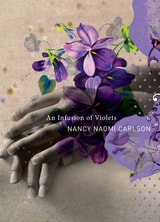
An Infusion of Violets
Nancy Naomi Carlson
Seagull Books, 2019
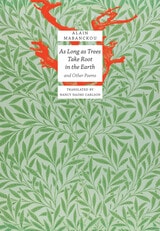
As Long As Trees Take Root in the Earth
and Other PoemsAlain Mabanckou
Seagull Books, 2025
These compelling poems by novelist and essayist Alain Mabanckou conjure nostalgia for an African childhood where the fauna, flora, sounds, and smells evoke snapshots of a life forever gone. Mabanckou’s poetry is frank and forthright, urging his compatriots to no longer be held hostage by the civil wars and political upheavals that have ravaged their country and to embrace a new era of self-determination where the village roosters can sing again.
These music-infused texts, beautifully translated by Nancy Naomi Carlson and supported by a grant from the National Endowment for the Arts, appear together in English for the first time. In these pages, Mabanckou pays tribute to his beloved mother, as well as to the regenerative power of nature, especially of trees, whose roots are a metaphor for the poet’s roots, anchored in the red earth of his birthplace. Mabanckou’s yearning for the land of his ancestors is even more poignant because he has been declared persona non grata in his homeland, now called Congo-Brazzaville, due to his biting criticism of the country’s regime. Despite these barriers, his poetry exudes hope that nature’s resilience will lead humankind on the path to redemption and reconciliation.

Calazaza's Delicious Dereliction
Suzanne Dracius
Tupelo Press, 2015
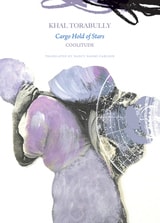
Cargo Hold Of Stars
CoolitudeKhal Torabully
Seagull Books, 2020
An arresting, musical ode to the forgotten voyages and resilient identities of indentured peoples.
Cargo Hold of Stars gives voice to the millions of indentured men and women, mostly from India and China, who were brought to Mauritius between 1849 and 1923. Kept in close quarters in the ship’s cargo hold, many died; most never returned home. Here, Khal Torabully introduces the concept of “Coolitude,” echoing Aimé Césaire’s “Negritude” to imbue the term with profound dignity, pride, and a resilient cultural identity. Stating that ordinary language could not capture these diverse voices, Torabully develops a new “poetics of Coolitude”: a French peppered with Mauritian Creole, brilliant wordplay, and neologisms.
The humor in these linguistic acrobatics only underscores the violence in which these poems are steeped. Deftly translated by Nancy Naomi Carlson, Cargo Hold of Stars is the song of an uprooting, destruction, and reconstruction. Yet it also celebrates setting down roots, conjuring an ideal homeland of fraternity and reconciliation in which bodies, memories, and languages mingle—a compelling odyssey defining the essence of humankind.
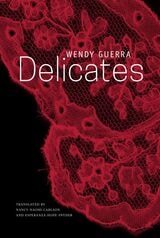
Delicates
Wendy Guerra
Seagull Books, 2023
Imbued with a sensuality reminiscent of the work of Anaïs Nin, Wendy Guerra’s Delicates takes readers on an exhilarating journey through the cities of love, where women leave their bodies “in the showers of men,” marking their territory “like animals in heat,” their panties “saturated with sand and a sidereal isolating odor.” Guerra’s shocking metaphors and images invite us to enter her gallery of striking and provoking poems where we witness a flight through the air from a thirty-fourth-story window and a woman’s pilgrimage to the salt flats “to taste the pink in stones” on her lover’s behalf. Guerra’s relationship with her native Cuba—much like her relationships with men—is complex and multilayered. Her work confronts the realities of a political system that doesn’t celebrate artistic freedom. Here we have a new way of looking at a woman, an artist, a country, and the colonizers of that country. In these music-infused poems, Guerra shares with us her hard-won truths.
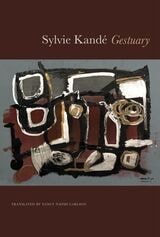
Gestuary
Sylvie Kandé
Seagull Books, 2026
Sylvie Kandé’s Gestuary offers a collection of gestures—of death and life, of tenderness and brutality—that fractures the flow of time. Senegalese riflemen from World War I are juxtaposed with migrants at borders who sew their lips shut in protest over immigration policies. In dream-like sequences, the dead refuse to stay underground and “push against the fence / that swings between our realm and theirs.” Inspired by unexpected sources, including jazz, sculpture, the legacy of the slave trade, proverbs, and elements of Diola culture, Kandé’s poems are rich in musicality and sophisticated syntax, rendered into a lyrical and luminous English by Nancy Naomi Carlson.
Hammer with No Master
Poems of René Char (French and English Edition)René Char
Tupelo Press, 2016
Stone Lyre was a selection of poems from Char’s numerous volumes of poems; Carlson’s new Hammer with No Master is a discrete and continuous work, the first English translation of Char’s Le marteau sans maître, first published in 1934 — a time of rumbling menace that our time resembles.

Naming the Dawn
Abdourahman A. Waberi
Seagull Books, 2018
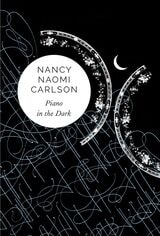
Piano in the Dark
Nancy Naomi Carlson
Seagull Books, 2023
This latest book of wonders from Nancy Naomi Carlson fixes upon one of the few defenses we have to confront the body’s betrayals—our words. Though in the end, even the world’s last word “forgets its name . . . has no word for this forgetting.” At once vulnerable and open, tempered and tempted equally by the erotic and the empathic, such dualities limn these affectingly beautiful and lyrical poems. Carlson’s lines, entreating as Scheherazade, “weave chords / into tales within tales, whirlpools within seas” to save her life. Indeed, music has no need for voice or harp, as “in anechoic chambers, you become / the only instrument of your worldly sounds,” echoing Mozart’s credo “that music lies / in the silence between notes.” In a world scarred by pandemics, wars, and violent tribalism, the givens are gone—“talismans we clung to, believing / we might be spared in some way / by marking our doors / with our own sacrificial blood.” In these unflinching free and formal verse poems, Carlson seduces us with the promise of the joy yet to be had, were we to look in the right places.
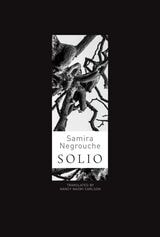
Solio
Samira Negrouche
Seagull Books, 2024
In these otherworldly poetry sequences, Samira Negrouche reminds us that “all life is movement,” where “time passes through me / beings pass through me / they are me / I am them.” The “I” is representative of one voice, three voices, all voices, all rooted in movement as their bodies brush past one another, brush against thresholds of time and space. Everything is in flux—including the dream-like landscapes at the borders of borders—as the poet seeks to recover parts of self and memory, on both a personal and universal level. In these poems, history-laden locales such as Algiers, Timbuktu, N’Djamena, Cotonou, Zanzibar, Cape Town, and Gorée are evoked. Even the language, expertly and sensitively translated by Nancy Naomi Carlson, refuses to be pinned down, as it loops back on itself. At times contradictory, at times fractured in meaning, syntax, and diction, the playful language is riddled with “restless” verbs. In the end, the “I” takes on prophetic overtones, instilling hope for the future.
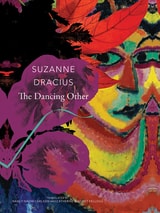
The Dancing Other
Suzanne Dracius
Seagull Books, 0