Results by title
4 books match the query 'Carsten, Janet'
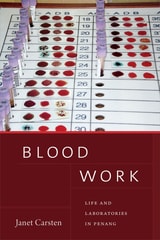
Blood Work
Life and Laboratories in PenangJanet Carsten
Duke University Press, 2019
Divorce Portals
The Postdivorce in Asian ContextsShalini Grover
Rutgers University Press, 2027
Across Asia and its global diasporas, marriage remains a dominant and public institution, and divorce generates widespread comment and concern. Breaking new ground, Divorce Portals reveals divorce to be generative of transformations in individual intimate lives and wider societies. Through compelling, sensitive ethnographic accounts inviting readers into the lives of people undergoing separation and divorce, chapters capture the antecedent-lives of uncoupling – the imaginary, anticipatory, and cautionary – and the afterlives of divorce, in the immediate aftermath and across life courses and generations. Chapters explore the vivid and bold new selves that divorcees are fashioning for themselves and highlight the intersecting inequalities that shape postdivorce predicaments, sometimes belying the hoped-for freedoms of divorce and remarriage. Together, chapters chart nascent and haltering accommodations of the single, repartnered, and queer. Across cases drawn from diverse geographic contexts, this book unlocks new, expansive, and accessible ways to think about divorce and its aftermath.

Marriage in Past, Present and Future Tense
Edited by Janet Carsten, Hsiao-Chiao Chiu, Siobhan Magee, Eirini Papadaki, and Koreen M. Reece
University College London, 2021
A series of global case studies, Marriage in Past, Present and Future Tense unravels the ever-changing intimate and institutional questions united by marriage. Traversing politics, economics, and religion, the authors explore how marital practices both react to and produce broader social transformation. In particular, the authors contend that contexts marked by violent sociopolitical ruptures such as civil war or colonization illuminate the links between the personal and political. What emerges is a complex portrait of marriage as a site of cultural memory, embodied experience, and active imagination.
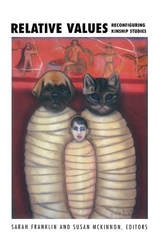
Relative Values
Reconfiguring Kinship StudiesSarah Franklin and Susan McKinnon, eds.
Duke University Press, 2001
Ideas about kinship are vital not only to understanding but also to forming many of the practices and innovations of contemporary society. How do the cultural logics of contemporary biopolitics, commodification, and globalization intersect with kinship practices and theories? In what ways do kinship analogies inform scientific and clinical practices; and what happens to kinship when it is created in such unfamiliar sites as biogenetic labs, new reproductive technology clinics, and the computers of artificial life scientists? How does kinship constitute—and get constituted by—the relations of power that draw lines of hierarchy and equality, exclusion and inclusion, ambivalence and violence? The contributors assess the implications for kinship of such phenomena as blood transfusions, adoption across national borders, genetic support groups, photography, and the new reproductive technologies while ranging from rural China to mid-century Africa to contemporary Norway and the United States. Addressing these and other timely issues, Relative Values injects new life into one of anthropology's most important disciplinary traditions.
Posing these and other timely questions, Relative Values injects an important interdisciplinary curiosity into one of anthropology’s most important disciplinary traditions.
Contributors. Mary Bouquet, Janet Carsten, Charis Thompson Cussins, Carol Delaney, Gillian Feeley-Harnik, Sarah Franklin, Deborah Heath, Stefan Helmreich, Signe Howell, Jonathan Marks, Susan McKinnon, Michael G. Peletz, Rayna Rapp, Martine Segalen, Pauline Turner Strong, Melbourne Tapper, Karen-Sue Taussig, Kath Weston, Yunxiang Yan