Results by title
6 books match the query 'Case for'
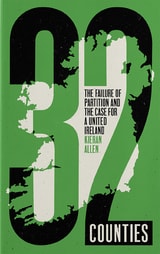
32 Counties
The Failure of Partition and the Case for a United IrelandKieran Allen
Pluto Press, 2021
'This is Irish history seen anew, from below, bristling with practical lessons for working-class struggle today' - Eamonn McCann
The 32 counties of Ireland were divided through imperial terror and gerrymandering. Partition was borne from a Tory strategy to defend the British Empire and has spawned a 'carnival of reaction' in Irish politics ever since. Over the last 100 years, conservative forces have dominated both states offering religious identity as a diversion from economic failures and inequality.
Through a sharp analysis of the history of partition, Kieran Allen rejects the view that the 'two cultures' of Catholic and Protestant communities lock people into permanent antagonism. Instead, the sectarian states have kept its citizens divided through political and economic measures like austerity, competition for reduced services and low wages.
Overturning conventional narratives, 32 Counties evokes the tradition of James Connolly and calls for an Irish unity movement from below to forge the North and the Republic into a secular, socialist and united Ireland.
A Love Affair with Europe
The Case for a European FutureGiles Radice
Haus Publishing, 2018
Claim Of Language
A Case For The HumanitiesChristopher Fynsk
University of Minnesota Press, 2004
Argues for the importance of humanities research in an era of globalization and technical reason
The humanities—in their conceptual and intellectual specificity, disciplinary rigor, and ethical, social, and political potential—are very much in need of defense and rearticulation in our time, particularly from a perspective that moves beyond the political and philosophical reductions of identity politics. In The Claim of Language, Christopher Fynsk clearly and eloquently does just that. Leaving aside polemics, Fynsk asserts that discourses in the humanities will find real ethical-political purchase when they engage with the material events in art, literature, and social life that call for humanistic reflection.
Fynsk describes the collapse of the traditional terms of defense in the contemporary academy, and then sets out to establish that the humanities are more than a loose affiliation of academic disciplines and research projects. Showing how events in language raise questions fundamental to the humanities—questions about the nature of human experience in the modern era and the nature of the human itself—The Claim of Language proposes a renewed relationship to language as a way to rethink humanistic research. Fynsk extends his philosophical meditation with two essays on the university and the politics of philosophy. The first, devoted to the work of Gérard Granel, explores the political implications of a quite radical project of fundamental critique. The second focuses on Jacques Derrida’s propositions for a reconception of the nature and task of critical thought in the new Collège International de Philosophie.
Kafka and Wittgenstein
The Case for an Analytic ModernismRebecca Schuman
Northwestern University Press, 2015
In Kafka and Wittgenstein, Rebecca Schuman undertakes the first ever book-length scholarly examination of Ludwig Wittgenstein’s philosophy of language alongside Franz Kafka’s prose fiction. In groundbreaking readings, she argues that although many readers of Kafka are searching for what his texts mean, in this search we are sorely mistaken. Instead, the problems and illusions we portend to uncover, the im-portant questions we attempt to answer—Is Josef K. guilty? If so, of what? What does Gregor Samsa’s transformed body mean? Is Land-Surveyor K. a real land surveyor?— themselves presuppose a bigger delusion: that such questions can be asked in the first place. Drawing deeply on the entire range of Wittgenstein’s writings, Schuman can-nily sheds new light on the enigmatic Kafka.
The Case for the Prosecution in the Ciceronian Era
Michael C. Alexander
University of Michigan Press, 2003
Writing Religion
The Case for the Critical Study of ReligionEdited by Steven W. Ramey
University of Alabama Press, 2015
Section one of the volume, “Writing Discourses,” features essays by Jonathan Z. Smith, Bruce Lincoln, and Ann Pellegrini that illustrate how critical study enables the analysis of discourses in society and history. Section two, “Riting Social Formations,” includes pieces by Arjun Appadurai, Judith Plaskow, and Nathan Katz that reference both the power of rites to construct society and the act of riting as a form of disciplining that both prescribes and proscribes. The writings of Tomoko Masuzawa, Amy-Jill Levine, Aaron W. Hughes, and Martin S. Jaffee appear in section three, “Righting the Discipline.” They emphasize the correction of movements within the academic study of religion.
Steven W. Ramey frames the collection with a thoughtful introduction that explores the genesis, development, and diversity of critical analysis in the study of religion. An afterword by Russell McCutcheon reflects on the critical study of religion at the University of Alabama and rounds out this superb collection.
The mission of the Department of Religious Studies is to “avoid every tendency toward confusing the study of religion with the practice of religion.” Instruction about—rather than in—religion is foundational to the department’s larger goal of producing knowledge of the world and its many practices and systems of beliefs. Infused with this spirit, these fascinating essays, which read like good conversations with learned friends, offer significant examples of each scholar’s work. Writing Religion will be of value to graduate students, advanced undergraduates, and scholars interested in the study of religion from a critical perspective.