Results by title
2 books match the query 'Castán Broto, Vanesa'
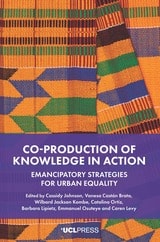
Co-production of Knowledge in Action
Emancipatory Strategies for Urban EqualityEdited by Cassidy Johnson, Vanesa Castán Broto, Wilbard Kombe, Catalina Ortiz, Barbara Lipietz, Emmanuel Osuteye, and Caren Levy
University College London, 2025
A postcolonial examination of co-production as an urban development strategy.
In urban development, co-production refers to a strategy that prioritizes collaboration across multiple institutions and with citizens, aiming to enable conflict resolution and transformative change. However, critics contend that these theoretical ambitions often have limited practical impact. Co-production of Knowledge in Action examines how co-production is articulated and deployed in cities such as Lima, Freetown, Kampala, Dar es Salaam, and Delhi. It engages with ongoing experiences of co-production-inspired action, mapping the different aspirations that inform co-production practices and their impacts on urban communities. Critiquing co-production strategies for urban development in relation to practical experiences in these cities, this volume adopts a postcolonial approach to knowledge production as a means to transform urban planning practices.
In urban development, co-production refers to a strategy that prioritizes collaboration across multiple institutions and with citizens, aiming to enable conflict resolution and transformative change. However, critics contend that these theoretical ambitions often have limited practical impact. Co-production of Knowledge in Action examines how co-production is articulated and deployed in cities such as Lima, Freetown, Kampala, Dar es Salaam, and Delhi. It engages with ongoing experiences of co-production-inspired action, mapping the different aspirations that inform co-production practices and their impacts on urban communities. Critiquing co-production strategies for urban development in relation to practical experiences in these cities, this volume adopts a postcolonial approach to knowledge production as a means to transform urban planning practices.
[more]
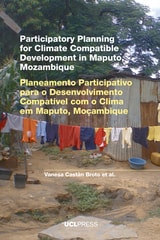
Participatory Planning for Climate Compatible Development in Maputo, Mozambique
Edited by Vanesa Castán Broto, Jonathan Ensor, Emily Boyd, Charlotte Allen, Carlos Seventine, and Domingos Augusto Macucule
University College London, 2015
Participatory Planning for Climate Compatible Development in Maputo, Mozambique is a practitioners’ handbook that builds upon the experience of a pilot project that was awarded the United Nations ‘Lighthouse Activity’ Award. Building upon a long scholarly tradition of participatory planning, this dual-language (English/Portuguese) book addresses crucial questions about the relevance of citizen participation in planning for climate compatible development and argues that citizens have knowledge and access to resources that enable them to develop a sustainable vision for their community. In order to do so, the author proposes a Participatory Action Planning methodology to organise communities, and also advances mechanisms for institutional development through partnerships.
[more]