Results by title
2 books match the query 'Catching Hell'
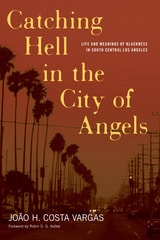
Catching Hell In The City Of Angels
Life And Meanings Of Blackness In South Central Los AngelesJoão H. Costa Vargas
University of Minnesota Press, 2006
Since the 1980s, Los Angeles has become the most racially and economically divided city in the United States. In the poorest parts of South Central Los Angeles, buildings in disrepair—the legacy of racial unrest. Moving beyond stereotypes of South Central's predominantly African American residents, João H. Costa Vargas recounts his almost two years living in the district. Personal, critical, and disquieting, Catching Hell in the City of Angels examines the ways in which economic and social changes in the twentieth century have affected the black community, and powerfully conveys the experiences that bind and divide its people.
Through compelling stories of South Central, including his own experience as an immigrant of color, Vargas presents portraits of four groups. He talks daily with women living in a low-income Watts apartment building; works with activists in a community organization against police brutality; interacts with former gang members trying to maintain a 1992 truce between the Bloods and the Crips; and listens to amateur jazz musicians who perform in a gentrified section of the neighborhood. In each case he describes the worldviews and the definitions of “blackness” these people use to cope with oppression. Vargas finds, in turn, that blackness is a form of racial solidarity, a vehicle for the renewal of African American culture, and a political expression of revolutionary black nationalism.
Vargas reveals that the social fault lines in South Central reflect both contemporary disparities and long-term struggles. In doing so, he shows both the racialized power that makes “blackness” a prized term of identity and the terrible price that African Americans have paid for this emphasis. Ultimately, Catching Hell in the City of Angels tells the story of urban America through the lives of individuals from diverse, overlapping, and vibrant communities.
João H. Costa Vargas is assistant professor in the Center for African and African American Studies and the department of anthropology at the University of Texas, Austin.
Robin D. G. Kelley is the William B. Ransford Professor of Cultural and Historical Studies at Columbia University. He is the author of numerous books, including Yo Mama's Disfunktional: Fighting the Culture Wars in Urban America.
[more]
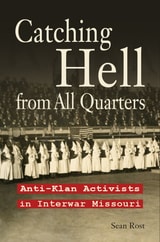
Catching Hell from All Quarters
Anti-Klan Activists in Interwar MissouriSean Rost
University of Missouri Press, 2025
In Catching Hell from All Quarters Sean Rost works to invert the traditional history of what has been termed the second Ku Klux Klan (1915-1930) by examining the efforts of anti-Klan activists, in particular in Missouri, who challenged the growth, recruitment, and political ambitions of the Invisible Empire during the 1920s and 1930s through editorial crusades, educational campaigns, public pressure on elected officials, political investigations, and in some cases counter-vigilantism.
Although anit-Klan activism was nation-wide, Missouri provides an excellent case study for the rise and fall of the second Klan as the organization gained a large membership and obtained a notable level of political power in some parts of the Show-Me State. Significantly, despite membership totals comparable to that of neighboring states, the Missouri Klan did not translate its recruiting success into substantial influence and political power due to significant local opposition from anti-Klan activists.
Catching Hell from All Quarters addresses key questions about the legacy of the Klan, both in Missouri and nationwide. Traditional scholarship on the second Klan stops at the hooded order’s decline at the start of the Great Depression, thus neatly splitting that era’s Klan from the Civil Rights Movement era Klan of the 1950s and 1960s. This book, however, draws direct connections between both eras by highlighting continued anti-Klan activism as well as several far-right, fascist, and white supremacist organizations that found support among Klan members (both active and former) during the 1930s and 1940s and aided not only in the Klan’s re-emergence after World War II but also influenced present-day hate groups.
[more]