Results by title

34 books match the query 'Catholic authors'
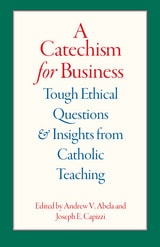
cover of A Catechism For Business

A Catechism For Business

Andrew V. Abela

Catholic University of America Press, 2014
A Catechism for Business presents the teachings of the Catholic Church as they relate to more than one hundred specific and challenging moral questions that have been asked by business leaders. Andrew V. Abela and Joseph E. Capizzi have assembled the relevant quotations from recent Catholic social teaching as responses to these questions. Questions and answers are grouped under major topics such as marketing, finance, and investment. Business ethics questions can be too subtle for definitive yes / no answers, so the book offers no more and no less than church teaching on each particular question. Where the church has offered definitive answers, the book provides them. When the church has not, the book offers guidelines for reflection and insights into what one should consider in given situations.
[more]
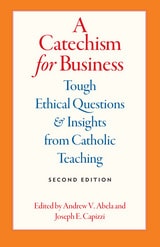
cover of A Catechism for Business

A Catechism for Business

Andrew V. Abela

Catholic University of America Press, 2016
This second edition streamlines some of the editing from the first addition, and more importantly, includes material from Pope Francis's encyclical, Laudato Si’, and his apostolic exhortation, Evangelii Gaudium. A Catechism for Business presents the teachings of the Catholic Church as they relate to more than one hundred specific and challenging moral questions as they have been asked by business leaders. Andrew V. Abela and Joseph E. Capizzi have assembled the relevant quotations from recent Catholic social teaching as responses to these questions. Questions and answers are grouped together under major topics such as marketing, finance and investment. The book's easy-to-use question and answer approach invites quick reference for tough questions and serves as a basis for reflection and deeper study in the rich Catholic tradition of social doctrine.
[more]
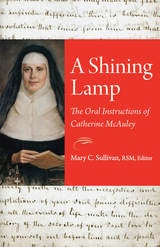
cover of A Shining Lamp

A Shining Lamp

Mary C. Sullivan

Catholic University of America Press, 2017
Catherine McAuley (1778-1841), the founder of the Sisters of Mercy in 1831, frequently gave oral instructions to the first Mercy community. Though she sometimes spoke explicitly about their religious vows, her words were always focused on the life, example, teachings, and evangelic spirit of Jesus Christ, emphasizing "resemblance" to him, and fidelity to the calls of the Gospel. Her instructions have, therefore, a broad present-day relevance that can be inspiring and encouraging for all Christians. They are the "shining" words of a companion, a soul-friend, who offers guiding light to those who wend their pilgrim way toward the full embrace of God's merciful reign.
[more]
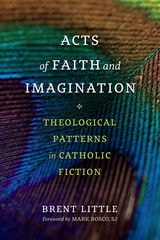
cover of Acts of Faith and Imagination: Theological Patterns in Catholic Fiction

Acts of Faith and Imagination

Theological Patterns in Catholic Fiction

Brent Little

Catholic University of America Press, 2023
Acts of Faith and Imagination wagers that fiction written by Catholic authors assists readers to reflect critically on the question: “what is faith?” To speak of a person’s “faith-life” is to speak of change and development. As a narrative form, literature can illustrate the dynamics of faith, which remains in flux over the course of one’s life. Because human beings must possess faith in something (whether religious or not), it inevitably has a narrative structure—faith ebbs and flows, flourishes and decays, develops and stagnates. Through an exploration of more than a dozen Catholic authors’ novels and short stories, Brent Little argues that Catholic fiction encourages the reader to reflect upon their faith holistically, that is, the way faith informs one’s affections, and how a person conceives and interacts with the world as embodied beings. Amidst the diverse stories of modern and contemporary fiction, a consistent pattern emerges: Catholic fiction portrays faith—at its most fundamental, often unconscious, level—as an act of the imagination. Faith is the way one imagines themselves, others, and creation. A person’s primary faith conditions how they live in the world, regardless of the level of conscious reflection, and regardless of whether this is a “religious” faith. Acts of Faith and Imagination investigates the creative depth and vitality of the Catholic literary imagination by bringing late modern Catholic authors into dialogue with more contemporary ones. Readers will then consider well-known works, such as those by Graham Greene, Flannery O’Connor, and Muriel Spark in the fresh light of contemporary stories by Toni Morrison, Alice McDermott, Uwem Akpan, and several others.
[more]
cover of Between Human and Divine: The Catholic Vision in Contemporary Literature

Between Human and Divine

The Catholic Vision in Contemporary Literature

Mary Reichardt

Catholic University of America Press, 2010
Between Human and Divine is the first collection of scholarly essays published on a wide variety of contemporary (post 1980) Catholic literary works and artists. Its aim is to introduce readers to recent and emerging writers and texts in the tradition.
[more]
cover of By knowledge & by love: charity and knowledge in the moral theology of St. Thomas Aquinas

By knowledge & by love

charity and knowledge in the moral theology of St. Thomas Aquinas

Michael S. Sherwin

Catholic University of America Press, 2005
By Knowledge and By Love represents a major contribution to Thomistic moral theology and philosophy by providing a thoughtful examination of Aquinas' psychology of action and his theology of charity.
[more]
cover of Counsels of Imperfection: Thinking Through Catholic Social Teaching

Counsels of Imperfection

Thinking Through Catholic Social Teaching

Edward Hadas

Catholic University of America Press, 2021
For more than a century, the teaching authority of the Catholic Church has attempted to walk along with the modern world, criticizing what is bad and praising what is good. Counsels of Imperfection described the current state of that fairly bumpy journey. The book is divided into 11 chapters. First comes an introduction to ever-changing modernity and the unchanging Christian understanding of human nature and society. Then come two chapters on economics, including a careful delineation of the Catholic response, past and present, to socialism and capitalism. The next topic is government, with one chapter on Church and State, another on War, and a third that runs quickly through democracy, human rights, the welfare state, crimes and punishments (including the death penalty), anti-Semitism, and migration. Counsels of Imperfection then dedicates two chapters on ecology, including an enthusiastic analysis of Francis’s “technocratic paradigm”. The last topic is the family teaching, which presents the social aspects of the Church’s sexual teaching. A brief concluding chapter looks at the teaching’s changing response to the modern world, and at the ambiguous Catholic appreciation of the modern idea of progress. For each topic, Counsels of Imperfection provides biblical, historical and a broad philosophical background. Thomas Aquinas appears often, but so does G. W. F Hegel. The goal is not only to explain what the Church really says, but also how it got to its current position and who it is arguing with. In the spirit of a doctrine that is always in development, Counsels of Imperfection points out both strong-points and imperfections in the teaching. The book should be of interest to specialists in Catholic Social Teaching, but its main audience is curious newcomers, especially people who do not want to be told that there are simple Catholic answers to the complicated problems of the modern world.
[more]
cover of Dwelling in the Splendor of Truth: Catholic Moral Theology in Light of <i>Veritatis splendor</i>

Dwelling in the Splendor of Truth

Catholic Moral Theology in Light of <i>Veritatis splendor</i>

James W. Stroud

Catholic University of America Press, 2026
On August 6, 1993, Pope John Paul II promulgated the long-awaited encyclical on moral theology entitled Veritatis splendor. In this landmark encyclical, directed principally toward bishops, Pope John Paul II sought a reset of the discipline of Catholic moral theology after the Second Vatican Council in response to the theological dissent that had called into question the foundations of Catholic morality. More than thirty years after the promulgation of Veritatis splendor, the essays in this edited volume consider the major themes and topics of this encyclical as it seeks to contribute to the revitalization of moral theology today. These themes and topics include: the rich young man and the renewal of moral theology, freedom, nature, and law, conscience, intrinsically evil acts, the state of revisionism, the moral object, martyrdom and morality, evangelization, the role of the moral theologian, and the role of scripture in moral theology. Contributors include: William C. Mattison, III, Irene Alexander, Matthew Levering, Matthew Dugandzic, James W. Stroud, Stephen L. Brock, Patrick Clark, Timothy P. O’Malley, Jana Marguerite Bennet, John Grabowski, with a foreword by Archbishop of Sydney Anthony Fisher, OP.
[more]
cover of Ethica Thomistica: The Moral Philosophy of Thomas Aquinas

Ethica Thomistica

The Moral Philosophy of Thomas Aquinas

Ralph McInerny

Catholic University of America Press, 1997

First published fifteen years ago, Ethica Thomistica is widely recognized as one of the finest introductions to St. Thomas's moral philosophy. Though the book has been out of print for several years, scholars and students still refer to it as the standard resource on Thomistic ethics. In this much-anticipated, revised edition, Ralph McInerny revisits the basics of Thomas's teachings and offers a brief, intelligible, and persuasive summary.


Chapters: Morality and Human Life; The Good for Man; Ultimate End and Moral Principles; The Structure of the Human Act; Good and Evil Action; Character and Decision; Prudence and Conscience; Religion and Morality ABOUT THE AUTHOR:


Ralph McInerny is Michael P. Grace Professor of Medieval Studies and director of the Jacques Maritain Center at the University of Notre Dame, where he has taught since 1955. He is founder and publisher of Catholic Dossier magazine; cofounder of Crisis magazine; and author of several books published by CUA Press, including Aquinas on Human Action (1992), The Question of Christian Ethics (1993), and Aquinas and Analogy (1996).


PRAISE FOR THE BOOK:


"Remarkable for its moderation and common sense. . . . [McInerny] rapidly sketches selected themes from Thomistic moral thinking: what distinguishes the moral activities of man, what is distinctive of moral goodness (in Aristotle and in Aquinas), an analysis of practical reason in relation to natural law, the bases for judging good and evil moral actions, the roles of intellect and will in voluntary activity, the work of virtues as components of moral character, the functions of prudence and conscience, and finally the relation of ethics to religious belief. . . . For the person who desires a quick and understandable introduction to this subject, this little book can be recommended as readable and reliable."—Vernon J. Bourke, Speculum "An important contribution both to moral philosophy and to its teaching. . . . [McInerny] has put us all in his debt by writing it."—Alasdair MacIntyre, Teaching Philosophy "A clear, thorough and readable introduction to the thought of one of the intellectual giants of the Catholic moral tradition."—National Catholic Register

[more]
cover of Ethics and Theological Disclosures: The Thought of Robert Sokolowski

Ethics and Theological Disclosures

The Thought of Robert Sokolowski

Guy Mansini, O.S.B.

Catholic University of America Press, 2003
[more]
cover of Ethics of Liberation: In the Age of Globalization and Exclusion

Ethics of Liberation

In the Age of Globalization and Exclusion

Enrique Dussel

Duke University Press, 2012

Available in English for the first time, this much-anticipated translation of Enrique Dussel's Ethics of Liberation marks a milestone in ethical discourse. Dussel is one of the world's foremost philosophers. This treatise, originally published in 1998, is his masterwork and a cornerstone of the philosophy of liberation, which he helped to found and develop.

Throughout his career, Dussel has sought to open a space for articulating new possibilities for humanity out of, and in light of, the suffering, dignity, and creative drive of those who have been excluded from Western Modernity and neoliberal rationalism. Grounded in engagement with the oppressed, his thinking has figured prominently in philosophy, political theory, and liberation movements around the world.

In Ethics of Liberation, Dussel provides a comprehensive world history of ethics, demonstrating that our most fundamental moral and ethical traditions did not emerge in ancient Greece and develop through modern European and North American thought. The obscured and ignored origins of Modernity lie outside the Western tradition. Ethics of Liberation is a monumental rethinking of the history, origins, and aims of ethics. It is a critical reorientation of ethical theory.
[more]
cover of Faithful Fictions: The Catholic Novel in British Literature

Faithful Fictions

The Catholic Novel in British Literature

Thomas M. Woodman

Catholic University of America Press, 2022
Catholic writers have made a rich contribution to British fiction, despite their minority status. Evelyn Waugh, Graham Greene, and Muriel Spark are well-known examples, but there are many other significant novelists whose work has a Catholic aspect. This is the first book to survey the whole range of this material and examine whether valid generalizations can be made about it. In charting such fiction from its development in the Victorian period through to the work of contemporaries such as David Lodge, the author analyses its complex relationships with changes in British society and the international Church. There is more than one way of being a Catholic, as Woodman shows, but he also demosntrates that many of these writers share common themes and a distinctive perspective. They often wish in particular to use their religion as a weapon against what they portray as a complacent Protestant or secular society. Their consciousness of writing in the midst of such a society gives a special edge to their treatments of the perennial Catholic themes of suffering, sin and sex. It also has implications for literary form and relates to what has been seen as the extremist mode of Catholic fiction. The final question that Woodman puts is whether the changes in the Church since the Second Vatican Council must inevitably lead to the loss of this distinctive Catholic contribution to the novel.
[more]
cover of Faithful Passages: American Catholicism in Literary Culture, 1844–1931

Faithful Passages

American Catholicism in Literary Culture, 1844–1931

James Emmett Ryan

University of Wisconsin Press, 2013

Roman Catholic writers in colonial America played only a minority role in debates about religion, politics, morality, national identity, and literary culture. However, the commercial print revolution of the nineteenth century, combined with the arrival of many European Catholic immigrants, provided a vibrant evangelical nexus in which Roman Catholic print discourse would thrive among a tightly knit circle of American writers and readers. James Emmett Ryan’s pathbreaking study follows the careers of important nineteenth-century religionists including Orestes Brownson, Isaac Hecker, Anna Hanson Dorsey, and Cardinal James Gibbons, tracing the distinctive literature that they created during the years that non-Catholic writers like Herman Melville and Emily Dickinson were producing iconic works of American literature.
    Faithful Passages also reveals new dimensions in American religious literary culture by moving beyond the antebellum period to consider how the first important cohort of Catholic writers shaped their message for subsequent generations of readers in the late nineteenth and early twentieth centuries. Perhaps most strikingly, Ryan shows that by the early twentieth century, Roman Catholic themes and traditions in American literature would be advanced in complex ways by mainstream, non-Catholic modernist writers like Kate Chopin and Willa Cather.
    Catholic literary culture in the United States took shape in a myriad of ways and at the hands of diverse participants. The process by which Roman Catholic ideas, themes, and moralities were shared and adapted by writers with highly differentiated beliefs, Ryan contends, illuminates a surprising fluidity of religious commitment and expression in early U.S. literary culture.
[more]
cover of Knowing the Natural Law

Knowing the Natural Law

Steven Jensen

Catholic University of America Press, 2015
Knowing the Natural Law traces the thought of Aquinas from an understanding of human nature to a knowledge of the human good, from there to an account of ought-statements, and finally to choice, which issues in human actions. The much discussed article on the precepts of the natural law (I-II, 94, 2) provides the framework for a natural law rooted in human nature and in speculative knowledge. Practical knowledge is itself threefold: potentially practical knowledge, virtually practical knowledge, and fully practical knowledge.
[more]
cover of Living the Good Life

Living the Good Life

Steven J. Jensen

Catholic University of America Press, 2013
Living the Good Life presents a brief introduction to virtue and vice, self-control and weakness, misery and happiness.
[more]
cover of Masked Atheism: Catholicism and the Secular Victorian Home

Masked Atheism

Catholicism and the Secular Victorian Home

Maria LaMonaca

The Ohio State University Press, 2008

Why did the Victorians hate and fear Roman Catholics so much? This question has long preoccupied literary and cultural scholars alike. Masked Atheism: Catholicism and the Secular Victorian Home by Maria LaMonaca begins with the assumption that anti-Catholicism reveals far more about the Victorians than simple theological disagreements or religious prejudice. An analysis of anti-Catholicism exposes a host of anxieties, contradictions, and controversies dividing Great Britain, the world’s most powerful nation by the mid-nineteenth century.

Noting that Catholicism was frequently caricatured by the Victorians as “masked atheism”—that is, heathenism and paganism masquerading as legitimate Christianity—LaMonaca’s study suggests that much anti-Catholic rhetoric in Victorian England was fueled by fears of encroaching secularism and anxieties about the disappearance of God in the modern world. For both male and female writers, Catholicism became a synonym for larger, “ungodly” forces threatening traditional ways of life: industrialization, rising standards of living, and religious skepticism.

LaMonaca situates texts by Charlotte Brontë, George Eliot, Christina Rossetti, Elizabeth Barrett Browning, Michael Field, and others against a rich background of discourses about the growing visibility of Anglo and Roman Catholicism in Victorian England. In so doing, she demonstrates the influence of both pro- and anti-Catholic sentiment on constructs of Victorian domesticity, and explores how writers appropriated elements of Catholicism to voice anxieties about the growing secularization of the domestic sphere: a bold challenge to sentimental notions of the home as a “sacred” space. Masked Atheism will contribute a fresh perspective to an ongoing conversation about the significance of Catholicism in Victorian literature and culture.
[more]
cover of Medicine, Health Care, & Ethics: Catholic Voices

Medicine, Health Care, & Ethics

Catholic Voices

John F. Morris

Catholic University of America Press, 2007
Medicine, Health Care, and Ethics adds to this rich tradition with a collection of contemporary essays that represent the very best efforts of current Catholic scholarship in the field of health care and medical ethics.
[more]
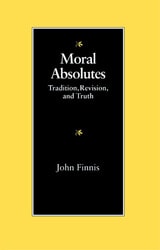
cover of Moral Absolutes: Tradition, Revision, and Truth (Michael J. McGivney Lectures of the John Paul II Institute)

Moral Absolutes

Tradition, Revision, and Truth (Michael J. McGivney Lectures of the John Paul II Institute)

John Finnis

Catholic University of America Press, 1991
Moral Absolutes sets forth a vigorous but careful critique of much recent work in moral theology. It is illustrated with examples from the most controversial aspects of Christian moral doctrine, and a frank account is given of the roots of the upheaval in Roman Catholic moral theology in and after the 1960s.
[more]
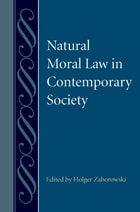
cover of Natural Moral Law in Contemporary Society

Natural Moral Law in Contemporary Society

Holger Zaborowski

Catholic University of America Press, 2010
The essays of this volume examine natural moral law, different natural law theories, and the role that natural law can and should play in our contemporary society
[more]
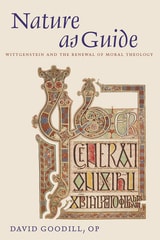
cover of Nature as Guide: Wittgenstein and the Renewal of Moral Theology

Nature as Guide

Wittgenstein and the Renewal of Moral Theology

David Goodill, OP

Catholic University of America Press, 2022
Wittgenstein influenced a generation of philosophers and theologians, with works such as Fergus Kerr’s Theology After Wittgenstein showing the relevance of Wittgenstein’s philosophy for contemporary questions in theology. Nature as Guide follows many of the insights of this earlier generation of Wittgenstein influenced scholars, to bring Wittgenstein into conversation with contemporary Catholic moral theology. The first four chapters of the book provides a reading of key themes in Wittgenstein’s philosophy, and draw among others on G.E.M. Anscombe to situate Wittgenstein in relation to the Platonic tradition. Understanding the relationship between grammar, metaphysics and nature is central to this tradition and these themes are examined through an account of Wittgenstein’s philosophical development. These four chapters also provides a critical perspective on Wittgenstein’s thought, engaging with the criticisms of Wittgenstein offered by philosophers such as Rhees Rush and William Charlton. Chapter five lays the groundwork for a dialogue between Wittgenstein and moral theology. Firstly, by examining how open Wittgenstein’s philosophy is to dialogue with theology, and secondly through proposing the use of Servais Pinckaers’ definition of moral theology to structure the conversation developed in subsequent chapters. Pinckaers’ definition is based upon St Thomas Aquinas’ presentation of the principles of human acts in the Prima Secundae of the Summa Theologiae and the final three chapters focus on the question of human acts and their basis in human nature. The reading of Wittgenstein developed in the first part of the book is brought into dialogue with the tradition of Catholic moral theology represented by Pinckaers and other students of St Thomas, such as Anscombe, Josef Pieper, Herbert McCabe, Jean Porter and Alasdair MacIntyre. The book finishes with McCabe’s account of the transformation of human nature through God’s Word, showing how Wittgenstein’s understanding of human practices can shed light on the life of grace.
[more]
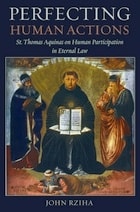
cover of Perfecting Human Actions: St. Thomas Aquinas on Human Participation in Eternal Law

Perfecting Human Actions

St. Thomas Aquinas on Human Participation in Eternal Law

John Rziha

Catholic University of America Press, 2009
During the last few centuries, a practical dichotomy between God and humans has developed within moral theory. As a result, moral theory tends to focus only on humans where human autonomy is foundational or only on God where divine commands capriciously rule. However, the moral theology of Thomas Aquinas overcomes this dichotomy. For Thomas, humans reach their perfection by participating in God's wisdom and love. Perfecting Human Actions explores the ways humans participate in eternal law--God's wisdom that guides and moves all things to their proper action. The book begins with a thoughtful examination of the philosophic recovery of the notion of participation in Thomistic metaphysics. It then explains Thomas's theological understanding of the notion of participation to show how humans are related to God. It is discovered that when performing human actions, humans participate in the eternal law in two ways: as moved and governed by it, and cognitively. In reference to participation as moved and governed, humans are directed by God to their proper end of eternal happiness. This mode of participation can be increased by perfecting the natural inclinations through virtue, grace, and the gifts of the Holy Spirit. In reference to cognitive participation, humans as rational creatures can know their proper end and how to attain it. Through this knowledge of moral truths, the intellect participates in the eternal law. Cognitive participation is perfected by the intellectual virtues (especially faith) and the gifts of the Holy Spirit (especially wisdom). The book concludes by showing how the notion of human participation in the eternal law is a much better foundation for moral theory than the contemporary notion of autonomy.
[more]
cover of Proportionalism and the Natural Law Tradition

Proportionalism and the Natural Law Tradition

Christopher Kaczor

Catholic University of America Press, 2002

Consequentialism and Catholic ethics seem to be natural enemies. The Catholic prohibition against intentionally killing the innocent, lying, committing adultery, and so on contradicts the very essence of consequentialism that no act may be assessed as good or evil independently of its consequences. However in the 1960s within the Catholic tradition itself, there arose a method in ethics called proportionalism which practically, if not theoretically, affirmed that which consequentialists have long affirmed and Catholic ethicists had so long denied, namely one may do evil that good may come. According to proportionalists, so long as the good effects are proportioned to the bad effects of the act, the act is licit even if evil is used as a means to achieve the good.


In this book, Christopher Kaczor argues against the plausibility of proportionalism and its first proponents, namely Peter Knauer, Joseph Fuchs, Bruno Schüller, Louis Janssens, and Richard McCormick. Examining the genealogy of the movement, he disputes a received history that depicts proportionalism as a recovery of Thomas Aquinas. Instead, contends Kaczor, proportionalism is best seen as the organic successor to the moral manuals of the pre-Vatican II era. Proportionalism arises not from Thomas but rather extends many of the tendencies and presuppositions of the manuals. In particular, it retains their marginalizing of the account of human action as a knowing-willing involving a number of stages not always consciously recognized yet carefully described by Thomas in Summa theologiae, Prima Secundae, 6-17. Kaczor shows that a great deal of the plausibility of proportionalism rests on a fragile foundation that is rapidly eroding, an education in the moral manuals.
[more]
cover of Some Catholic Writers

Some Catholic Writers

Ralph McInerny

St. Augustine's Press, 2007
[more]
cover of The Experiment of Faith: Pope Benedict XVI on Living the Theological Virtues in a Secular Age

The Experiment of Faith

Pope Benedict XVI on Living the Theological Virtues in a Secular Age

Catholic University of America Press, 2020
Pope Benedict XVI memorably remarked that the Christian faith is a lot like a Gothic cathedral with its stained-glass windows. From the outside, the Church can appear dark, dreary, and worn with age—the crumbling relic of an institution that no longer speaks to men and women living in our modern world. Indeed, for many people today, Christian morality with all of its commandments appears to be a source not of life and joy but instead of suffering and oppression. Even within the Church, many wonder: why should I submit to ancient doctrines and outdated practices that restrict my freedom and impede my happiness? In this timely and original book, his third exploring the riches of Benedict XVI’s vast corpus, theologian Matthew Ramage sets out to meet this challenge with an in-depth study of the emeritus pontiff’s wisdom on how to live Christian discipleship in today’s increasingly secularized world. Taking as his starting point Benedict’s conviction that the truth of Christianity—like the beauty of a cathedral’s glorious windows—can be grasped only from the inside, Ramage draws on Benedict’s insights to show how all Christians can make the “experiment of faith” by living the theological virtues of faith, hope, and charity in daily life. Along the way, he shares his personal reflections on how Benedict’s wisdom has helped him to navigate difficulties in embracing the faith and provides a way forward to those struggling to live as disciples in a way that is intellectually serious without remaining merely intellectual. In so doing, he also presents a highly nuanced yet accessible approach to defending the truth of the gospel in a world where life in Jesus Christ tends to be seen as unfulfilling, irrelevant, or just one lifestyle choice among others.
[more]
cover of The Law of Love: From Autonomy to Communion

The Law of Love

From Autonomy to Communion

Stephen F. Brett, SSJ

University of Scranton Press, 2010

With an interdisciplinary combination of philosophy, theology, and family law, The Law of Love explores the impact of secular conceptions of autonomy on sexuality and family. Drawing from the thought of Aristotle, Cicero, Augustine, Aquinas, and the modern theologian Servais Pinckaers, Stephen F. Brett argues that the divorce of freedom from virtue has caused cultural relativism, and that a potent and healthy mix of temperance, chastity, and modesty is the antidote. Styled accessibly and quite cleverly with a broader audience in mind, The Law of Love will appeal to intellectuals of all faiths who are interested in facing the ambiguities and problems of contemporary life in a secularized society.
[more]
cover of The Moral Philosophy of Dietrich von Hildebrand

The Moral Philosophy of Dietrich von Hildebrand

Martin Cajthaml

Catholic University of America Press, 2020
The Moral Philosophy of Dietrich von Hildebrand is the first full-fledged monograph on von Hildebrand’s moral philosophy available to date. Despite this pioneering effort, its aim is not to treat all the themes belonging to this area with equal depth and breadth. Rather, it focuses on the themes indicated by the aforementioned questions and relates them according to their inner systematic links rather than according to how and when they appear in von Hildebrand’s works. It also engages von Hildebrand in a critical dialogue, particularly with the ethics of Plato and Aristotle. This book will serve as a very good introduction not just to von Hildebrand´s moral philosophy but to his thought in general.
[more]
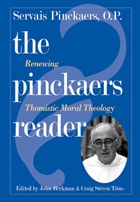
cover of The Pinckaers Reader: Renewing Thomistic Moral Theology

The Pinckaers Reader

Renewing Thomistic Moral Theology

Servais Pinckaers O.P.

Catholic University of America Press, 2005
The first collection of its kind available in any language, this volume features the twenty most significant essays written by Pinckaers since his highly praised Sources.
[more]
cover of The Praise of 'Sons of Bitches': On the Worship of God by Fallen Men

The Praise of 'Sons of Bitches'

On the Worship of God by Fallen Men

James V. Schall

St. Augustine's Press, 2014
[more]
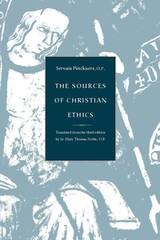
cover of The Sources of Christian Ethics

The Sources of Christian Ethics

Servais Pinckaers

Catholic University of America Press, 2013
First published in 1985 as Les sources de la morale chrétienne by University Press Fribourg, this work has been recognized by scholars worldwide as one of the most important books in the field of moral theology
[more]
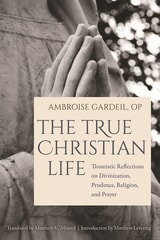
cover of The True Christian Life: Thomistic Reflections on Divinization, Prudence, Religion, and Prayer

The True Christian Life

Thomistic Reflections on Divinization, Prudence, Religion, and Prayer

Ambroise Gardeil, OP

Catholic University of America Press, 2022
Although not well-known in the English-speaking world, Fr. Ambroise Gardeil, OP (1859-1931) was a Dominican of significant influence in French Catholic thought at the turn of the 20th century. Conservative theologians like Frs. Reginald Garrigou-Lagrange, OP, Michel Labourdette, OP, Jean-Hervé Nicolas, OP and many others hailed him as a careful expositor of the supernaturality of faith, a defender of the theological nature of rational apologetics, and a spiritual master. In his controversial Le Saulchoir: Une école de théologie, Fr. Marie-Dominique Chenu, OP praised Fr. Gardeil as an important Dominican initiator of reforms in historical theology, presenting the latter as a kind of precursor to one of the streams of what is now referred to historically as the “Nouvelle Théologie.” And one cannot read the words of Fr. Gardeil’s contemporary Fr. Antoine Lemonnyer, OP, without hearing echoes and re-echoes of common cause regarding our lofty spiritual vocation, resounding within the halls of the Saulchoir. With such a broad appeal, it is no surprise that in private correspondence, a young Yves Simon, writing to Jacques Maritain, referred to Fr. Gardeil as “The Great Gardeil.” The True Christian Life provides a thorough and stirring introduction to Fr. Gardeil’s work in spiritual theology. The volume was originally published posthumously through the collaboration of Fr. Gardeil’s nephew, Fr. Henri-Dominique Gardeil, OP and Jacques Maritain. Fr. Ambroise, prior to beginning work on his masterpiece on spiritual experience, La Structure de l'âme et l'expérience mystique, drafted nearly eight-hundred pages that would have set forth a full presentation of moral-ascetical theology. While drafting this massive work, his reflection on the soul’s receptive capacity for grace led him to the two-volume study, La Structure, and he never was able to finish his original designs for a comprehensive study of the Christian moral-spiritual life. Soon after his death, his nephew gathered several essays from the Revue thomiste and Revue de Jeunes, along with a complete-but-unpublished study on prayer. Drafting a lengthy introduction on the basis of Fr. Ambroise’s unpublished notes, Fr. Henri-Dominique assembled a volume of moral / spiritual theology that sets out the principles of many important themes: divinization through grace, Christian prudence /conscience, the virtue of religion, devotion, and prayer. In his In memoriam written after the passing of Fr. Gardeil, Fr. Reginald Garrigou-Lagrange emphasized Fr. Gardeil’s ability to meditate on a given topic’s central principles, like someone who sees the highest peaks that give structure to the entire mountain range of theology. In this volume, the reader will find a clear and rhetorically striking presentation of the central mysteries of the spiritual life, presented with stirring and beautiful rhetoric by a theological master from the Thomist tradition.
[more]
cover of The person and the polis: faith and values within the secular state

The person and the polis

faith and values within the secular state

Craig Steven Titus

Catholic University of America Press, 2006

[more]
cover of Transformed in Christ

Transformed in Christ

John S. Grabowski

Catholic University of America Press, 2017
[more]
cover of Un Catecismo para los Negocios

Un Catecismo para los Negocios

Andrew V. Abela

Catholic University of America Press, 2016
This second edition, translated into Spanish, streamlines some of the editing from the first addition, and more importantly, includes material from Pope Francis's encyclical, Laudato Si’, and his apostolic exhortation, Evangelii Gaudium. A Catechism for Business presents the teachings of the Catholic Church as they relate to more than one hundred specific and challenging moral questions as they have been asked by business leaders. Andrew V. Abela and Joseph E. Capizzi have assembled the relevant quotations from recent Catholic social teaching as responses to these questions. Questions and answers are grouped together under major topics such as marketing, finance and investment. The book's easy-to-use question and answer approach invites quick reference for tough questions and serves as a basis for reflection and deeper study in the rich Catholic tradition of social doctrine.
[more]
cover of Walking with Jesus Christ: Catholic and Evangelical Visions of the Moral Life

Walking with Jesus Christ

Catholic and Evangelical Visions of the Moral Life

Steven Hoskins

Saint Paul Seminary Press, 2023

Walking with Jesus Christ: Catholic and Evangelical Visions of the Moral Life is the collected essays and consensus statements of the second round of the National Evangelical-Catholic Dialogue. In 2021 the National Evangelical-Catholic Dialogue completed its four-year round of discussion on the moral life, at the University of St. Thomas in St. Paul, MN. Sessions were held each year on the following topics. In 2017, the dialogue discussed the norms governing the moral life. In 2018, the dialogue discussed sexual ethics. In 2019, the dialogue discussed social ethics. Finally, in 2021 the dialogue discussed the relationship of the moral life to eschatology. At each of the annual meetings, members presented background papers that formed the basis of that meeting’s discussion and became starting points for constructing a common statement. These common statements and background papers make up this book. The members of the dialogue hope this book will provide a fruitful starting point for future conversations between evangelicals and Catholics. The Catholic essays begin with the contributions of Catholic theologians Daniel Keating, William Stevenson and Christian Washburn, who examine the various norms for Catholic moral theology including the role of Scripture, tradition, magisterium, and natural law (2017). David Fleischacker, Daniel Keating, and Christian Washburn examine the morality of marriage, contraception, abortion, and homosexual acts (2018). Daniel Keating and William Stevenson discuss social ethics, including Catholic social teaching and socialism (2019). David Fleischacker and Christian Washburn discuss the relationship of the moral life to our final beatific end (2020). The Evangelical essays begin with the contribution of Evangelical theologians Bruce Cromwell and Dennis Jowers who explore the norms of Protestant Ethics (2017). David Van Drunen and Luke Geraty discuss sexual ethics from different ends of the Evangelical perspective (2018). Glen Menzies and Steve Hoskins evaluate approaches to evangelical social ethics from Pentecostal and Wesleyan points of view (2019). Bruce Cromwell and Steve Hoskins discuss the notions of eschatology and ethics from a Wesleyan viewpoint (2020).
[more]