Results by title
6 books match the query 'Catholic universities and colleges'
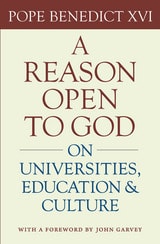
A Reason Open to God
Pope Benedict XVI Brown
Catholic University of America Press, 2013
With clarity and wisdom, Pope Benedict XVI sets out his vision for Catholic higher education in this first and only collection of his major addresses on the topic. What is the mission and identity of a Catholic university? What are the responsibilities of administrators, teachers, and students in Catholic institutes of higher learning? Where does the central theme of "love of God and others" fit into academia?
[more]
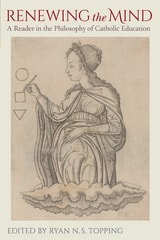
Renewing the Mind
Ryan N.S. Topping
Catholic University of America Press, 2015
Renewing the Mind includes an introductory essay on the history and renewal of Catholic education, followed by 38 selections each with an introduction, biography, and study questions; adorning the text throughout are illustrations from the National Gallery of Art. Educators of children and college students will find this an essential guide to the best of what has been said about what it means to be conformed to the mind of Christ.
[more]
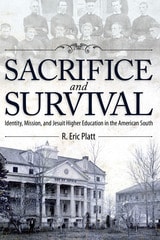
Sacrifice and Survival
Identity, Mission, and Jesuit Higher Education in the American SouthR. Eric Platt
University of Alabama Press, 2014
Recounts the history and development of Jesuit higher education in the American South
R. Eric Platt examines in Sacrifice and Survival the history and evolution of Jesuit higher education in the American South and hypothesizes that the identity and mission of southern Jesuit colleges and universities may have functioned as catalytic concepts that affected the “town and gown” relationships between the institutions and their host communities in ways that influenced whether they failed or adapted to survive.
The Catholic religious order known as the Society of Jesus (Jesuits) manages a global network of colleges and universities with a distinct Catholic identity and mission. Despite this immense educational system, several Jesuit institutions have closed throughout the course of the order’s existence. Societal pressures, external perceptions or misperceptions, unbalanced curricular structures rooted in liberal arts, and administrators’ slow acceptance of courses related to practical job seeking may all influence religious-affiliated educational institutions. The religious identity and mission of these colleges and universities are fundamentals that influence their interaction with external environs and contribute to their survival or failure.
Platt traces the roots of Jesuit education from the rise of Ignatius Loyola in the mid-sixteenth century through the European development of the Society of Jesus, Jesuit educational identity and mission, the migration of Jesuits to colonial New Orleans, the expulsion of Jesuits by Papal mandate, the reorganization of Jesuit education, their attempt to establish a network of educational institutions across the South, and the final closure of all but two southern Jesuit colleges and a set of high schools.
Sacrifice and Survival explores the implications of the Galveston Hurricane of 1900, yellow fever, Georgia floods, devastating fires, the Civil War, the expansion of New Orleans due to the 1884 Cotton Centennial Exposition, and ties between town and gown, as well as anti-Catholic/anti-Jesuit sentiment as the Society of Jesus pushed forward to create a system of southern institutions. Ultimately, institutional identity and mission critically impacted the survival of Jesuit education in the American South.
[more]

The Idea of a Catholic University
George Dennis O'Brien
University of Chicago Press, 2002
George Bernard Shaw thought that a Catholic university was a contradiction in terms—"university" represents intellectual freedom and "Catholic" represents dogmatic belief. Scholars, university administrators, and even the Vatican have staked out positions debating Shaw's observation. In this refreshing book, George Dennis O'Brien argues that contradiction arises both from the secular university's limited concept of academic freedom and the church's defective notion of dogma.
Truth is a central concept for both university and church, and O'Brien's book is built on the idea that there are different areas of truth—scientific, artistic, and religious—each with its own proper warrant and "method." In this light, he argues that one can reverse Shaw's comparison and uncover academic dogma and Christian freedom, university "infallibility" and dogmatic "fallibility."
Drawing on theology and the history of philosophy, O'Brien shows how religious truth relates to the work of a Catholic university. He then turns to the current controversies over Pope John Paul II's recent statement, Ex Corde Ecclesiae, which seeks to make Catholic universities conform to the church's official teaching office. O'Brien rejects the conventional "institutional-juridical" model used by the Vatican as improper both to faith and academic freedom. He argues for a "sacramental" model, one that respects the different kinds of "truth"—thus preserving the integrity of both church and university while making their combination in a Catholic university not only possible but desirable. O'Brien concludes with a practical consideration of how the ideal Catholic university might be expressed in the actual life of the contemporary curriculum and extracurriculum.
For anyone concerned about the place of religion in higher education, The Idea of a Catholic University will be essential reading.
[more]

What Happened to Notre Dame?
Charles E. Rice
St. Augustine's Press, 2009
[more]
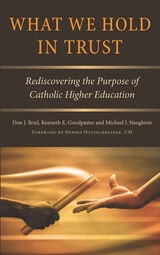
What We Hold in Trust
Rediscovering the Purpose of Catholic Higher EducationDon Briel
Catholic University of America Press, 2021
The specific concern in What We Hold in Trust comes to this: the Catholic university that sees its principal purpose in terms of the active life, of career, and of changing the world, undermines the contemplative and more deep-rooted purpose of the university. If a university adopts the language of technical and social change as its main and exclusive purpose, it will weaken the deeper roots of the university’s liberal arts and Catholic mission. The language of the activist, of changing the world through social justice, equality and inclusion, or of the technician through market-oriented incentives, plays an important role in university life. We need to change the world for the better and universities play an important role, but both the activist and technician will be co-opted by our age of hyper-activity and technocratic organizations if there is not first a contemplative outlook on the world that receives reality rather than constructs it.
To address this need for roots What We Hold in Trust unfolds in four chapters that will demonstrate how essential it is for the faculty, administrators, and trustees of Catholic universities to think philosophically and theologically (Chapter One), historically (Chapter Two) and institutionally (Chapters Three and Four). What we desperately need today are leaders in Catholic universities who understand the roots of the institutions they serve, who can wisely order the goods of the university, who know what is primary and what is secondary, and who can distinguish fads and slogans from authentic reform. We need leaders who are in touch with their history and have a love for tradition, and in particular for the Catholic tradition. Without this vision, our universities may grow in size, but shrink in purpose. They may be richer but not wiser.
[more]