Results by title
5 books match the query 'Cave paintings'
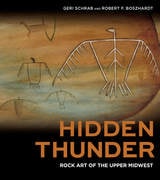
Hidden Thunder
Rock Art of the Upper MidwestGeri Schrab
Wisconsin Historical Society Press, 2016
In Hidden Thunder, renowned watercolor artist Geri Schrab and archaeologist Robert "Ernie" Boszhardt give readers an up-close-and-personal look at rock art. With an eye toward preservation, Schrab and Boszhardt take you with them as they research, document, and interpret at the ancient petroglyphs and pictographs made my Native Americans in past millennia. In addition to publicly accessible sites such as Wisconsin’s Roche-a-Cri State Park and Minnesota’s Jeffers Petroglyphs, Hidden Thunder covers the artistic treasures found at several remote and inaccessible rock art sites—revealing the ancient stories through words, full-color photographs, and artistic renditions.
Offering the duo perspectives of scientist and artist, Boszhardt shares the facts that archaeologists have been able to establish about these important artifacts of our early history, while Schrab offers the artist's experience, describing her emotional and creative response upon encountering and painting these sites. Viewpoints by members of the Menominee, Ho-Chunk, Ojibwe, and other Native nations offer additional insight on the historic and cultural significance of these sites. Together these myriad voices reveal layers of meaning and cultural context that emphasize why these fragile resources—often marred by human graffiti and mishandling or damage from the elements—need to be preserved.
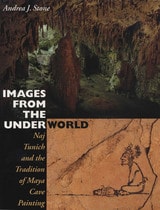
Images from the Underworld
Naj Tunich and the Tradition of Maya Cave PaintingBy Andrea J. Stone
University of Texas Press, 1995
In 1979, a Kekchi Maya Indian accidentally discovered the entrance to Naj Tunich, a deep cave in the Maya Mountains of El Peten, Guatemala. One of the world's few deep caves that contain rock art, Naj Tunich features figural images and hieroglyphic inscriptions that have helped to revolutionize our understanding of ancient Maya art and ritual.
In this book, Andrea Stone takes a comprehensive look at Maya cave painting from Preconquest times to the Colonial period. After surveying Mesoamerican cave and rock painting sites and discussing all twenty-five known painted caves in the Maya area, she focuses extensively on Naj Tunich. Her text analyzes the images and inscriptions, while photographs and line drawings provide a complete visual catalog of the cave art, some of which has been subsequently destroyed by vandals.
This important new body of images and texts enlarges our understanding of the Maya view of sacred landscape and the role of caves in ritual. It will be important reading for all students of the Maya, as well as for others interested in cave art and in human relationships with the natural environment.

San Rock Art
J.D. Lewis-Williams
Ohio University Press, 2011
San rock paintings, scattered over the range of southern Africa, are considered by many to be the very earliest examples of representational art. There are as many as 15,000 known rock art sites, created over the course of thousands of years up until the nineteenth century. There are possibly just as many still awaiting discovery.
Taking as his starting point the magnificent Linton panel in the Iziko-South African Museum in Cape Town, J. D. Lewis-Williams examines the artistic and cultural significance of rock art and how this art sheds light on how San image-makers conceived their world. It also details the European encounter with rock art as well as the contentious European interaction with the artists’ descendants, the contemporary San people.
The Nature of Paleolithic Art
R. Dale Guthrie
University of Chicago Press, 2005
With a natural historian's keen eye for observation, and as one who has spent a lifetime using bones and other excavated materials to piece together past human behavior and environments, Guthrie demonstrates that Paleolithic art is a mode of expression we can comprehend to a remarkable degree and that the perspective of natural history is integral to that comprehension. He employs a mix of ethology, evolutionary biology, and human universals to access these distant cultures and their art and artifacts. Guthrie uses innovative forensic techniques to reveal new information; estimating, for example, the ages and sexes of some of the artists, he establishes that Paleolithic art was not just the creation of male shamans.
With more than 3,000 images, The Nature of Paleolithic Art offers the most comprehensive representation of Paleolithic art ever published and a radical (and controversial) new way of interpreting it. The variety and content of these images—most of which have never been available or easily accessible to nonspecialists or even researchers—will astonish you. This wonderfully written work of natural history, of observation and evidence, tells the great story of our deepest past.
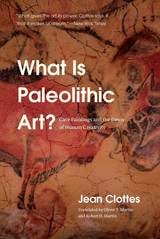
What Is Paleolithic Art?
Cave Paintings and the Dawn of Human CreativityJean Clottes
University of Chicago Press, 2016
In this book, Jean Clottes, one of the most renowned figures in the study of cave paintings, pursues an answer to this “why” of Paleolithic art. While other books focus on particular sites and surveys, Clottes’s work is a contemplative journey across the world, a personal reflection on how we have viewed these paintings in the past, what we learn from looking at them across geographies, and what these paintings may have meant—what function they may have served—for their artists. Steeped in Clottes’s shamanistic theories of cave painting, What Is Paleolithic Art? travels from well-known Ice Age sites like Chauvet, Altamira, and Lascaux to visits with contemporary aboriginal artists, evoking a continuum between the cave paintings of our prehistoric past and the living rock art of today. Clottes’s work lifts us from the darkness of our Paleolithic origins to reveal, by firelight, how we think, why we create, why we believe, and who we are.