Results by title
10 books match the query 'Cavell, Stanley'
Conditions Handsome and Unhandsome
The Constitution of Emersonian Perfectionism: The Carus Lectures, 1988Stanley Cavell
University of Chicago Press, 1991
In these three lectures, Cavell situates Emerson at an intersection of three crossroads: a place where both philosophy and literature pass; where the two traditions of English and German philosophy shun one another; where the cultures of America and Europe unsettle one another.
"Cavell's 'readings' of Wittgenstein and Heidegger and Emerson and other thinkers surely deepen our understanding of them, but they do much more: they offer a vision of what life can be and what culture can mean. . . . These profound lectures are a wonderful place to make [Cavell's] acquaintance."—Hilary Putnam
"Cavell's 'readings' of Wittgenstein and Heidegger and Emerson and other thinkers surely deepen our understanding of them, but they do much more: they offer a vision of what life can be and what culture can mean. . . . These profound lectures are a wonderful place to make [Cavell's] acquaintance."—Hilary Putnam
[more]
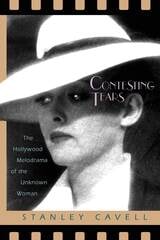
Contesting Tears
The Hollywood Melodrama of the Unknown WomanStanley Cavell
University of Chicago Press, 1996
What is marriage? Can a relationship dedicated to equality, friendship, and mutual education flower in an atmosphere of romance? What are the paths between loving another and knowing another? Stanley Cavell identified a genre of classic American films that engaged these questions in his study of comedies of remarriage, Pursuits of Happiness. With Contesting Tears, Cavell demonstrates that a contrasting genre, which he calls "the melodrama of the unknown woman," shares a surprising number and weave of concerns with those comedies.
Cavell provides close readings of four melodramas he finds definitive of the genre: Letter from an Unknown Woman, Gaslight, Now Voyager, and Stella Dallas. The women in these melodramas, like the women in the comedies, demand equality, shared education, and transfiguration, exemplifying for Cavell a moral perfectionism he identifies as Emersonian. But unlike the comedies, which portray a quest for a shared existence of expressiveness and joy, the melodramas trace instead the woman's recognition that in this quest she is isolated. Part of the melodrama concerns the various ways the men in the films (and the audiences of the films) interpret and desire to force the woman's consequent inaccessibility.
"Film is an interest of mine," Stanley Cavell has written, "or say a love, not separate from my interest in, or love of, philosophy." In Contesting Tears Cavell once again brilliantly unites his two loves, using detailed and perceptive musings on melodrama to reflect on philosophical problems of skepticism, psychoanalysis, and perfectionism. As he shows, the fascination and intelligence of such great stars as
Ingrid Bergman, Bette Davis, and Barbara Stanwyck illuminate, as they are illuminated by, the topics and events of these beloved and enduring films.
[more]
Hearing Things
Voice and Method in the Writing of Stanley CavellTimothy Gould
University of Chicago Press, 1998
What does philosophy have to do with the human voice? Has contemporary philosophy banished the "voice" from the field of legitimate investigation? Timothy Gould examines these questions through the philosopher most responsible for formulating them, Stanley Cavell. Hearing Things is the first work to treat systematically the relation between Cavell's pervasive authorial voice and his equally powerful, though less discernible, impulse to produce a set of usable philosophical methods.
Gould argues that a tension between voice and method unites Cavell's broad and often perplexing range of interests. From Wittgenstein to Thoreau, from Shakespeare to the movies, and from opera to Freud, Gould reveals the connection between the voice within Cavell's writing and the voices Cavell appeals to through the methods of ordinary language philosophy. Within Cavell's extraordinary productivity lies a new sense of philosophical method based on elements of the act of reading. Hearing Things is both an important study of Cavell's work and a major contribution to the construction of American philosophy.
Gould argues that a tension between voice and method unites Cavell's broad and often perplexing range of interests. From Wittgenstein to Thoreau, from Shakespeare to the movies, and from opera to Freud, Gould reveals the connection between the voice within Cavell's writing and the voices Cavell appeals to through the methods of ordinary language philosophy. Within Cavell's extraordinary productivity lies a new sense of philosophical method based on elements of the act of reading. Hearing Things is both an important study of Cavell's work and a major contribution to the construction of American philosophy.
[more]
In Quest of the Ordinary
Lines of Skepticism and RomanticismStanley Cavell
University of Chicago Press, 1988
These lectures by one of the most influential and original philosophers of the twentieth century constitute a sustained argument for the philosophical basis of romanticism, particularly in its American rendering. Through his examination of such authors as Emerson, Thoreau, Poe, Wordsworth, and Coleridge, Stanley Cavell shows that romanticism and American transcendentalism represent a serious philosophical response to the challenge of skepticism that underlies the writings of Wittgenstein and Austin on ordinary language.
[more]
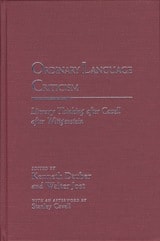
Ordinary Language Criticism
Literary Thinking after Cavell after WittgensteinKenneth Dauber and Walter Jost
Northwestern University Press, 2003
Marking a return of literary study from the remote reaches of abstraction to the realm of the immediate, the particular, and the real in which language and literature truly live, the essays in this volume articulate a productive, new critical approach: ordinary language criticism. With roots in the ordinary language philosophy derived especially from Wittgenstein in the early twentieth century, and in the ideas of American pragmatic philosophy propounded and extended by Stanley Cavell, this approach seeks to return criticism to its grounds in the natural language we all speak; to expose the terms of our engagement with narratives, arguments, and concepts-what Wittgenstein and Cavell call the "criteria" of our writing and reading.
Resisting master formulations and overarching theories, Ordinary Language Criticism does not so much dismiss the excitement of the last two decades of literary theorizing as it reminds us of the excitement of the shared common enterprises to which theory may still contribute. In this, the volume and the model it offers have wide implications for the academy, in which a widespread ersatz-sophistication has shorted the circuit between literary works and the real lives of those reading and teaching them.
With a definitive introduction by editors Kenneth Dauber and Walter Jost, and elaborations and practical examples by major figures such as Cavell himself, Martha Nussbaum, Marjorie Perloff, Anthony Cascardi, and Charles Altieri, among others, this volume clearly shows and explains how ordinary language criticism differs from current trends and what it exactly it can accomplish in theory and practice. These essays prove that by attending more faithfully to what we actually do when we read, we can make reading more productive--can reveal how extraordinary and rich, how really sophisticated, the ordinary actually is.
[more]
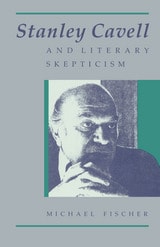
Stanley Cavell and Literary Skepticism
Michael Fischer
University of Chicago Press, 1989
Stanley Cavell's work is distinctive not only in its importance to philosophy but also for its remarkable interdisciplinary range. Cavell is read avidly by students of film, photography, painting, and music, but especially by students of literature, for whom Cavell offers major readings of Thoreau, Emerson, Shakespeare, and others. In this first book-length study of Cavell's writings, Michael Fischer examines Cavell's relevance to the controversies surrounding poststructuralist literary theory, particularly works by Jacques Derrida, J. Hillis Miller, Paul de Man, and Stanley Fish.
Throughout his study, Fischer focuses on skepticism, a central concern of Cavell's multifaceted work. Cavell, following J. L. Austin and Wittgenstein, does not refute the radical epistemological questioning of Descartes, Hume, and others, but rather characterizes skepticism as a significant human possibility or temptation. As presented by Fischer, Cavell's accounts of both external-world and other-minds skepticism share significant affinities with deconstruction, a connection overlooked by contemporary literary theorists.
Fischer follows Cavell's lead in examining how different genres address the problems raised by skepticism and goes on to show how Cavell draws on American and English romanticism in fashioning a response to it. He concludes by analyzing Cavell's remarks about current critical theory, focusing on Cavell's uneasiness with some of the conclusions reached by its practitioners. Fischer shows that Cavell's insights, grounded in powerful analyses of Descartes, Hume, and Wittgenstein, permit a fresh view of Derrida, Miller, de Man, and Fish. The result is not only a revealing characterization of deconstruction but a much-needed and insightful introduction to Cavell's rich but difficult oeuvre.
[more]
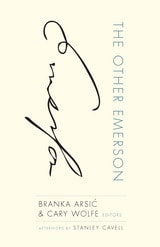
The Other Emerson
Branka Arsic
University of Minnesota Press, 2010
Ralph Waldo Emerson is one of the most significant figures in nineteenth-century American literature and culture-indeed, this collection argues, in the history of philosophy. The Other Emerson is a thorough reassessment of the philosophical underpinnings, theoretical innovations, and ethical and political implications of the prose writings of one of America's most enduring thinkers.
Considering Emerson first and foremost as a daring and original thinker, The Other Emerson focuses on three Emersonian subjects-subjectivity, the political, and the nature of philosophy-and range in topic from Emerson's relationships to slavery and mourning to his place in the development of Romanticism as reread by contemporary systems theory. It is Emerson's appreciation of truth's instability that link him to the European philosophical tradition.
Contributors: Eduardo Cadava, Princeton U; Sharon Cameron, Johns Hopkins U; Russell B. Goodman, U of New Mexico; Paul Grimstad, Yale U; Eric Keenaghan, U at Albany, SUNY; Gregg Lambert, Syracuse U; Sandra Laugier, Université de Picardie Jules Verne; Donald Pease, Dartmouth College.
[more]
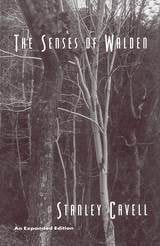
The Senses of Walden
An Expanded EditionStanley Cavell
University of Chicago Press, 1992
Stanley Cavell, one of America's most distinguished philosophers, has written an invaluable companion volume to Walden, a seminal book in our cultural heritage. This expanded edition includes two essays on Emerson.
[more]
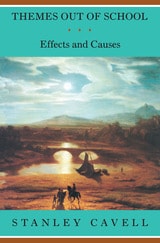
Themes out of School
Effects and CausesStanley Cavell
University of Chicago Press, 1988
In the first essay of this book, Stanley Cavell characterizes philosophy as a "willingness to think not about something other than what ordinary human beings think about, but rather to learn to think undistractedly about things that ordinary human beings cannot help thinking about, or anyway cannot help having occur to them, sometimes in fantasy, sometimes as a flash across a landscape."
Fantasies of film and television and literature, flashes across the landscape of literary theory, philosophical discourse, and French historiography give Cavell his starting points in these twelve essays. Here is philosophy in and out of "school," understood as a discipline in itself or thought through the works of Shakespeare, Molière, Kierkegaard, Thoreau, Brecht, Makavejev, Bergman, Hitchcock, Astaire, and Keaton.
Fantasies of film and television and literature, flashes across the landscape of literary theory, philosophical discourse, and French historiography give Cavell his starting points in these twelve essays. Here is philosophy in and out of "school," understood as a discipline in itself or thought through the works of Shakespeare, Molière, Kierkegaard, Thoreau, Brecht, Makavejev, Bergman, Hitchcock, Astaire, and Keaton.
[more]
This New Yet Unapproachable America
Lectures after Emerson after WittgensteinStanley Cavell
University of Chicago Press, 2013
Stanley Cavell is a titan of the academic world; his work in aesthetics and philosophy has shaped both fields in the United States over the past forty years. In this brief yet enlightening collection of lectures, Cavell investigates the work of two of his most tried-and-true subjects: Emerson and Wittgenstein. Beginning with an introductory essay that places his own work in a philosophical and historical context, Cavell guides his reader through his thought process when composing and editing his lectures while making larger claims about the influence of institutions on philosophers, and the idea of progress within the discipline of philosophy. In “Declining Decline,” Cavell explains how language modifies human existence, looking specifically at the culture of Wittgenstein’s writings. He draws on Emerson, Thoreau, and many others to make his case that Wittgenstein can indeed be viewed as a “philosopher of culture.” In his final lecture, “Finding as Founding,” Cavell writes in response to Emerson’s “Experience,” and explores the tension between the philosopher and language—that he or she must embrace language as his or her “form of life,” while at the same time surpassing its restrictions. He compares finding new ideas to discovering a previously unknown land in an essay that unabashedly celebrates the power and joy of philosophical thought.
[more]