Results by title

8 books match the query 'Celibacy'
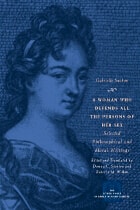
cover of A Woman Who Defends All the Persons of Her Sex: Selected Philosophical and Moral Writings

A Woman Who Defends All the Persons of Her Sex

Selected Philosophical and Moral Writings

Gabrielle Suchon

University of Chicago Press, 2010

During the oppressive reign of Louis XIV, Gabrielle Suchon (1632–1703) was the most forceful female voice in France, advocating women’s freedom and self-determination, access to knowledge, and assertion of authority. This volume collects Suchon’s writing from two works—Treatise on Ethics and Politics (1693) and On the Celibate Life Freely Chosen; or, Life without Commitments (1700)—and demonstrates her to be an original philosophical and moral thinker and writer.

Suchon argues that both women and men have inherently similar intellectual, corporeal, and spiritual capacities, which entitle them equally to essentially human prerogatives, and she displays her breadth of knowledge as she harnesses evidence from biblical, classical, patristic, and contemporary secular sources to bolster her claim. Forgotten over the centuries, these writings have been gaining increasing attention from feminist historians, students of philosophy, and scholars of seventeenth-century French literature and culture. This translation, from Domna C. Stanton and Rebecca M. Wilkin, marks the first time these works will appear in English.

[more]
cover of Celibacies: American Modernism and Sexual Life

Celibacies

American Modernism and Sexual Life

Benjamin Kahan

Duke University Press, 2013
In this innovative study, Benjamin Kahan traces the elusive history of modern celibacy. Arguing that celibacy is a distinct sexuality with its own practices and pleasures, Kahan shows it to be much more than the renunciation of sex or a cover for homosexuality. Celibacies focuses on a diverse group of authors, social activists, and artists, spanning from the suffragettes to Henry James, and from the Harlem Renaissance's Father Divine to Andy Warhol. This array of figures reveals the many varieties of celibacy that have until now escaped scholars of literary modernism and sexuality. Ultimately, this book wrests the discussion of celibacy and sexual restraint away from social and religious conservatism, resituating celibacy within a history of political protest and artistic experimentation. Celibacies offers an entirely new perspective on this little-understood sexual identity and initiates a profound reconsideration of the nature and constitution of sexuality.
[more]
cover of Celibacy, Culture, And Society: Anthropology Of Sexual Abstinence

Celibacy, Culture, And Society

Anthropology Of Sexual Abstinence

Elisa J Sobo

University of Wisconsin Press, 2001

This is the first cross-cultural inquiry into the practice of celibacy around the world and through the ages, among groups as diverse as Kenyan villagers and U.S. prisoners, Mazatec Shamans and Buddhist nuns and monks, Shaker church members and anorexic women.
    The examples of celibacy described here illustrate the complex relationship between human sexuality and its particular sociocultural context. Ideas about the body, gender, family, work, religion, health, and other dimensions of life come sharply into focus as the contributors examine the many practices and institutions surrounding sexual abstinence. They show that, though celibacy is certainly sometimes a punishment or a deliberate ritual abstinence, it also serves many other social and material functions and in some cases contributes to kin-group survival and well-being. Celibacy, Culture, and Society represents a significant step towards understanding the functions and meanings of sexuality.
[more]
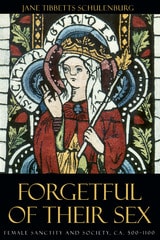
cover of Forgetful of Their Sex: Female Sanctity and Society, ca. 500-1100

Forgetful of Their Sex

Female Sanctity and Society, ca. 500-1100

Jane Tibbetts Schulenburg

University of Chicago Press, 1998

In this remarkable study of over 2,200 female and male saints, Jane Schulenburg explores women's status and experience in early medieval society and in the Church by examining factors such as family wealth and power, patronage, monasticism, virginity, and motherhood. The result is a unique depiction of the lives of these strong, creative, independent-minded women who achieved a visibility in their society that led to recognition of sanctity.

"A tremendous piece of scholarship. . . . This journey through more than 2,000 saints is anything but dull. Along the way, Schulenburg informs our ideas regarding the role of saints in the medieval psyche, gender-specific identification, and the heroics of virginity." —Library Journal

"[This book] will be a kind of 'roots' experience for some readers. They will hear the voices, haunted and haunting, of their distant ancestors and understand more about themselves." —Christian Science Monitor

"This fascinating book reaches far beyond the history of Christianity to recreate the 'herstory' of a whole gender." —Kate Saunders, The Independent
[more]
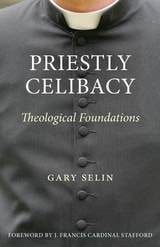
cover of Priestly Celibacy

Priestly Celibacy

Gary B. Selin

Catholic University of America Press, 2016
Pope Francis has called mandatory priestly celibacy a "gift for the Church," but added "since it is not a dogma, the door is always open" to change. As this Church discipline continues to be debated, it is important for Catholics to delve into the theological and not merely pragmatic reasons behind its continuation. Priestly Celibacy: Theological Foundations, therefore, fills a critical gap in the current theological literature on this important topic of ecclesial ministry and life, and also helps to contribute to the advancement of the rather underdeveloped theology of priestly celibacy.
[more]
cover of Religion and Sexuality: The Shakers, the Mormons, and the Oneida Community

Religion and Sexuality

The Shakers, the Mormons, and the Oneida Community

Lawrence Foster

University of Illinois Press, 2009

"Most writers have treated these three groups and the social ferment out of which they grew as simply an American sideshow. . . . In this book, therefore, I have attempted to go beyond the conventional focus on what these groups did; I have also sought to explain why they did what they did and how successful they were in terms of their own objectives. By trying sympathetically to understand these extraordinary experiments in social and religious revitalization, I believe it is possible to come to terms with a broader set of questions that affect all men and women during times of crisis and transition."--From the preface

Winner of the Best Book Award, Mormon History Association
[more]
cover of Religious Crisis and Civic Transformation: How Conflicts over Gender and Sexuality Changed the West German Catholic Church

Religious Crisis and Civic Transformation

How Conflicts over Gender and Sexuality Changed the West German Catholic Church

Kimba Allie Tichenor

Brandeis University Press, 2016
This book offers a fresh interpretation of the connection between the West German Catholic Church and post-1950s political debates on women’s reproductive rights and the protection of life in West Germany. According to Tichenor, Catholic women in West Germany, influenced by the culture of consumption, the sexual revolution, Vatican II reforms, and feminism, sought to renegotiate their relationship with the Church. They demanded a more active role in Church ministries and challenged the Church’s hierarchical and gendered view of marriage and condemnation of artificial contraception. When the Church refused to compromise, women left en masse. In response, the Church slowly stitched together a new identity for a postsecular age, employing an elaborate nuptial symbolism to justify its stance on celibacy, women’s ordination, artificial contraception, abortion, and reproductive technologies. Additionally, the Church returned to a radical interventionist agenda that embraced issue-specific alliances with political parties other than the Christian parties. In her conclusion, Tichenor notes more recent setbacks to the German Catholic Church, including disappointment with the reactionary German Pope Benedict XVI and his failure in 2010 to address over 250 allegations of sexual abuse at twenty-two of Germany’s twenty-seven dioceses. How the Church will renew itself in the twenty-first century remains unclear. This closely observed case study, which bridges religious, political, legal, and women’s history, will interest scholars and students of twentieth-century European religious history, modern Germany, and the intersection of Catholic Church practice and women’s issues.
[more]
cover of Sex, Celibacy, and Deviance: The Victorians and the Song of Songs

Sex, Celibacy, and Deviance

The Victorians and the Song of Songs

Duc Dau

The Ohio State University Press, 2024

Finalist for the American Academy of Religion's Award for Excellence in Textual Studies

Sex, Celibacy, and Deviance is the first major study to explore the Song of Songs (or Song of Solomon) in Victorian literature and art. As the Bible’s only erotic poem, the Song of Songs is the canonical Judeo-Christian book about love, furnishing the Victorians with an authoritative and literary language for love, marriage, sex, mourning, and religious celibacy.

Duc Dau adopts a queer and feminist lens to consider how Victorians employed and interpreted the Song of Songs in their work. How did writers and artists fashion and, most importantly, challenge the norms of gender, romantic love, and marriage? Spanning the early Victorian era through the first two decades of the twentieth century, Sex, Celibacy, and Deviance considers the works of Charlotte Brontë, Thomas Hardy, Christina Rossetti, John Gray, Michael Field, Edward Burne-Jones, and Simeon Solomon alongside two lesser-known figures: Irish-born Scottish artist Phoebe Anna Traquair and the Catholic religious leader Augusta Theodosia Drane. By addressing the relevance of the Song of Songs in light of shifting and conflicting religious and social contexts, Dau provides a fresh perspective on Victorian literature, religion, and culture.
[more]