Results by title
5 books match the query 'Cells'
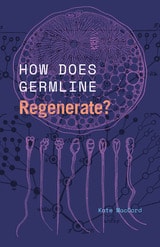
How Does Germline Regenerate?
Kate MacCord
University of Chicago Press, 2024
A concise primer that complicates a convenient truth in biology—the divide between germ and somatic cells—with far-reaching ethical and public policy ramifications.
Scientists have long held that we have two kinds of cells—germ and soma. Make a change to germ cells—say using genome editing—and that change will appear in the cells of future generations. Somatic cells are “safe” after such tampering; modify your skin cells, and your future children’s skin cells will never know. And, while germ cells can give rise to new generations (including all of the somatic cells in a body), somatic cells can never become germ cells. How did scientists discover this relationship and distinction between somatic and germ cells—the so-called Weismann Barrier—and does it actually exist? Can somatic cells become germ cells in the way germ cells become somatic cells? That is, can germ cells regenerate from somatic cells even though conventional wisdom denies this possibility? Covering research from the late nineteenth century to the 2020s, historian and philosopher of science Kate MacCord explores how scientists came to understand and accept the dubious concept of the Weismann Barrier and what profound implications this convenient assumption has for research and policy, from genome editing to stem cell research, and much more.
Scientists have long held that we have two kinds of cells—germ and soma. Make a change to germ cells—say using genome editing—and that change will appear in the cells of future generations. Somatic cells are “safe” after such tampering; modify your skin cells, and your future children’s skin cells will never know. And, while germ cells can give rise to new generations (including all of the somatic cells in a body), somatic cells can never become germ cells. How did scientists discover this relationship and distinction between somatic and germ cells—the so-called Weismann Barrier—and does it actually exist? Can somatic cells become germ cells in the way germ cells become somatic cells? That is, can germ cells regenerate from somatic cells even though conventional wisdom denies this possibility? Covering research from the late nineteenth century to the 2020s, historian and philosopher of science Kate MacCord explores how scientists came to understand and accept the dubious concept of the Weismann Barrier and what profound implications this convenient assumption has for research and policy, from genome editing to stem cell research, and much more.
[more]
In Search of Cell History
The Evolution of Life's Building BlocksFranklin M. Harold
University of Chicago Press, 2014
The origin of cells remains one of the most fundamental problems in biology, one that over the past two decades has spawned a large body of research and debate. With In Search of Cell History, Franklin M. Harold offers a comprehensive, impartial take on that research and the controversies that keep the field in turmoil.
Written in accessible language and complemented by a glossary for easy reference, this book investigates the full scope of cellular history. Assuming only a basic knowledge of cell biology, Harold examines such pivotal subjects as the relationship between cells and genes; the central role of bioenergetics in the origin of life; the status of the universal tree of life with its three stems and viral outliers; and the controversies surrounding the last universal common ancestor. He also delves deeply into the evolution of cellular organization, the origin of complex cells, and the incorporation of symbiotic organelles, and considers the fossil evidence for the earliest life on earth. In Search of Cell History shows us just how far we have come in understanding cell evolution—and the evolution of life in general—and how far we still have to go.
Written in accessible language and complemented by a glossary for easy reference, this book investigates the full scope of cellular history. Assuming only a basic knowledge of cell biology, Harold examines such pivotal subjects as the relationship between cells and genes; the central role of bioenergetics in the origin of life; the status of the universal tree of life with its three stems and viral outliers; and the controversies surrounding the last universal common ancestor. He also delves deeply into the evolution of cellular organization, the origin of complex cells, and the incorporation of symbiotic organelles, and considers the fossil evidence for the earliest life on earth. In Search of Cell History shows us just how far we have come in understanding cell evolution—and the evolution of life in general—and how far we still have to go.
[more]
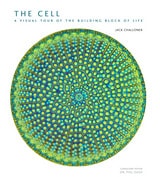
The Cell
A Visual Tour of the Building Block of LifeJack Challoner
University of Chicago Press, 2015
The cell is the basic building block of life. In its 3.5 billion years on the planet, it has proven to be a powerhouse, spreading life first throughout the seas, then across land, developing the rich and complex diversity of life that populates the planet today.
With The Cell: A Visual Tour of the Building Block of Life, Jack Challoner treats readers to a visually stunning tour of these remarkable molecular machines. Most of the living things we’re familiar with—the plants in our gardens, the animals we eat—are composed of billions or trillions of cells. Most multicellular organisms consist of many different types of cells, each highly specialized to play a particular role—from building bones or producing the pigment in flower petals to fighting disease or sensing environmental cues. But the great majority of living things on our planet exist as single cell. These cellular singletons are every bit as successful and diverse as multicellular organisms, and our very existence relies on them.
The book is an authoritative yet accessible account of what goes on inside every living cell—from building proteins and producing energy to making identical copies of themselves—and the importance of these chemical reactions both on the familiar everyday scale and on the global scale. Along the way, Challoner sheds light on many of the most intriguing questions guiding current scientific research: What special properties make stem cells so promising in the treatment of injury and disease? How and when did single-celled organisms first come together to form multicellular ones? And how might scientists soon be prepared to build on the basic principles of cell biology to build similar living cells from scratch.
[more]
The Third Lens
Metaphor and the Creation of Modern Cell BiologyAndrew S. Reynolds
University of Chicago Press, 2018
Does science aim at providing an account of the world that is literally true or objectively true? Understanding the difference requires paying close attention to metaphor and its role in science. In The Third Lens, Andrew S. Reynolds argues that metaphors, like microscopes and other instruments, are a vital tool in the construction of scientific knowledge and explanations of how the world works. More than just rhetorical devices for conveying difficult ideas, metaphors provide the conceptual means with which scientists interpret and intervene in the world.
Reynolds here investigates the role of metaphors in the creation of scientific concepts, theories, and explanations, using cell theory as his primary case study. He explores the history of key metaphors that have informed the field and the experimental, philosophical, and social circumstances under which they have emerged, risen in popularity, and in some cases faded from view. How we think of cells—as chambers, organisms, or even machines—makes a difference to scientific practice. Consequently, an accurate picture of how scientific knowledge is made requires us to understand how the metaphors scientists use—and the social values that often surreptitiously accompany them—influence our understanding of the world, and, ultimately, of ourselves.
The influence of metaphor isn’t limited to how we think about cells or proteins: in some cases they can even lead to real material change in the very nature of the thing in question, as scientists use technology to alter the reality to fit the metaphor. Drawing out the implications of science’s reliance upon metaphor, The Third Lens will be of interest to anyone working in the areas of history and philosophy of science, science studies, cell and molecular biology, science education and communication, and metaphor in general.
[more]
Visions of Cell Biology
Reflections Inspired by Cowdry's "General Cytology"Edited by Karl S. Matlin, Jane Maienschein, and Manfred D. Laubichler
University of Chicago Press, 2017
Although modern cell biology is often considered to have arisen following World War II in tandem with certain technological and methodological advances—in particular, the electron microscope and cell fractionation—its origins actually date to the 1830s and the development of cytology, the scientific study of cells. By 1924, with the publication of Edmund Vincent Cowdry’s General Cytology, the discipline had stretched beyond the bounds of purely microscopic observation to include the chemical, physical, and genetic analysis of cells. Inspired by Cowdry’s classic, watershed work, this book collects contributions from cell biologists, historians, and philosophers of science to explore the history and current status of cell biology.
Despite extraordinary advances in describing both the structure and function of cells, cell biology tends to be overshadowed by molecular biology, a field that developed contemporaneously. This book remedies that unjust disparity through an investigation of cell biology’s evolution and its role in pushing forward the boundaries of biological understanding. Contributors show that modern concepts of cell organization, mechanistic explanations, epigenetics, molecular thinking, and even computational approaches all can be placed on the continuum of cell studies from cytology to cell biology and beyond. The first book in the series Convening Science: Discovery at the Marine Biological Laboratory, Visions of Cell Biology sheds new light on a century of cellular discovery.
Despite extraordinary advances in describing both the structure and function of cells, cell biology tends to be overshadowed by molecular biology, a field that developed contemporaneously. This book remedies that unjust disparity through an investigation of cell biology’s evolution and its role in pushing forward the boundaries of biological understanding. Contributors show that modern concepts of cell organization, mechanistic explanations, epigenetics, molecular thinking, and even computational approaches all can be placed on the continuum of cell studies from cytology to cell biology and beyond. The first book in the series Convening Science: Discovery at the Marine Biological Laboratory, Visions of Cell Biology sheds new light on a century of cellular discovery.
[more]