Results by title
4 books match the query 'Central Valley'
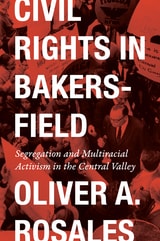
Civil Rights in Bakersfield
Segregation and Multiracial Activism in the Central ValleyOliver A. Rosales
University of Texas Press, 2024
2024 Outstanding Book Award, National Association for Ethnic Studies
2025 Honorable Mention, Norris & Carol Hundley Award, Pacific Coast Branch of the American Historical Association
2025 The Ambassador Julian Nava Best Ethnic Studies Book, International Latino Book Awards
A multiracial history of civil rights coalitions beyond the farm worker movement in twentieth-century Bakersfield, California.
In Civil Rights in Bakersfield, Oliver Rosales uncovers the role of the multiracial west in shaping the course of US civil rights history. Focusing on Bakersfield, one of the few sizable cities within California’s Central Valley for much of the twentieth century in a region most commonly known as a bastion of political conservatism, oil, and industrial agriculture, Rosales documents how multiracial coalitions emerged to challenge histories of racial segregation and discrimination. He recounts how the region was home to both the historic farm worker movement, led by César Chávez, Dolores Huerta, and Larry Itliong, and also a robust multiracial civil rights movement beyond the fields. This multiracial push for civil rights reform included struggles for fair housing, school integration, public health, media representation, and greater political representation for Black and Brown communities. In expanding on this history of multiracial activism, Rosales further explores the challenges activists faced in community organizing and how the legacies of coalition building contribute to ongoing activist efforts in the Central Valley of today.
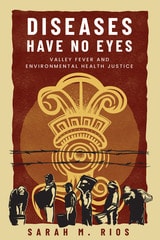
Diseases Have No Eyes
Valley Fever and Environmental Health JusticeSarah M. Rios
Temple University Press, 2026
Diseases Have No Eyes investigates how communities in Central Valley, California deal with Valley Fever, a painful illness caused by a soil fungus. The airborne disease’s symptoms can last from two months to a patient’s lifetime and may be fatal. Nearly a third of the national cases are reported in California, where those infected are disproportionately farmworkers and people incarcerated in the region. Poverty, pollution, and prison expose these groups to cumulative environmental and health risks that deny Valley Fever patients adequate medical treatment.
Sarah M. Rios examines how these populations face racial health disparities and develop strategies of care. She connects environmental justice activists as well as prison advocates and abolitionists who mobilize protests and issue calls to action to the past and ongoing efforts for medical autonomy and healthy communities. Diseases Have No Eyes emphasizes that vulnerable groups have developed an expertise and understanding of Valley Fever out of necessity. In the process, these community members offer an alternative public health response that extends beyond the individual body.
In the series Insubordinate Spaces
The Crable Site, Fulton County, Illinois
A Late Prehistoric Site in the Central Illinois ValleyHale Gilliam Smith
University of Michigan Press, 1951
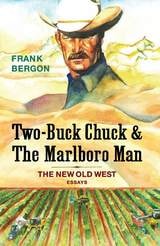
Two-Buck Chuck & The Marlboro Man
The New Old WestFrank Bergon
University of Nevada Press, 2019
Bergon presents a powerful array of rural and small-town Westerners who often see themselves as part of a region and a way of life most Americans aren’t aware of or don’t understand, their voices unheard, their stories untold. In these essays, Westerners from the diverse heritage of the San Joaquin Valley include California’s legendary Fred Franzia, the maker of the world’s best-selling Charles Shaw wines dubbed “Two-Buck Chuck,” and Darrell Winfield, a Dust Bowl migrant and lifelong working cowboy who for more than thirty years reigned as the iconic Marlboro Man. Their voices help us understand the complexities of today’s rural West, where Old West values intersect with New West realities. This is the West (and America today)—a region in conflict with itself.