Results by title
3 books match the query 'Changing Landscape'
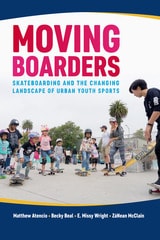
Moving Boarders
Skateboarding and the Changing Landscape of Urban Youth SportsMatthew Atencio
University of Arkansas Press, 2018
This excellent treatise on the contemporary youth sports scene examines how modern families embrace skateboarding and the role commerce plays in this unexpected new parent culture, and highlights how private corporations, community leaders, parks and recreation departments, and nonprofits like the Tony Hawk Foundation have united to energize skate parks—like soccer fields before them—as platforms for community engagement and the creation of social and economic capital.
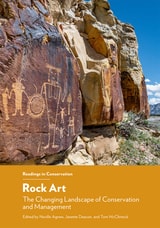
Rock Art
The Changing Landscape of Conservation and ManagementNeville Agnew
J. Paul Getty Trust, The, 2026
Painted and engraved marks and images on rock surfaces represent the oldest and most widespread form of human expression. Found globally in its original landscapes, with some images dating back fifty thousand years or more, the world’s rock art constitutes the most important body of latent knowledge about our deep past. Today, however, mass tourism, vandalism, theft, land development, and climate change are posing increasingly dire threats to this irreplaceable heritage.
This richly illustrated volume is the first interdisciplinary anthology to focus on the conservation and management of rock art sites. Its 133 readings survey the arc of published writings on the subject, ranging from early academic theories and oral narratives of Traditional peoples to an abundant selection of recent scholarship covering current best practices and advances in portable instrumentation that can be used in the field. Initial sections probe the origins and significance of these often-enigmatic forms, then survey scientific and technological methods of dating, monitoring, and documenting them. Subsequent readings discuss rock art’s physical characteristics and weathering, its importance to Indigenous communities, the decolonization of site management, the role of governments, the value of public outreach, and climate change. The volume closes with a selection of case studies drawn from major sites worldwide.
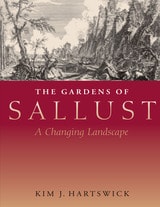
The Gardens of Sallust
A Changing LandscapeBy Kim J. Hartswick
University of Texas Press, 2003
Pleasure gardens, or horti, offered elite citizens of ancient Rome a retreat from the noise and grime of the city, where they could take their leisure and even conduct business amid lovely landscaping, architecture, and sculpture. One of the most important and beautiful of these gardens was the horti Sallustiani, originally developed by the Roman historian Sallust at the end of the first century B.C. and later possessed and perfected by a series of Roman emperors. Though now irrevocably altered by two millennia of human history, the Gardens of Sallust endure as a memory of beauty and as a significant archaeological site, where fragments of sculpture and ruins of architecture are still being discovered.
In this ambitious work, Kim Hartswick undertakes the first comprehensive history of the Gardens of Sallust from Roman times to the present, as well as its influence on generations of scholars, intellectuals, and archaeologists. He draws from an astonishing array of sources to reconstruct the original dimensions and appearance of the gardens and the changes they have undergone at specific points in history. Hartswick thoroughly discusses the architectural features of the garden and analyzes their remains. He also studies the sculptures excavated from the gardens and discusses the subjects and uses of many outstanding examples.