Results by title
15 books match the query 'Chaplains'
A Ministry of Presence
Chaplaincy, Spiritual Care, and the LawWinnifred Fallers Sullivan
University of Chicago Press, 2014
In A Ministry of Presence, Winnifred Fallers Sullivan explores how chaplaincy works in the United States—and in particular how it sits uneasily at the intersection of law and religion, spiritual care, and government regulation. Responsible for ministering to the wandering souls of the globalized economy, the chaplain works with a clientele often unmarked by a specific religious identity, and does so on behalf of a secular institution, like a hospital. Sullivan's examination of the sometimes heroic but often deeply ambiguous work yields fascinating insights into contemporary spiritual life, the politics of religious freedom, and the never-ending negotiation of religion's place in American institutional life.
An American Rabbi in Korea
A Chaplain's Journey in the Forgotten WarMilton J. Rosen, translated and edited by Stanley R. Rosen
University of Alabama Press, 2004
During the height of the Korean conflict, 1950–51, Orthodox Jewish chaplain Milton J. Rosen wrote 19 feature-length articles for Der Morgen Zhornal, a Yiddish daily in New York, documenting his wartime experiences as well as those of the servicemen under his care. An American Rabbi in Korea is an English translation of Rosen's important articles prepared by his son and annotated with background about Rosen's military service, a general introduction to the war and conflict on the Korean peninsula, and numerous maps and photographs.
Rosen was among those nearly caught in the Chinese entrapment of American and Allied forces in North Korea in late 1950, and some of his most poignant writing details the trying circumstances that faced both soldiers and civilians during that time. As chaplain, Rosen was able to offer a unique account of the American Jewish experience on the frontlines and in the United States military while also describing the impact of the American presence on Korean citizens and their culture. His interest in Korean attitudes toward Jews is also a significant theme within these articles. The sum is a readable account of war and its turmoil from an astute and compassionate observer.
Combat Chaplain
A Thirty-Year Vietnam BattleJames D. Johnson
University of North Texas Press, 2001
Dixie Heretic
The Civil Rights Odyssey of Renwick C. KennedyTennant McWilliams
University of Alabama Press, 2023
A life-and-times biography of the minister and social reformer Renwick C. Kennedy
Drawn from some 5,000 letters, six decades of daily-diary writings, and extensive interviews, Dixie Heretic: The Civil Rights Odyssey of Renwick C. Kennedy offers a life-and-times biography of the Alabama Black Belt minister, Renwick C. Kennedy (1900–1985). Here, Tennant McWilliams gives an unvarnished account of Kennedy’s tortuous efforts to make his congregants and other southern whites “better Christians.”
Kennedy came from “upcountry” South Carolina, a place rife with Scotch-Irish Associate Reformed Presbyterians—people of biblical infallibility and individual piety and salvation. In 1927, after a life-changing theology education at Princeton, he moved to Camden, Alabama, county seat of Wilcox County. There, he came to believe that God had a mandate for him: to change the “Half Christian” conservative, and the often violent, racial behaviors around him. As a neo-orthodox Protestant, Kennedy never rejected literal approaches to the Bible. Still, out of the “Full Christian” Social Gospel, he urged changed racial behavior. Ultimately this led him to publish confrontational short stories and essays in Christian Century and New Republic—most set in fictitious “Yaupon County.”
In World War II, Kennedy served as a chaplain with the famed 102nd Evacuation Hospital. He came home hoping the Allied victory would spur Americans to fight racial segregation just as they had fought racial fascism in Europe. The 1948 Dixiecrat movement dashed these hopes, turning much of his neo-orthodox optimism to cynicism. His hope found fleeting resurgence in the civil rights movement, and saw Kennedy quietly leading desegregation of Troy University, where he was an administrator. But the era’s assassinations, combined with George Wallace and the rise of southern white Republicans, regularly returned him to the frustrated hopes of 1948 and fostered a pessimism about truly changed hearts that he took to his grave in 1985.
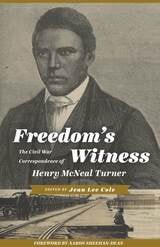
Freedom's Witness
The Civil War Correspondence of Henry McNeal TurnerJean Lee Cole
West Virginia University Press, 2013
Frenchman, Chaplain, Rebel
The Civil War Letters of Pere Louis-Hippoltye Gache, 10th Louisiana InfantryPere Louis-Hippolyte Gache, S.J.
University of Alabama Press, 2007
The American Civil War through the eyes of a French Jesuit chaplain.
"This book has a tantalizing quality, and it certainly is fresh literature for those who have watched the story of the Civil War unfold. . . . One cannot help but marvel at the research undertaken by Fr. Buckley. These letters of Fr. Gache cover such subjects as the duties of a chaplain, the lack of stimulating conversation in camp, whiskey as medication for diarrhea, the chaplain’s uniform, the oversupply of Catholic chaplains, descriptions of battles—Chancellorsville, Fredericksburg—chaplains as prisoners of war, the possibility of General Lee being chosen as the second president of the Confederacy, making candles for the alter and bleaching wax, procuring sacramental wine, conflicts with Protestant preachers, and the surrender of Richmond. Such subjects allow the personality and character of Hippolyte to stand out. . . . [The book] is interesting reading for all who love and admire the Jesuits. Its wealth of information makes it a must for others whose concern is the Confederate soldier and his God."
—Journal of Southern History
Learning from Case Studies in Chaplaincy
Towards Practice Based Evidence and ProfessionalismEdited by Renske Kruizinga, Jacques Körver, Martin Walton, and Martjin Stoutjesdijk
Eburon Academic Publishers, 2020
The recent body of case-study work on chaplaincy care synthesizes the inherent narrative nature of chaplaincy with the structured rigors of contemporary care research. This volume is composed of contributions from both practitioners and academic researchers, joining reflections on the challenges of case studies in chaplaincy care with specific results. Drawing on reflections on methodology and professionalization in chaplaincy, the volume hopes to contribute to answering the question of how and why chaplaincy works.

Mantle of Mercy
Islamic Chaplaincy in North AmericaMuhammad A. Ali
Templeton Press, 2022
Working in a variety of settings—including hospitals, prisons, universities, and the armed forces—Muslim chaplains encounter unique challenges on a daily basis, requiring them to call upon the resources of their Islamic faith with wisdom and tenderness. The contributors to this volume explore these circumstances vividly and honestly. Their personal stories are instructive of how Islamic principles can be employed with spiritual insight to bring strength and comfort to the sick and suffering.
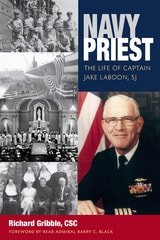
Navy Priest
Richard Gribble
Catholic University of America Press, 2015
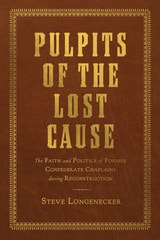
Pulpits of the Lost Cause
The Faith and Politics of Former Confederate Chaplains during ReconstructionSteve Longenecker
University of Alabama Press, 2023
A comparison of the faith and politics of former Confederate chaplains with intriguing insights about the evolution of their postwar beliefs and the Lost Cause
Pulpits of the Lost Cause: The Faith and Politics of Former Confederate Chaplains during Reconstruction is the first in-depth study of former chaplains that juxtaposes their religion and politics, thereby revealing important insights about the Lost Cause movement. Steve Longenecker demonstrates that while some former chaplains vigorously defended the Lost Cause and were predictably conservative in the pulpit, embracing orthodoxy and resisting religious innovation, others were unexpectedly progressive and advocated on behalf of evolution, theological liberalism, and modern biblical criticism.
Former Confederate chaplains embodied both the distinctive white, Southern, regional identity and the variation within it. Most were theologically conservative and Lost Cause racists. But as with the larger South, variation abounded. The Lost Cause, which Longenecker interprets as a broad popular movement with numerous versions, meant different things to different chaplains. It ranged from diehard-ism to tempered sectional forgiveness to full reconciliation to a harmless once-a-year Decoration Day ritual.
This volume probes the careers of ten former chaplains, including their childhoods, wartime experiences, Lost Cause personas, and theologies, making use of manuscripts and published sermons as well as newspapers, diaries, memoirs, denominational periodicals, letters, and the books they themselves produced. In theology, many former chaplains were predictably conservative, while others were unexpectedly broad-minded and advocated evolution, theological liberalism, and modern Biblical criticism. One former chaplain became a social-climbing Harvard progressive. Another wrote innovative, liberal theology read by European scholars. Yet another espoused racial equality, at least in theory if not full practice. Additionally, former chaplains often exhibited the fundamental human trait of compartmentalization, most notably by extolling the past as they celebrated the Lost Cause while simultaneously looking to the future as religious progressives or New South boosters. The stereotypical preacher of the Lost Cause—a gray-clad Bible thumper—existed sufficiently to create the image but hardly enough to be universally accurate.

Sky Pilots
The Yankee Division Chaplains in World War IMichael E. Shay
University of Missouri Press, 2014
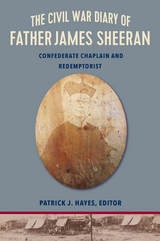
The Civil War Diary of Rev. James Sheeran, C.Ss.R.
Patrick J. Hayes
Catholic University of America Press, 2017
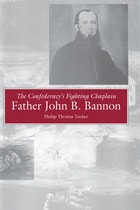
The Confederacy's Fighting Chaplain
Father John B. BannonPhillip Thomas Tucker
University of Alabama Press, 1992
The Confederacy’s Fighting Chaplain is the remarkable story of the Irishman who brought the Bible and his own resourcefulness and daring to both the battlefield and the diplomatic field—a story that has been largely ignored for more than 130 years. The biography of John B. Bannon also chronicles the forgotten Southerners—the Irish immigrants of the Confederacy—whose colorful and crucial role in the Civil War has been seriously neglected.
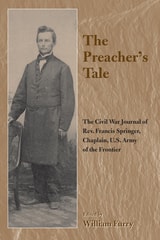
The Preacher's Tale
The Civil War Journal of Rev. Francis Springer, Chaplain, U.S. Army of the FrontierWilliam Furry
University of Arkansas Press, 2001
In the fall of 1861, fifty-one-year-old Rev. Francis Springer enlisted in the Union army. The following spring, Springer, a friend and one-time neighbor to Abraham Lincoln, rode away with the 10th Illinois Cavalry. A witness to the Battle of Prairie Grove (December 1862), Springer was later named post chaplain at Fort Smith, where, in additon to preaching and ministering to the troops, he was placed in charge of refugees—widows, orphans, and contrabands—the displaced victims of virulent guerrilla warfare in Northwest Arkansas. Springer also wrote articles and columns in the Fort Smith New Era under the pseudonym, “Thrifton.” Springer’s honest appraisals of life in the Army of the Frontier make for fascinating reading, and his unique perspective as moralist, educator, and journalist provide new insight into the Civil War and how it was fought in the West. The book includes several never-before published photographs and appendixes which feature accounts of six military executions that Springer participated in as a Union Army chaplain, the hitherto unpublished last letters home of two rebel soldiers condemned and executed at Fort Smith, as well as a eulogy for Abraham Lincoln.
The Preacher’s Tale includes several never before published photographs, and appendixes that contain accounts of six military executions that Springer participated in as a Union Army chaplain, the last letters home of two rebel soldiers condemned and executed at Fort Smith, as well as a eulogy written for Abraham Lincoln.
The Priest Who Put Europe Back Together
The Life of Rev. Fabian Flynn, CPSean Brennan
Catholic University of America Press, 2018