Results by title
3 books match the query 'Chaput, Catherine'
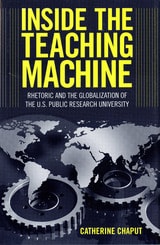
Inside the Teaching Machine
Rhetoric and the Globalization of the U.S. Public Research UniversityCatherine Chaput
University of Alabama Press, 2008
An incisive critique of the corporatized university, tracing the entanglement of academic missions with economic, political, and cultural systems.
Advocates of higher education have long contended that universities should operate above the crude material negotiations of economics and politics. Such arguments, ignore the historical reality that the American university system emerged through, and in service to, a capitalist political economy that unevenly combines corporate, state, and civil interests.
As the corporatization of U.S. universities becomes nearly impossible to deny, the common response from many academics has been a superior stand against the contamination of the professional ideal by tainted corporate interests. Inside the Teaching Machine proposes a correction to this view through the lens of historical materialism.
Chaput argues that the U.S. public research university has always been a vital component of the capitalist political economy. While conventional narratives of public higher education emphasize civic preparation and upward mobility, Chaput demonstrates that supposedly egalitarian policies like the Morrill Land-Grant Act and the G.I. Bill served the changing interests of capitalism much as education, creating a professional class that supports the capitalist political economy. Chaput also focuses on the relationship between American universities and globalization, showing how the trend toward professionalization contributes to the production of surplus value, and the ways that the American university model circulates outside the United States. Chaput concludes by advocating rhetorical strategies for the professional who opposes the capitalist logic of the global university system, proposing concrete options for engaging and redirecting globalization within the university system.
Propaganda and Rhetoric in Democracy
History, Theory, AnalysisEdited by Gae Lyn Henderson and M. J. Braun Foreword by Charles Bazerman
Southern Illinois University Press, 2016
Propaganda and Rhetoric in Democracy offers new perspectives on the history of propaganda, explores how it has evolved during the twentieth and twenty-first centuries, and advances a much more nuanced understanding of what it means to call discourse propaganda.
What Democracy Looks Like
The Rhetoric of Social Movements and CounterpublicsEdited by Christina R. Foust, Amy Pason, and Kate Zittlow Rogness
University of Alabama Press, 2017
Examining How Social Movements and Counterpublics Shape Democratic Change.
Recent protests around the world (such as the Arab Spring uprisings and Occupy Wall Street movements) have drawn renewed interest to the study of social change and, especially, to the manner in which words, images, events, and ideas associated with protestors can “move the social.” What Democracy Looks Like is an attempt to foster a more coherent understanding of social change among scholars of rhetoric and communication studies by juxtaposing the ideas of social movements and counterpublics—historically two key factors significant in the study of social change. Foust, Pason, and Zittlow Rogness’s volume compiles the voices of leading and new scholars who are contributing to the history, application, and new directions of these two concepts, all in conversation with a number of acts of resistance or social change.
The theories of social movements and counterpublics are related, but distinct. Social movement theories tend to be concerned with enacting policy and legislative changes. Scholars flying this flag have concentrated on the organization and language (for example, rallies and speeches) that are meant to enact social change. Counterpublic theory, on the other hand, focuses less on policy changes and more on the unequal distribution of power and resources among different protest groups, which is sometimes synonymous with subordinated identity groups such as race, gender, sexuality, and class.
Nonetheless, contributors argue that in recent years the distinctions between these two methods have become less evident. By putting the literatures of the two theories in conversation with one another, these scholars seek to promote and imagine social change outside the typical binaries.