Results by title
14 books match the query 'Child care'

Child Care Problem
An Economic AnalysisDavid M. Blau
Russell Sage Foundation, 2001

Child Care and Training
Marion E. Faegre and John E. Anderson
University of Minnesota Press, 1928
Child Care and Training was first published in 1928. Minnesota Archive Editions uses digital technology to make long-unavailable books once again accessible, and are published unaltered from the original University of Minnesota Press editions.
In this completely revised edition, a book with a long and successful history is brought up to date in keeping with current concepts of child development and growth. This basic handbook has been used and enthusiastically endorsed by thousands of teachers, students, doctors, parents, and nurses.
The present volume retains the time-tested plan of previous editions, but much of the material has been revised and new information, including a whole chapter on Personality, Adjustment, and Mental Health, has been added. All of the illustrations are new also.
The authors of the original volume, Marion L. Faegre and John E. Anderson, were joined in the preparation of this revision by Dale B. Harris, Dr. Anderson's successor as director of the Institute of Child Welfare at the University of Minnesota. In his long and distinguished career Dr. Anderson has served as president of the American Psychological Association and of the Society for Research in Child Development, as editor of the Psychological Bulletin and as advisory editor of Parents' Magazine and Childhood Education. Mrs. Faegre, author of numerous other works on child development, served for many years as consultant in parent education in the U. S. Children's Bureau, Washington, D. C.
Whether this book is used as a text for teaching or as a reference or guidebook for the individual, it admirably fills the need for a practical, authoritative source of instruction and advice.
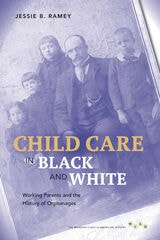
Child Care in Black and White
Working Parents and the History of OrphanagesJessie B. Ramey
University of Illinois Press, 2013

Cradle to Kindergarten
A New Plan to Combat InequalityAjay Chaudry
Russell Sage Foundation, 2017
The U.S. government invests less in children under the age of five than do most other developed nations. Most working families must seek private childcare, which means that children from low-income households, who would benefit most from high-quality early education, are the least likely to attend them. Existing policies, such as pre-kindergarten in some states are only partial solutions. To address these deficiencies, the authors propose to overhaul the early care system, beginning with a federal paid parental leave policy that provides both mothers and fathers with time and financial support after the birth of a child. They also advocate increased public benefits, including an expansion of the child care tax credit, and a new child care assurance program that subsidizes the cost of early care for low- and moderate-income families. They also propose that universal, high-quality early education in the states should start by age three, and a reform of the Head Start program that would include more intensive services for families living in areas of concentrated poverty and experiencing multiple adversities from the earliest point in these most disadvantaged children’s lives. They conclude with an implementation plan and contend that these reforms are attainable within a ten-year timeline.
Reducing educational and economic inequalities requires that all children have robust opportunities to learn, fully develop their capacities, and have a fair shot at success. Cradle to Kindergarten presents a blueprint for fulfilling this promise by expanding access to educational and financial resources at a critical stage of child development.
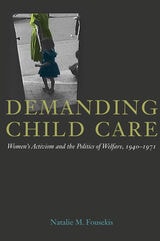
Demanding Child Care
Women's Activism and the Politics of Welfare, 1940-1971Natalie M. Fousekis
University of Illinois Press, 2013
During World War II, as women stepped in to fill jobs vacated by men in the armed services, the federal government established public child care centers in local communities for the first time. When the government announced plans to withdraw funding and terminate its child care services at the end of the war, women in California protested and lobbied to keep their centers open, even as these services rapidly vanished in other states.
Analyzing the informal networks of cross-class and cross-race reformers, policymakers, and educators, Demanding Child Care: Women's Activism and the Politics of Welfare, 1940–1971 traces the rapidly changing alliances among these groups. During the early stages of the childcare movement, feminists, Communists, and labor activists banded together, only to have these alliances dissolve by the 1950s as the movement welcomed new leadership composed of working-class mothers and early childhood educators. In the 1960s, when federal policymakers earmarked child care funds for children of women on welfare and children described as culturally deprived, it expanded child care services available to these groups but eventually eliminated public child care for the working poor.
Deftly exploring the possibilities for partnership as well as the limitations among these key parties, Fousekis helps to explain the barriers to a publically funded comprehensive child care program in the United States.
Economics of Child Care
David M. Blau
Russell Sage Foundation, 1991
Individual and Social Responsibility
Child Care, Education, Medical Care, and Long-Term Care in AmericaEdited by Victor R. Fuchs
University of Chicago Press, 1995
Four in-depth studies of human-service sectors—child care, education, medical care, and long-term care for the elderly—are followed by six cross-sector studies that stimulate new ways of thinking about human services through the application of economic theory, institutional analysis, and the history of social policy.
The contributors include Kenneth J. Arrow, Martin Feldstein, Victor Fuchs, Alan M. Garber, Eric A. Hanushek, Christopher Jencks, Seymour Martin Lipset, Glenn Loury, Roger G. Noll, Paul M. Romer, Amartya Sen, and Theda Skocpol.
This timely study sheds important light on the tension between individual and social responsibility, and will appeal to economists and other social scientists and policymakers concerned with social policy issues.

Making Care Work
Employed Mothers in the New Childcare MarketUttal, Lynet
Rutgers University Press, 2002
As ever more women work outside the home, ever more families employ childcare workers. In the absence of government regulations or social models that clearly define the childcare provider’s role, mothers worry about the quality of care their children are getting. By connecting the personal level of mothers’ daily experiences to the larger political, economic, and ideological context of childcare, Lynet Uttal describes and explains how mothers rely on their relationship with the providers to monitor and influence the quality of care their children receive. Whereas other studies have emphasized how mothers undervalue and exploit providers, this book paints a more nuanced picture, arguing that the ties between adults who share in the care of children creates neither heroes nor victims. This ethnography reveals that mothers are often reluctant to discuss their concerns with their childcare providers. Uttal shows how mothers walk a fine line between wanting to believe in the quality of care they have chosen, and the fact that they might have made a mistake. Catalyzed by their worries about the quality of care, mothers develop complex relationships with the women—and most are women—who look after their children.

Medicalized Motherhood
Perspectives from the Lives of African-American and Jewish WomenJacquelyn S. Litt
Rutgers University Press, 1999
When Jacquelyn S. Litt interviewed African-American and Jewish women who raised their children in the 1930s and 1940s, she found that these women responded to experts' advice in ways uniquely shaped by their ethnicity, race, and class. For middle-class African-American and Jewish women, medicalization took place in ethnically/racially segregated networks and functioned as a collectively held strategy for social advance as much as a set of technical practices for raising healthy children. For poor, single African-American mothers, everyday networks offered limited access to medical institutions or mainstream norms. Medical discourse was largely controlled by white women and men, which left these women disempowered in medical institutions and marginal to dominant definitions of acceptable mothering.
Litt's book is enriched with many narratives from the mothers themselves. Both the women's voices and her acute sociological research bring to light how medicalized motherhood, while not the single cause of difference and inequality among the women, was a site where they were produced.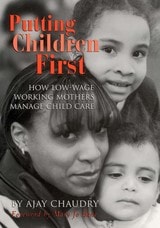
Putting Children First
How Low-Wage Working Mothers Manage Child CareAjay Chaudry
Russell Sage Foundation, 2004

The Erosion of Childhood
Valerie Polakow
University of Chicago Press, 1992
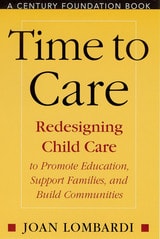
Time To Care
Redesigning Child Care To Promote Education,Joan Lombardi
Temple University Press, 2002

Who's Watching?
Daily Practices of Surveillance among Contemporary FamiliesMargaret K. Nelson
Vanderbilt University Press, 2009

Working in a 24/7 Economy
Challenges for American FamiliesHarriet B. Presser
Russell Sage Foundation, 2003