Results by title
16 books match the query 'Children's literature, American'

25 Projects for Art Explorers
Christine Kirker
American Library Association, 2018
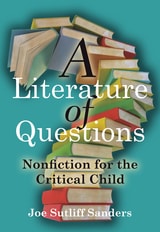
A Literature of Questions
Nonfiction for the Critical ChildJoe Sutliff Sanders
University of Minnesota Press, 2018
Nonfiction books for children—from biographies and historical accounts of communities and events to works on science and social justice—have traditionally been most highly valued by educators and parents for their factual accuracy. This approach, however, misses an opportunity for young readers to participate in the generation and testing of information.
In A Literature of Questions, Joe Sutliff Sanders offers an innovative theoretical approach to children’s nonfiction that goes beyond an assessment of a work’s veracity to develop a book’s equivocation as a basis for interpretation. Addressing how such works are either vulnerable or resistant to critical engagement, Sanders pays special attention to the attributes that nonfiction shares with other forms of literature, including voice and character, and those that play a special role in the genre, such as peritexts and photography.
The first book-length work to theorize children’s nonfiction as nonfiction from a literary perspective, A Literature of Questions carefully explains how the genre speaks in unique ways to its young readers and how it invites them to the project of understanding. At the same time, it clearly lays out a series of techniques for analysis, which it then applies and nuances through extensive close readings and case studies of books published over the past half century, including recent award-winning books such as Tanya Lee Stone’s Almost Astronauts: Thirteen Women Who Dared to Dream and We Are the Ship: The Story of Negro League Baseball by Kadir Nelson. By looking at a text’s willingness or reluctance to let children interrogate its information and ideological context, Sanders reveals how nonfiction can make young readers part of the project of learning rather than passive recipients of information.
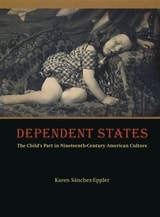
Dependent States
The Child's Part in Nineteenth-Century American CultureKaren Sánchez-Eppler
University of Chicago Press, 2005
Dependent States examines the ties between children's literacy training and the growing cultural prestige of the novel; the way children functioned rhetorically in reform literature to enforce social norms; the way the risks of death to children shored up emotional power in the home; how Sunday schools socialized children into racial, religious, and national identities; and how class identity was produced, not only in terms of work, but also in the way children played. For Sánchez-Eppler, nineteenth-century childhoods were nothing less than vehicles for national reform. Dependent on adults for their care, children did not conform to the ideals of enfranchisement and agency that we usually associate with historical actors. Yet through meticulously researched examples, Sánchez-Eppler reveals that children participated in the making of social meaning. Her focus on childhood as a dependent state thus offers a rewarding corrective to our notions of autonomous individualism and a new perspective on American culture itself.
Diversity in Youth Literature
Opening Doors through ReadingJamie Campbell Naidoo
American Library Association, 2013
In the Words of the Winners
The Newbery and Caldecott Medals 2001-2010American Library Association, 2011
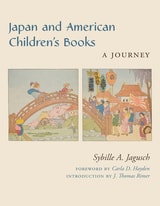
Japan and American Children's Books
A JourneySybille Jagusch
Rutgers University Press, 2021
For generations, children’s books provided American readers with their first impressions of Japan. Seemingly authoritative, and full of fascinating details about daily life in a distant land, these publications often presented a mixture of facts, stereotypes, and complete fabrications.
This volume takes readers on a journey through nearly 200 years of American children’s books depicting Japanese culture, starting with the illustrated journal of a boy who accompanied Commodore Matthew Perry on his historic voyage in the 1850s. Along the way, it traces the important role that representations of Japan played in the evolution of children’s literature, including the early works of Edward Stratemeyer, who went on to create such iconic characters as Nancy Drew. It also considers how American children’s books about Japan have gradually become more realistic with more Japanese-American authors entering the field, and with texts grappling with such serious subjects as internment camps and the bombing of Hiroshima and Nagasaki.
Drawing from the Library of Congress’s massive collection, Sybille A. Jagusch presents long passages from many different types of Japanese-themed children’s books and periodicals—including travelogues, histories, rare picture books, folktale collections, and boys’ adventure stories—to give readers a fascinating look at these striking texts.
Published by Rutgers University Press, in association with the Library of Congress.
Literature and the Child
Romantic Continuations, Postmodern ContestationsJames Holt Mcgavran
University of Iowa Press, 1999
Making Americans
Children's Literature from 1930 to 1960Gary D. Schmidt
University of Iowa Press, 2013
Although some later critics have argued that the books published in this era offered a vision of a safe, secure, simple world without injustice or unhappy endings, Gary D. Schmidt shows that the progressive political agenda shared by many Americans who wrote, illustrated, published, and taught children’s books had a powerful effect. Authors like James Daugherty, Laura Ingalls Wilder, Lois Lenski, Ingri and Edgar Parin D’Aulaire, Virginia Lee Burton, Robert McCloskey, and many others addressed directly and indirectly the major social issues of a turbulent time: racism, immigration and assimilation, sexism, poverty, the Great Depression, World War II, the atomic bomb, and the threat of a global cold war.
The central concern that many children’s book authors and illustrators wrestled with was the meaning of America and democracy itself, especially the tension between individual freedoms and community ties. That process produced a flood of books focused on the American experience and intent on defining it in terms of progress toward inclusivity and social justice. Again and again, children’s books addressed racial discrimination and segregation, gender roles, class differences, the fate of Native Americans, immigration and assimilation, war, and the role of the United States in the world. Fiction and nonfiction for children urged them to see these issues as theirs to understand, and in some ways, theirs to resolve. Making Americans is a study of a time when the authors and illustrators of children’s books consciously set their eyes on national and international sights, with the hope of bringing the next generation into a sense of full citizenship.
Newbery & Caldecott Medal Books, 1986-2000
A Comprehensive Guide to the WinnersAmerican Library Association, 2001
Pura Belpré Awards
Celebrating Latino Authors and IllustratorsRose Zertuche Treviño
American Library Association, 2006
Raising Your Kids Right
Children's Literature and American Political ConservatismAbate, Michelle Ann
Rutgers University Press, 2011
Highlighting the works of William Bennett, Lynne Cheney, Bill O'Reilly, and others, Michelle Ann Abate brings together such diverse fields as cultural studies, literary criticism, political science, childhood studies, brand marketing, and the cult of celebrity. Raising Your Kids Right dispels lingering societal attitudes that narratives for young readers are unworthy of serious political study by examining a variety of texts that offer information, ideology, and even instructions on how to raise kids right, not just figuratively but politically.
Slavery in American Children's Literature, 1790-2010
Paula T. Connolly
University of Iowa Press, 2013
Teaching Banned Books
12 Guides for Young ReadersPat R. Scales
American Library Association, 2001
Teaching Banned Books
32 Guides For Children And TeensPat R. Scales
American Library Association, 2019
As standard-bearers for intellectual freedom, school and children’s librarians are in ideal positions to collaborate with educators to not only protect the freedom to read but also ensure that valued books which touch upon important topics are not quarantined from the readers for whom they were written. In this best-selling classroom- and library-ready book of discussion guides, thoroughly updated and expanded to include genres such as graphic novels and nonfiction, award-winning champion of children's literature Scales shows that there is a way to teach these books while respecting all views. Also freshened to include only books that are in print, this resource
- reprints Judy Blume's stirring introduction from the first edition;
- aids educators and librarians in stimulating the critical thinking skills of young readers aged 9-18 while also encouraging freedom of thought and expression, in either classroom or book club settings;
- spotlights titles dealing with sensitive but vital issues such as bullying, racism, bigotry, making tough choices, other cultures, and our uncertain future;
- offers tips for introducing each book and its associated topics;
- provides open-ended questions for discussion which explore the book as a whole rather than simply its "controversial" aspects, along with research and writing activities; and
- includes short summaries of each book, plus a read-alikes section to keep the conversation going.
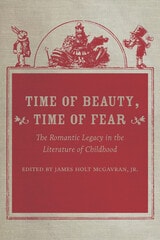
Time of Beauty, Time of Fear
The Romantic Legacy in the Literature of ChildhoodJames Holt McGavran, Jr.
University of Iowa Press, 2012

You're Only Young Twice
Children's Literature and FilmTim Morris
University of Illinois Press, 2000
Moving from classic texts (The Secret Garden, Goodnight Moon) to ephemera (the Hardy Boys, Goosebumps, and Harry Potter series), from the printed page to the silver screen (Willie Wonka, Jumanji, 101 Dalmatians, Beethoven), Tim Morris employs his experience as a parent and teacher to interrogate children's culture and reveal its conflicting messages.
Books and films for children--favorites accepted as wholesome fare for impressionable young minds --do not always teach straightforward lessons. Instead, they reflect the anxieties of the times and the desires of adults. At the heart of many a children's classic lies power, often expressed through racism, sexism, or violence. Under Morris's gaze, revered animal stories like Black Beauty turn into litanies of abuse; fantasies of childhood like Big are revealed as patriarchal struggles.
You're Only Young Twice redirects the focus on children's literature, asking not "What messages should children receive?" but "What messages do adults actually send?" For example, Morris recounts his own childhood confusion upon viewing Peter Pan, with its queenish, inept pirate and a grown woman (Mary Martin) in tights who pretends to be a crowing boy.
Morris shatters our long-held assumptions and challenges our best intentions, demonstrating how children's literature and films lay bare a troubled and troubling worldview.