Results by title

28 books match the query 'Christ'
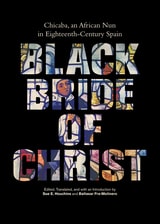
cover of Black Bride of Christ: Chicaba, an African Nun in Eighteenth-Century Spain

Black Bride of Christ

Chicaba, an African Nun in Eighteenth-Century Spain

Sue E. Houchins

Vanderbilt University Press, 2018

Teresa de Santo Domingo, born with the name Chicaba, was a slave captured in the territory known to seventeenth- and eighteenth-century Spanish and Portuguese navigators and slave traffickers as La Mina Baja del Oro, the part of West Africa that extends through present-day eastern Ghana, Togo, Benin, and western Nigeria. Upon the death of her Spanish master, Chicaba was freed to enter a convent. The Dominicans of La Penitencia in Salamanca accepted her after she had been rejected by several other monasteries because of her skin color. Even in her own religious community, race put her at a disadvantage in the highly stratified social hierarchy of monastic houses of the era. Her life story is known to us through a document entitled Compendio de la vida ejemplar de la Venerable Madre Sor Teresa Juliana de Santo Domingo, which is the foundational documentary evidence in the case for beatification of this nun, and as such it is the most significant and comprehensive source of information about her.

This volume, the first English translation of the Compendio, is a hagiography, an example of a biographical genre that recounts the lives and describes the spiritual practices of saints officially canonized by the Church, respected ecclesiastical leaders, or holy people informally recognized by local devotees. The effort to have Chicaba canonized continues today, as Fra-Molinero and Houchins explore in their introduction to the volume.
[more]
cover of Christ and Spirituality in St. Thomas Aquinas

Christ and Spirituality in St. Thomas Aquinas

Jean-Pierre Torrell

Catholic University of America Press, 2011

The studies in this volume investigate themes of particular spiritual relevance in Aquinas's theology: friendship, charity, prayer, configuration to Christ, priesthood, preaching.
[more]
cover of Christ and the Moral Life

Christ and the Moral Life

James M. Gustafson

University of Chicago Press, 1979
In this work, originally published in 1968, the distinguished theologian James M. Gustafson asks the fundamental question, "What is the significance of Jesus Christ for the moral life?" His answer is in the form of an ethical map, showing the ways in which theological affirmations about Christ relate to moral life in the writings of a number of important Christian thinkers.
[more]
cover of Christ the Educator

Christ the Educator

Catholic University of America Press, 1954
No description available
[more]
cover of Christ, Crime, and Moral Judgment

Christ, Crime, and Moral Judgment

Nemeth

St. Augustine's Press, 2025

After a career of teaching law, ethics, and the relationship between criminal activity and the moral imperative, Charles Nemeth wants to revisit the post-modern 'caricature' of the God who is so loving and merciful that one overlooks the urgency of the human requirement to be good at all times.
            Nemeth traces the modern shift in considering God as judge to the God who just wants to wipe away tears. If we look in Scripture, there are harsh words for the person who dismisses moral action as less than a continual call to evaluation and conversion. One also sees the detrimental effect of granting political underpinnings to all interpretations of the Bible and its indications of what righteous action is. Nemeth asserts that not only is the measure of law worthless without a kind of hardness toward offenders, but charity itself has no backbone without justice. Restoration requires judgment, but the Judge who speaks harshly is the one who cultivates the desire for his softness. Post-modern scholars don't worry about receiving God's mercy, but they really ought to define the parameters of human responsibility. Any human attempt to define mercy and compassion on the part of God will always fall short, we ought to save our energies to live up to the moral life and take Christ as a perfect example and proof of the possibility.
 
[more]
cover of Conversation with Christ

Conversation with Christ

Douglas Gwyn

QuakerPress, 2011
[more]
cover of Dionysus, Christ, and the Death of God, Volume 1: The Great Mediations of the Classical World

Dionysus, Christ, and the Death of God, Volume 1

The Great Mediations of the Classical World

Giuseppe Fornari

Michigan State University Press, 2020
This magisterial reflection on the history and destiny of the West compares Greco-Roman civilization and the Judeo-Christian tradition in order to understand what both unites and divides them. Mediation, understood as a collective, symbolic experience, gives society unity and meaning, putting human beings in contact with a universal object known as the world or reality. But unity has a price: the very force that enables peaceful coexistence also makes us prone to conflict. As a result, in order to find a common point of convergence—of at-one-ment—someone must be sacrificed. Sacrifice, then, is the historical pillar of mediation. It was endorsed in a cosmic-religious sense in antiquity and rejected for ethical reasons in modernity, where the Judeo-Christian tradition plays an intermediate role in condemning sacrificial violence as such, while accepting sacrifice as a voluntary act offered to save other human beings. Today, as we face the collapse of all shared mediations, this intermediating solution offers a way out of our moral and cultural plight.
[more]
cover of Dionysus, Christ, and the Death of God, Volume 2: Christianity and Modernity

Dionysus, Christ, and the Death of God, Volume 2

Christianity and Modernity

Giuseppe Fornari

Michigan State University Press, 2020
This magisterial reflection on the history and destiny of the West compares Greco-Roman civilization and the Judeo-Christian tradition in order to understand what both unites and divides them. Mediation, understood as a collective, symbolic experience, gives society unity and meaning, putting human beings in contact with a universal object known as the world or reality. But unity has a price: the very force that enables peaceful coexistence also makes us prone to conflict. As a result, in order to find a common point of convergence—of at-one-ment—someone must be sacrificed. Sacrifice, then, is the historical pillar of mediation. It was endorsed in a cosmic-religious sense in antiquity and rejected for ethical reasons in modernity, where the Judeo-Christian tradition plays an intermediate role in condemning sacrificial violence as such, while accepting sacrifice as a voluntary act offered to save other human beings. Today, as we face the collapse of all shared mediations, this intermediating solution offers a way out of our moral and cultural plight.
[more]
cover of Inka Bodies and the Body of Christ: Corpus Christi in Colonial Cuzco, Peru

Inka Bodies and the Body of Christ

Corpus Christi in Colonial Cuzco, Peru

Carolyn Dean

Duke University Press, 1999

In Inka Bodies and the Body of Christ Carolyn Dean investigates the multiple meanings of the Roman Catholic feast of Corpus Christi as it was performed in the Andean city of Cuzco after the Spanish conquest. By concentrating on the era’s paintings and its historical archives, Dean explores how the festival celebrated the victory of the Christian God over sin and death, the triumph of Christian orthodoxy over the imperial Inka patron (the Sun), and Spain’s conquest of Peruvian society.
As Dean clearly illustrates, the central rite of the festival—the taking of the Eucharist—symbolized both the acceptance of Christ and the power of the colonizers over the colonized. The most remarkable of Andean celebrants were those who appeared costumed as the vanquished Inka kings of Peru’s pagan past. Despite the subjugation of the indigenous population, Dean shows how these and other Andean nobles used the occasion of Corpus Christi as an opportunity to construct new identities through tinkuy, a native term used to describe the conjoining of opposites. By mediating the chasms between the Andean region and Europe, pagans and Christians, and the past and the present, these Andean elites negotiated a new sense of themselves. Dean moves beyond the colonial period to examine how these hybrid forms of Inka identity are still evident in the festive life of modern Cuzco.
Inka Bodies and the Body of Christ offers the first in-depth analysis of the culture and paintings of colonial Cuzco. This volume will be welcomed by historians of Peruvian culture, art, and politics. It will also interest those engaged in performance studies, religion, and postcolonial and Latin American studies.
[more]
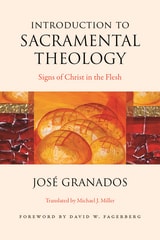
cover of Introduction to Sacramental Theology: Signs of Christ in the Flesh

Introduction to Sacramental Theology

Signs of Christ in the Flesh

Jose Granados

Catholic University of America Press, 2021
Introduction to Sacramental Theology presents a complete overview of sacramental theology from the viewpoint of the body. This viewpoint is supported, in the first place, by Revelation, for which the sacraments are the place where we enter into contact with the body of the risen Jesus. It is a viewpoint, secondly, which is firmly rooted in our concrete human bodily experience, thus allowing for a strong connection between faith and life, creation and redemption. From this point of view, the treatise on the sacraments occupies a strategic role. For the sacraments appear, not as the last of a series of topics (after dealing with Creation, Christ, the Church), but as the original place in which to stand in order to contemplate the entire Christian mystery. This point of view of the body, which resonates with contemporary philosophy, sheds fruitful light on classical themes, such as the relationship of the sacraments with creation, the composition of the sacramental sign, the efficacy of the sacraments, the sacramental character, the role of the minister, or the relationship of the sacrament with the Church as a sacrament. As a result of this approach, the Eucharist takes on a central role, since this is the sacrament where the body of Jesus is made present. The rest of the sacraments are seen as prolongations of the eucharistic body, so as to fill all the time and space of the faithful. This foundation of the theology of the sacraments in eucharistic theology is supported by an analysis of the patristic and medieval tradition. In order to support its conclusions, Introduction to Sacramental Theology examines the doctrine of Scripture (especially St. John and St. Paul), the main patristic and medieval authors (St. Augustine, Hugh of St. Victor, St. Bonaventure, St. Thomas Aquinas), the response of Trent to the protestant challenges, up to modern authors such as Scheeben, Rahner, Ratzinger, or Chauvet, including the teaching of Vatican II about the Church as a kind of sacrament.
[more]
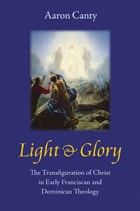
cover of Light and Glory: The Transfiguration of Christ in Early Franciscan and Dominican Theology

Light and Glory

The Transfiguration of Christ in Early Franciscan and Dominican Theology

Aaron Canty

Catholic University of America Press, 2011
Light and Glory offers an engaging comparison of the teachings of seven thirteenth-century theologians -- three Franciscans and four Dominicans -- on the subject of the transfiguration of Christ.
[more]
cover of Mel Gibson's Bible: Religion, Popular Culture, and "The Passion of the Christ"

Mel Gibson's Bible

Religion, Popular Culture, and "The Passion of the Christ"

Edited by Timothy K. Beal and Tod Linafelt

University of Chicago Press, 2005

The Passion of the Christ was an extraordinary media event. But the film has also, and more importantly, been a religious phenomenon. Mel Gibson's professed intent was to create not just a cinematic experience but a spiritual one. And he has succeeded for many moviegoers, most notably evangelical Christians, of whom millions have embraced the film as a presentation of Holy Scripture, a twenty-first century incarnation of the Word.

In this volume, biblical scholars Timothy K. Beal and Tod Linafelt—along with an esteemed group of contributors—offer a provocative range of views on The Passion of the Christ. Their book is organized in three parts. The first analyzes the film in terms of its religious foundations, including the Gospels and nonbiblical religious texts: What are the film's literary sources and how does it use them? In what ways does the medium of film require a radically different way of representing gospel narrative? The second group of essays focuses on the ethical and theological implications of the film's presentation of the Christian gospel: What do we make of its representations of female sexuality? What are the implications of focusing on the Passion in terms of atonement rather than social justice? Finally, the third section explores the film as a pop cultural phenomenon: How has the film worked to create a sense of insider status for some and alienated so many others? What can we learn about the religious dimensions of contemporary mass culture from the film's reception?

Whether one is inspired or appalled by The Passion of the Christ, there can be no question that it is a defining moment in the cultural afterlife of the Bible. This volume tries to make sense of that moment and will prove to be a touchstone for adherents and detractors of the film alike.
[more]
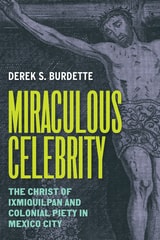
cover of Miraculous Celebrity: The Christ of Ixmiquilpan and Colonial Piety in Mexico City

Miraculous Celebrity

The Christ of Ixmiquilpan and Colonial Piety in Mexico City

Derek S. Burdette

University of Texas Press, 2025

A study of the Christ of Ixmiquilpan, a historically beloved religious icon from sixteenth-century Mexico, and its evolving cultural importance.

The life-sized crucifix known as the Christ of Ixmiquilpan (also the Señor de Santa Teresa) was one of the most important artworks in colonial Mexico. The statue began as an ordinary devotional image, but in 1621 devotees witnessed it undergo a miraculous renovation that gave it a supernatural beauty. Over the next two and half centuries, its perceived power increased until it was surpassed in importance only by the Virgin of Guadalupe. Despite its historical significance, the Christ of Ixmiquilpan’s history has yet to be fully told.

Derek Burdette brings the miraculous crucifix out of the shadows and explores its instrumental role in shaping the devotional culture of New Spain. Following the arc of the statue’s life, he chronicles the story of the statue’s creation, miraculous renovation, and subsequent veneration at the heart of Mexico City. He also reveals how colonial politics were woven into the statue’s life from the very start. Reconstructing the history of a key artwork, Miraculous Celebrity sheds new light on the intersection of art, faith, and politics in the Spanish colonial world.
[more]
cover of Principles of Catholic Theology, Book 3: On God, Trinity, Creation, and Christ

Principles of Catholic Theology, Book 3

On God, Trinity, Creation, and Christ

Thomas Joseph White

Catholic University of America Press, 2024
What if anything can human beings know about God, either by way of philosophical reasoning or by divine revelation? How does the mystery of the Incarnation illuminate our understanding of the nature and mystery of God and the nature and destiny of the human person? The essays in this book explore topics pertaining to the nature of God, apophatic theology, divine simplicity and the holy Trinity, divine beauty, and the beauty of creation. The book also contains a series of speculative considerations of Christology: Why did God become human? How ought we understand the two natures of Christ and the topic of the communication of idioms (attribution of both divine and human properties to one person)? There is also a sustained treatment of Jesus' human knowledge and voluntary freedom. Did Jesus understand his own lordship and his unity with the Father and the Holy Spirit, and if so, how? Did Christ's human will always accord with the divine will, and what significance does this idea have for our understanding of the redemption affected by Christ for the whole human race? Through these explorations, principles drawn from Thomas Aquinas and from Thomistic tradition are taken into account as key resources for the adjudication of contemporary theological challenges. Principles of Catholic Theology, Book 3 is a continuation of Fr. Thomas Joseph White's collection of essays, extending over a range of fundamental topics in Catholic dogmatic theology.
[more]
cover of Putting on Christ: Augustine's Early Theology of Salvation and the Sacraments

Putting on Christ

Augustine's Early Theology of Salvation and the Sacraments

Ty Paul Monroe

Catholic University of America Press, 2022
Putting on Christ aims to situate Augustine’s early soteriology and sacramental theology within the context of his personal history and intellectual development. Beginning with an extended analysis of the theology of salvation and sacramental efficacy contained within Augustine’s Confessions (ca. 400), the study then traces the maturation of his views on these matters, beginning with his earliest extant works, the Cassicacum dialogues (ca. 386). The journey entails treating Augustine’s earliest discussions of Christ’s person and his saving work, as well as the believer’s subjective experience of conversion and salvation. As Augustine’s corpus shifts from philosophical dialogues to explicitly apologetic and scriptural-exegetical works, so too does his soteriological lexicon expand to include concepts and terms that will later become his stock-in-trade, such as the virtue of humilitas. And as his roles in the North African Church come to include participation in the presbyterate and the episcopacy, so too does his engagement expand to a wider set of polemical contexts, both anti-Manichaean and anti-Donatist. Putting on Christ tracks these and many other aspects of Augustine’s maturing thought, showing where lines of both continuity and development lie and aiming to uncover their reasons. In doing so, it reveals Augustine to be a thinker and a teacher who continued to hone his understanding of salvation, the very heartbeat of Christian life and thought, as well as its relation to various other aspects of the Christian theological worldview, from Christology and anthropology to sacramental theology and ecclesiology.
[more]
cover of Sex, Christ, and Embodied Cognition: Paul's Wisdom for Corinth

Sex, Christ, and Embodied Cognition

Paul's Wisdom for Corinth

Robert H. von Thaden Jr.

SBL Press, 2017

A sociorhetorical analysis of First Corinthians

Robert H. von Thaden Jr.'s sociorhetorical analysis examines Paul's construction of sexual Christian bodies in First Corinthians by utilizing new insights from conceptual integration (blending) theory about the embodied processes of meaning making. Paul's teaching about proper sexual behavior in this letter is best viewed as an example of early Christian wisdom discourse. This discourse draws upon apocalyptic and priestly cognitive frames to increase the rhetorical force of the argument. Reading Paul's argument through the lens of rhetorical invention, von Thaden demonstrates that Paul first attempts to show the Corinthians why sexual immorality is the worst of all bodily sins before shifting rhetorical focus to explain to them how they can best avoid this infraction against the body of Christ.

Features:

  • A programmatic application of conceptual integration theory using a sociorhetorical mode of interpretation
  • A vivid account of key aspects of conceptual integration theory and how they function in sociorhetorical interpretation
  • A detailed application of these strategies to interpret 1 Corinthians 1-4; 6:12-7:7
[more]
cover of The Christology of Erasmus: Christ, Humanity, and Peace

The Christology of Erasmus

Christ, Humanity, and Peace

Terence J. Martin

Catholic University of America Press, 2024
Nothing is more central to the religious thinking of Erasmus of Rotterdam than the reality of Christ—in his eyes, that supreme revelation of divine mercy embodied in the life of Jesus of Nazareth to which Christian scriptures variously testify, but also the divine presence undergirding that life-centering ethic of love and peace, what Erasmus calls the “philosophy of Christ.” The purpose of this book is to distill the Christological elements from his vast corpus in a manner that shows the range, coherence, and value of Erasmus’ thinking on Christological questions. While Erasmus works within the broad parameters of orthodox teaching, his critical skills with languages, accent on rhetoric in theology, keen sense of irony, appreciation for the limits of human knowledge, incipient sense of history, emphasis on the welfare of humanity, and passionate defense of peace, give his work a distinctive stamp and thereby make a singular contribution to the history of Christology. What Erasmus contributes to discussions of the divinity of Christ is a counsel of restraint in metaphysical speculation, an accent on the revelatory breadth of the eternal Word of God, and an invitation to think of Christ incarnate as the eloquent oration of God. But the central impulse of the Christology of Erasmus is the affirmation of the full incarnation of Christ in human existence, abstaining as much as possible from docetic insulation of the divine from the struggles of human experience, in order to highlight the redemptive capacity of Christ for the transformation of human life. With that, the ethical capstone of Erasmus’ reflections on Christ centers on the responsibility to imitate Christ’s love for others, and thus for advancing the cause of peace in personal and social life. This books adds the voice of this remarkable Catholic humanist to the history of theological discussions in the early modern era, while also restoring its rightful place in the broader history of Christology.
[more]
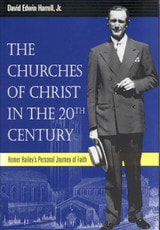
cover of The Churches of Christ in the 20th Century: Homer Hailey's Personal Journey of Faith

The Churches of Christ in the 20th Century

Homer Hailey's Personal Journey of Faith

David Edwin Harrell

University of Alabama Press, 2002

The story of one of this country's major religious movements is told through the spiritual odyssey of one of its prominent spokesmen. 

When Homer Hailey sparked controversy within Churches of Christ congregations over his stand on divorce and remarriage, he spoke to a movement already sundered. Historian David Edwin Harrell tells Hailey's story as a means of presenting the larger drama of faith and feuding within those churches.

A nondenominational movement of autonomous congregations, Churches of Christ have been among the fastest-growing religious bodies in the 20th century. Throughout the movement's history, church leaders debated issues ranging from missionary societies to the use of instrumental music in worship. Although some disagreements affected only the ties between congregations, others led to the creation of three distinct groups calling themselves Churches of Christ identified by their sociological and theological positions. 

This book shows how the story of the Churches of Christ is reflected by Homer Hailey, a preacher, educator, and author whose life puts in perspective the personal journeys traveled by members in this century. Writing from the perspective of the non-institutional wing within the movement, Harrell avoids mainstream biases to describe the various dissenting views as fully and fairly as possible.

Combining institutional history and biography, Harrell's book is the first to bring the story of the Churches of Christ to century's end. It provides new insight into how this movement realigned itself and shows how one man's career reflected a century of spiritual growth and change for the church as a whole.


[more]
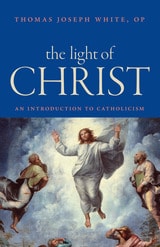
cover of The Light of Christ: An Introduction to Catholicism

The Light of Christ

An Introduction to Catholicism

Thomas Joseph White, OP

Catholic University of America Press, 2017

The Light of Christ provides an accessible presentation of Catholicism that is grounded in traditional theology, but engaged with a host of contemporary questions or objections. Inspired by the theologies of Iranaeus, Thomas Aquinas and John Henry Newman, and rooted in a post-Vatican II context, Fr. Thomas Joseph White presents major doctrines of the Christian religion in a way that is comprehensible for non-specialists: knowledge of God, the mystery of the Trinity, the Incarnation and the atonement, the sacraments and the moral life, eschatology and prayer.

At the same time, The Light of Christ also addresses topics such as evolution, the modern historical study of Jesus and the Bible, and objections to Catholic moral teaching. Touching on the concerns of contemporary readers, Fr. White examines questions such as whether Christianity is compatible with the findings of the modern sciences, do historical Jesus studies disrupt or confirm the teaching of the faith, and does history confirm the antiquity of Catholic claims.

This book serves as an excellent introduction for young professionals with no specialized background in theology who are interested in learning more about Catholicism, or as an introduction to Catholic theology. It will also serve as a helpful text for theology courses in a university context.

As Fr. White states in the book’s introduction: “This is a book that offers itself as a companion. I do not presume to argue the reader into the truths of the Catholic faith, though I will make arguments. My goal is to make explicit in a few broad strokes the shape of Catholicism. I hope to outline its inherent intelligibility or form as a mystery that is at once visible and invisible, ancient and contemporary, mystical and reasonable.”
[more]
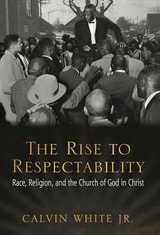
cover of The Rise to Respectability: Race, Religion, and the Church of God in Christ

The Rise to Respectability

Race, Religion, and the Church of God in Christ

Calvin White

University of Arkansas Press, 2015
The Rise to Respectability documents the history of the Church of God in Christ (COGIC) and examines its cultural and religious impact on African Americans and on the history of the South. It explores the ways in which Charles Harrison Mason, the son of slaves and founder of COGIC, embraced a Pentecostal faith that celebrated charismatic forms of religious expression that many blacks had come to view as outdated, unsophisticated, and embarrassing. While examining the intersection of race, religion, and class, The Rise to Respectability details how the denomination dealt with the stringent standard of bourgeois behavior imposed on churchgoers as they moved from southern rural areas into the urban centers in both the South and North. Rooted in the hardships of slavery and coming of age during Jim Crow, COGIC's story is more than a religious debate. Rather, this book sees the history of the church as interwoven with the Great Migration, the struggle for modernity, class tension, and racial animosity--all representative parts of the African American experience.
[more]
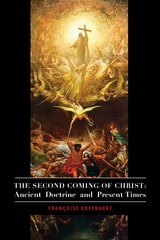
cover of The Second Coming of Christ: Ancient Doctrine and Present Times

The Second Coming of Christ

Ancient Doctrine and Present Times

Françoise Breynaert

St. Augustine's Press, 2022

Compelling theological questions converge with contemporary concerns in Françoise Breynaert's exposition of the doctrine surrounding Christ's second coming. Why must Christ come again? What will become of this earth as the dominion of man is more and more power concentrated in the hands of the few? Ideologies associated with the pursuit of power promise salvation––of the world, the planet, of humanity itself––through politics, technology, and science. But Breynaert draws answers to both questions instead from Scripture and with this book prepares us for what lies ahead. She points to the spiritual journey that is humanity's true destiny, along which man will encounter the temptation to accept the claims of power and its promises of fulfillment in this life, and the traps laid for the man who does not wish to be challenged for the victory of his soul. Breynaert's account of the second coming and the false promises of today's world also remind us of the assurances given in Scripture for mercy and triumph, an optimism that offers much needed strength of spirit. 

The great mystery of Christ's second coming is part of the core of Christian faith. And at long last, here is a book that explains what this truly means. And in doing so, we come to know the revealed meaning of history, which has nourished the hope of Christians through the ages. 
[more]
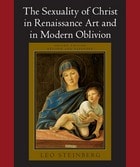
cover of The Sexuality of Christ in Renaissance Art and in Modern Oblivion

The Sexuality of Christ in Renaissance Art and in Modern Oblivion

Leo Steinberg

University of Chicago Press, 1996

Originally published in 1983, Leo Steinberg's classic work has changed the viewing habits of a generation. After centuries of repression and censorship, the sexual component in thousands of revered icons of Christ is restored to visibility. Steinberg's evidence resides in the imagery of the overtly sexed Christ, in Infancy and again after death. Steinberg argues that the artists regarded the deliberate exposure of Christ's genitalia as an affirmation of kinship with the human condition. Christ's lifelong virginity, understood as potency under check, and the first offer of blood in the circumcision, both required acknowledgment of the genital organ. More than exercises in realism, these unabashed images underscore the crucial theological import of the Incarnation. 

This revised and greatly expanded edition not only adduces new visual evidence, but deepens the theological argument and engages the controversy aroused by the book's first publication.
[more]
cover of To Be a Friend of Christ: The Life of Marion D. Hanks

To Be a Friend of Christ

The Life of Marion D. Hanks

Hanks, Richard D.

Signature Books, 2024

Marion Duff Hanks (1921–2011) was one of the most beloved and influential leaders of the Church of Jesus Christ of Latter-day Saints in the twentieth century, serving as a General Authority (senior leader) for forty years. He was also a leader of national import. As a recognized expert on youth, five US presidents appointed him to their President’s Council on Physical Fitness and Sports. Hanks also served as an executive leader of Rotary International and the Boy Scouts of America.

Author Richard Hanks draws on previously unavailable primary sources—journals, correspondence, notebooks, and recordings—to share this first and only authorized biography of his father. Hanks traces his father’s influence as he advocated for numerous changes in the institutional church, including humanitarian efforts, refugee relief services, missionary community service, a focus on mercy for the sinner, and a churchwide emphasis on “coming unto Christ.” A Renaissance man, Duff Hanks felt comfortable mingling with presidents and world leaders and speaking from pulpits and podiums to huge audiences and on television. But he found his greatest joy in assisting the individual, encouraging each in their personal search for happiness. Once, when asked about his goals, he replied, “My strongest desire is to qualify to be a friend of Christ.”
[more]
cover of To Be a Friend of Christ: The Life of Marion D. Hanks

To Be a Friend of Christ

The Life of Marion D. Hanks

Hanks, Richard D.

Signature Books, 2025

Marion Duff Hanks (1921–2011) was one of the most beloved and influential leaders of the Church of Jesus Christ of Latter-day Saints in the twentieth century, serving as a General Authority (senior leader) for forty years. He was also a leader of national import. As a recognized expert on youth, five US presidents appointed him to their President’s Council on Physical Fitness and Sports. Hanks also served as an executive leader of Rotary International and the Boy Scouts of America.

Author Richard Hanks draws on previously unavailable primary sources—journals, correspondence, notebooks, and recordings—to share this first and only authorized biography of his father. Hanks traces his father’s influence as he advocated for numerous changes in the institutional church, including humanitarian efforts, refugee relief services, missionary community service, a focus on mercy for the sinner, and a churchwide emphasis on “coming unto Christ.” A Renaissance man, Duff Hanks felt comfortable mingling with presidents and world leaders and speaking from pulpits and podiums to huge audiences and on television. But he found his greatest joy in assisting the individual, encouraging each in their personal search for happiness. Once, when asked about his goals, he replied, “My strongest desire is to qualify to be a friend of Christ.”

[more]
cover of Transformed in Christ

Transformed in Christ

John S. Grabowski

Catholic University of America Press, 2017
[more]
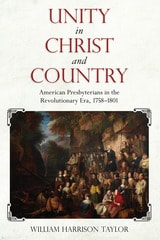
cover of Unity in Christ and Country: American Presbyterians in the Revolutionary Era, 1758–1801

Unity in Christ and Country

American Presbyterians in the Revolutionary Era, 1758–1801

William Harrison Taylor

University of Alabama Press, 2017

Examines the interdenominational pursuits of the American Presbyterian Church from 1758 to 1801

In Unity in Christ and Country: American Presbyterians in the Revolutionary Era, 1758–1801, William Harrison Taylor investigates the American Presbyterian Church’s pursuit of Christian unity and demonstrates how, through this effort, the church helped to shape the issues that gripped the American imagination, including evangelism, the conflict with Great Britain, slavery, nationalism, and sectionalism. When the colonial Presbyterian Church reunited in 1758, a nearly twenty-year schism was brought to an end. To aid in reconciling the factions, church leaders called for Presbyterians to work more closely with other Christian denominations. Their ultimate goal was to heal divisions, not just within their own faith but also within colonial North America as a whole.
 
Taylor contends that a self-imposed interdenominational transformation began in the American Presbyterian Church upon its reunion in 1758. However, this process was altered by the church’s experience during the American Revolution, which resulted in goals of Christian unity that had both spiritual and national objectives. Nonetheless, by the end of the century, even as the leaders in the Presbyterian Church strove for unity in Christ and country, fissures began to develop in the church that would one day divide it and further the sectional rift that would lead to the Civil War.
 
Taylor engages a variety of sources, including the published and unpublished works of both the Synods of New York and Philadelphia and the General Assembly of the Presbyterian Church in the United States, as well as numerous published and unpublished Presbyterian sermons, lectures, hymnals, poetry, and letters. Scholars of religious history, particularly those interested in the Reformed tradition, and specifically Presbyterianism, should find Unity in Christ and Country useful as a way to consider the importance of the theology’s intellectual and pragmatic implications for members of the faith.
[more]
cover of Unity in Christ: Bishops, Synodality, and Communion

Unity in Christ

Bishops, Synodality, and Communion

Archbishop Anthony Fisher, OP

Catholic University of America Press, 2023
What does episcopal fraternity and communio look like? This central question is explored through the erudition and experience of Archbishop Anthony Fisher, Catholic Archbishop of Sydney, Australia. Unity in Christ, based upon a series of addresses given to the United States Conference of Catholic Bishops (USCCB) at their Special Assembly in 2022, delves into the themes associated with episcopal unity. By surveying the Christian tradition, beginning with the scriptures and then through various periods (Apostolic generation, patristic, scholastic, Vatican II, recent post Vatican II developments such as synodality) a coherent picture of episcopal togetherness is presented. What becomes clear is that unity among Christ’s disciples and their successors is not simply an ideal but rather a constitutive element of their office. They are called to love as Christ loved, expressed above all through genuine friendship with one another. The consequences of this fraternity and communio have implications in areas such as spirituality, preaching and fraternal correction, among others. This second feature, the implications of episcopal fraternity and communio, are explored through Archbishop Fisher’s twenty years of experience as a bishop of the Catholic Church. By providing concrete examples of lived episcopal fraternity and communio, Fisher offers a glimpse into both the challenges and fruits of living out Christ’s call that "they might all be one" (Jn 17:21).
[more]
cover of Whose Sacrifice is the Eucharist? The Offering of Christ and His Church in Catholic and Methodist Theology

Whose Sacrifice is the Eucharist? The Offering of Christ and His Church in Catholic and Methodist Theology

Stephen B. Sours

Catholic University of America Press, 2024

This book explores what Catholics and Methodists believe about eucharistic sacrifice. Eucharistic sacrifice refers to the offering that Christ and his church make in the celebration of the Lord’s Supper. It is, therefore, both a Christian doctrine and a church practice. The sacrificial dimension of the sacrament comes both from Christ’s sacrifice on the cross and from his self-offering at the Last Supper in which Christ gives himself to the Father on behalf of his people. “This is my body, which is given for you” (Luke 22:19). The eucharist is a sacrificial meal because in the bread and cup Christians are united to the body and blood of Christ that was sacrificed for them on the cross. Moreover, the resurrected Lord is really present with his people in the eucharist, and while his historic crucifixion is an event in the past, Jesus’ salvation continues and his grace is given to his people in the sacrament, “for this is my blood of the covenant, which is poured out for many for the forgiveness of sins” (Matthew 26:28). Catholics and Methodists believe that Jesus instructs his followers to repeat his words and actions from the Last Supper in their celebration of the eucharist, but a long running assumption is that Catholics and Methodists—following the historic Reformation schism—are deeply divided over eucharistic sacrifice. This book challenges that assumption by analyzing what these churches teach on eucharistic sacrifice from historical, sacramental, liturgical, and ecumenical perspectives. Key figures like Thomas Aquinas and John Wesley help define eucharistic sacrifice in each tradition. Subsequently, authoritative texts such as ecclesial statements, eucharistic prayers, and hymns further specify what Catholics and Methodists believe they are doing when they offer the eucharist to God. Sours argues that far from being divided, Catholics and Methodists have much in common regarding this controversial doctrine.
[more]