Results by title
8 books match the query 'Christian conservatism'
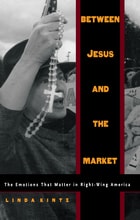
Between Jesus and the Market
The Emotions that Matter in Right-Wing AmericaLinda Kintz
Duke University Press, 1997
With texts from such organizations as the Christian Coalition, the Heritage Foundation, and Concerned Women for America, and writings by Elizabeth Dole, Newt Gingrich, Pat Robertson, and Rush Limbaugh, Kintz traces the usefulness of this activism for the secular claim that conservative political economy is, in fact, simply an expression of the deepest and most admirable elements of human nature itself. The discussion of Limbaugh shows how he draws on the skepticism of contemporary culture to create a sense of absolute truth within his own media performance—its truth guaranteed by the market. Kintz also describes how conservative interpretations of the Holy Scriptures, the U.S. Constitution, and the Declaration of Independence have been used to challenge causes such as feminism, women’s reproductive rights, and gay and lesbian rights. In addition to critiquing the intellectual and political left for underestimating the power of right-wing grassroots organizing, corporate interests, and postmodern media sophistication, Between Jesus and the Market discusses the proliferation of militia groups, Christian entrepreneurship, and the explosive growth and "selling" of the Promise Keepers.

Born Again
The Christian Right GlobalizedJennifer S. Butler
Pluto Press, 2006
This book reveals how Christian conservative groups are able to shape policy in every corner of the world. Drawing on interviews with religious leaders, it reveals how today's most powerful Christian Right organisations are building interfaith coalitions, connecting Catholic, Mormon and Muslim allies to advance a conservative agenda.
The US under Bush Jr. has given them a significant voice in shaping US policy on issues including women's rights, reproductive health, human cloning, children's rights and AIDS.
In short, the Christian Right is globalising -- a phenomenon that promises to challenge progressive social policy on a world-wide scale - as well as transform the Christian Right itself.
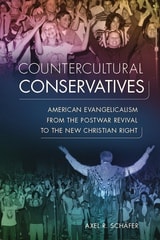
Countercultural Conservatives
American Evangelicalism from the Postwar Revival to the New Christian RightAxel R. Schäfer
University of Wisconsin Press, 2012
In the mid-twentieth century, far more evangelicals supported such “liberal” causes as peace, social justice, and environmental protection. Only gradually did the conservative evangelical faction win dominance, allying with the Republican Party of Ronald Reagan and, eventually, George W. Bush.
In Countercultural Conservatives Axel Schäfer traces the evolution of a diffuse and pluralistic movement into the political force of the New Christian Right. In forging its complex theological and political identity, evangelicalism did not simply reject the ideas of 1960s counterculture, Schäfer argues. For all their strict Biblicism and uncompromising morality, evangelicals absorbed and extended key aspects of the countercultural worldview.
Carefully examining evangelicalism’s internal dynamics, fissures, and coalitions, this book offers an intriguing reinterpretation of the most important development in American religion and politics since World War II.
Evangelical News
Politics, Gender, and Bioethics in Conservative Christian Magazines of the 1970s and 1980sAnja-Maria Bassimir
University of Alabama Press, 2022
A comprehensive study of evangelical magazine discourse during the 1970s and 1980s and how it navigated and sustained religious convictions in a time of dramatic social change
The 1970s and 1980s were a tumultuous period in US history. In tandem with a dramatic political shift to the right, evangelicalism also entered the public discourse as a distinct religious movement and was immediately besieged by cultural appropriations and internal fragmentations. Americans in general and evangelicals in particular grappled with issues and ideas such as feminism, abortion, birth control, and restructuring traditional roles for women and the family. During this time, there was a surge in readership for evangelical periodicals such as Christianity Today, Moody Monthly, Eternity, and Post-Americans/Sojourners as well as the feminist newsletter Daughters of Sarah.
While each of these magazines—and other publications and media—contributed to and participated in the overall dissemination of evangelical ideology, they also had their own outlooks and political leanings concerning hot-button issues. In Evangelical News: Politics, Gender, and Bioethics in Conservative Christian Magazines of the 1970s and 1980s, Anja-Maria Bassimir presents a nuanced view of evangelicalism in the late twentieth century through the lens of the movement’s own media.
Bassimir argues that community can be produced in discourse, especially when shared rhetoric, concepts, and perspectives signal belonging. To accomplish this, Evangelical News traces the emergence of evangelical social and political awareness in the 1970s to the height of its power as a political program. The chapters investigate such topics as how evangelicals reenvisioned gender norms and relations in light of the feminist movement, the use of childhood as a symbol of unspoiled innocence, and the place of evangelicals as political actors.

Globalizing Family Values
The Christian Right In International PoliticsDoris Buss
University of Minnesota Press, 2003
A timely exposé of the efforts of the religious right to influence global policy
With little fanfare and profound effect, “family values” have gone global, and the influence of the Christian Right is increasingly felt internationally. This is the first comprehensive study of the Christian Right’s global reach and its impact on international law and politics.
Doris Buss and Didi Herman explore tensions, contradictions, victories, and defeats for the Christian Right’s global project, particularly in the United Nations. The authors consult Christian Right materials, from pamphlets to novels; conduct interviews with people in the movement; and provide a firsthand account of the World Congress of Families II in 1999, a key event in formulating Christian Right global policy and strategy. The result is a detailed look at a new global player—its campaigns against women’s rights, population policy, and gay and lesbian rights; its efforts to build an alliance of orthodox faiths with non-Christians; and the tensions and strains as it seeks to negotiate a role for conservative Christianity in a changing global order.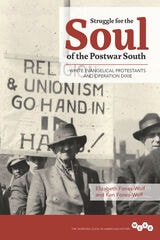
Struggle for the Soul of the Postwar South
White Evangelical Protestants and Operation DixieElizabeth Fones-Wolf and Ken Fones-Wolf
University of Illinois Press, 2015
The authors' nuanced look at working class religion reveals how laborers across the surprisingly wide evangelical spectrum interpreted their lives through their faith. Factors like conscience, community need, and lived experience led individual preachers to become union activists and mill villagers to defy the foreman and minister alike to listen to organizers. As the authors show, however, all sides enlisted belief in the battle. In the end, the inability of northern organizers to overcome the suspicion with which many evangelicals viewed modernity played a key role in Operation Dixie's failure, with repercussions for labor and liberalism that are still being felt today.
Identifying the role of the sacred in the struggle for southern economic justice, and placing class as a central aspect in southern religion, Struggle for the Soul of the Postwar South provides new understandings of how whites in the region wrestled with the options available to them during a crucial period of change and possibility.
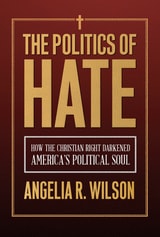
The Politics of Hate
How the Christian Right Darkened America's Political SoulAngelia R. Wilson
Temple University Press, 2025
Based on original research, participant observation at events, and data collection, Wilson follows the money to provide a meticulous analysis of how Christian Right political elites operate. She traces the evolutionary development of the Christian Right’s political professionalism and their allegiance to a grand vision that articulates a grammar of war to fulfill their Biblical worldview.
The Politics of Hate demonstrates how Christian Right organizations educate and train networks of soldiers to tactically engage the enemy in local, state, and national legal and political battles. Wilson carefully documents their history of co-belligerency, their strategies of political warfare, and, importantly, the impact of this war that has, over the past fifty years, forever changed American politics.
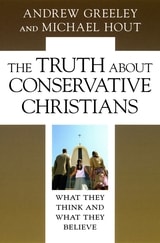
The Truth about Conservative Christians
What They Think and What They BelieveAndrew M. Greeley and Michael Hout
University of Chicago Press, 2006
Ever since the reelection of President Bush, conservative Christians have been stereotyped in the popular media: Bible-thumping militants and anti-intellectual zealots determined to impose their convictions on such matters as evolution, school prayer, pornography, abortion, and homosexuality on the rest of us. But conservative Christians are not as fanatical or intractable as many people think, nor are they necessarily the monolithic voting block or political base that kept Bush in power.
Andrew M. Greeley and Michael Hout's eye-opening book expertly conveys the complexity, variety, and sensibilities of conservative Christians, dispelling the myths that have long shrouded them in prejudice and political bias. For starters, Greeley and Hout reveal that class and income have trumped moral issues for these Americans more often than we realize: a dramatic majority of working-class and lower-class conservative Christians backed liberals such as Jimmy Carter and Bill Clinton during their runs for president. And when it comes to abortion, most conservative Christians are not consistently pro-life in the absolute fashion usually assumed: they are still more likely to oppose the practice than other Americans, but 86 percent of them are willing to tolerate it to protect the health of the mother or when the woman has been raped, and 22 percent of them are even pro-choice.
What do conservative Christians really think about evolution, homosexuality, or even the meaning of the word of God? Answering these questions and more, The Truth about Conservative Christians will interest—and surprise—a broad range of readers, especially in this heated election year.