Results by title

5 books match the query 'Christian heresies'
cover of Ancoratus

Ancoratus

Epiphanius of Cyprus

Catholic University of America Press, 2014
Epiphanius of Cyprus was lead bishop of the island from 367 until his death in 403, and he was a contemporary of several of the great church fathers of the patristic era, including Athanasius, Basil, and Jerome. He is well known among modern scholars for his monumental heresiology, the Panarion, as well as for his involvement in several ecclesiastical and theological controversies. Before he began to write his magnum opus, however, he had already completed the Ancoratus, an important theological treatise, written in the form of a letter to Christians in southern Anatolia. The Ancoratus addressed numerous theological issues, particularly in response to the continuous disputes about the divinity of the Son, the developing arguments over the divinity of the Holy Spirit, and the early quarrels over the Incarnation of Christ. In addition, he included his thoughts on proper biblical exegesis, the problematic theology of Origen, and the relationship of the Christian faith with Hellenistic culture. Epiphanius's convictions on these issues represented important contributions to the ongoing theological and cultural controversies of the late fourth century, but he has often been overshadowed in modern scholarship by the work of his more illustrious contemporaries. Because there has been no complete English translation of the Ancoratus to date, this volume adds significantly to the resources available for patristic studies.
[more]
cover of Refutation of All Heresies

Refutation of All Heresies

M. David Litwa

SBL Press, 2016

A reliable, readable translation for scholars and students

The Refutation of All Heresies (ca. 225 CE) is a treasure-trove of ancient philosophy, astrology, medicine, magic, Gnostic thought, numerology, heresiography, ecclesial politics, and early Christian studies in general. Offered here for the first time in almost a century is a full English translation, along with a newly-edited Greek text, extensive notes, and a thorough introduction.

Features:

  • A full English translation with extensive notes
  • Newly edited Greek text that avoids the pitfalls of the most recent edition
  • A thorough-going introduction that addresses the questions of authorship, date, and audience, as well as the purpose of the book, its organization, method, and importance for Gnostic studies
[more]
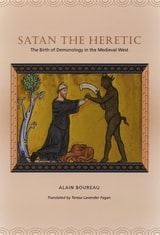
cover of Satan the Heretic: The Birth of Demonology in the Medieval West

Satan the Heretic

The Birth of Demonology in the Medieval West

Alain Boureau

University of Chicago Press, 2006

Before the end of the thirteenth century, theologians had little interest in demons, but with Thomas Aquinas and his formidable “Treatise on Evil” in 1272, everything changed. In Satan the Heretic, Alain Boureau trains his skeptical eye not on Satan or Satanism, but on the birth of demonology and the sudden belief in the power of demons who inhabited Satan’s Court, setting out to understand not why people believed in demons, but why theologians—especially Pope John XXII—became so interested in the subject.

Depicting this new demonology, Satan the Heretic considers the period between the mid-thirteenth and mid-fourteenth centuries when demons, in the eyes of Church authorities, suddenly burst forth, more real and more terrifying than ever before in the history of Christianity. Boureau argues that the rise in this obsession with demons occurs at the crossroads of the rise of sovereignties and of the individual, a rise that, tellingly, also coincides with the emergence of the modern legal system in the European West.

Teeming with original insights and lively anecdotes, Satan the Heretic is a significant contribution to the history of Christian demonology from one of the most original minds in the field of medieval studies today. 
[more]
cover of The Inner Lives of Medieval Inquisitors

The Inner Lives of Medieval Inquisitors

Karen Sullivan

University of Chicago Press, 2011

There have been numerous studies in recent decades of the medieval inquisitions, most emphasizing larger social and political circumstances and neglecting the role of the inquisitors themselves. In this volume, Karen Sullivan sheds much-needed light on these individuals and reveals that they had choices—both the choice of whether to play a part in the orthodox repression of heresy and, more frequently, the choice of whether to approach heretics with zeal or with charity.


In successive chapters on key figures in the Middle Ages—Bernard of Clairvaux, Dominic Guzmán, Conrad of Marburg, Peter of Verona, Bernard Gui, Bernard Délicieux, and Nicholas Eymerich—Sullivan shows that it is possible to discern each inquisitor making personal, moral choices as to what course of action he would take. All medieval clerics recognized that the church should first attempt to correct heretics through repeated admonitions and that, if these admonitions failed, it should then move toward excluding them from society. Yet more charitable clerics preferred to wait for conversion, while zealous clerics preferred not to delay too long before sending heretics to the stake. By considering not the external prosecution of heretics during the Middles Ages, but the internal motivations of the preachers and inquisitors who pursued them, as represented in their writings and in those of their peers, The Inner Lives of Medieval Inquisitors explores how it is that the most idealistic of purposes can lead to the justification of such dark ends.
[more]
cover of The Opuscula and the Dispute with Pyrrhus: The Theological and Polemical Works

The Opuscula and the Dispute with Pyrrhus

The Theological and Polemical Works

Kevin M. St. Maximus the Confessor

Catholic University of America Press, 2026

Maximus the Confessor (d. 662), regarded by certain of his contemporaries as a sword of division, has become a bridge between East and West in our time. He lived at a time of theological and political upheaval, coming under intense scrutiny from imperial authorities in the final decades of his life. His conflict with Constantinople led him to engage in a theological and polemical campaign to equip his associates around the Mediterranean to respond to certain innovative doctrines. Maximus saw these new teachings as disconnected from the thought of the approved Fathers and theologically linked with prior heresies. This volume contains significant theological and polemical works— The Small Theological and Polemical Works, also known as the Opuscula, and the Dispute with Pyrrhus—refuting monenergism and monotheletism, the notions that Christ had only one activity or only one will. The Small Theological and Polemical Works are offered here for the first time in a complete English translation, built upon critical scholarship from the past century with key additions from Sergey Epifanovich included. Regarded as the most iconic work associated with Maximus, the famed Dispute with Pyrrhus, the deposed Patriarch of Constantinople, took place in Carthage in July 645. The record of this dialogue reflects Maximus’s mature Christology, while it is also a noteworthy prelude to his journey to Rome, where he worked with Pope Martin at the 649 Lateran Synod, uniting their voices and sealing their fates.
[more]