Results by title
41 books match the query 'Christianity and culture'
A Reason Open to God
Pope Benedict XVI Brown
Catholic University of America Press, 2013
After Transformation
A Lyrical History of Christian Late AntiquityMaia Kotrosits
Duke University Press, 2025
America's Blessings
How Religion Benefits Everyone, Including AtheistsRodney Stark
Templeton Press, 2013
A few years ago, a debate between atheists and religious believers spilled out from the halls of academia and the pews of America’s churches and into the public spotlight. A crop of atheist manifestos led the charge, surmounting and holding the tops of the nonfiction bestseller lists. This debate brought on an outpouring of religious rebuttals as both sides exchanged spirited volleys, accusations were leveled; myths, stereotypes, and strawmen arguments were perpetuated; and bitter hostility filled the air. Today many of these misconceptions and myths linger on, along with the generally acrimonious spirit of the debate.
In America’s Blessings, distinguished researcher Rodney Stark seeks to clear the air of this hostility and debunk many of the debate’s most widely perpetuated misconceptions by drawing from an expansive pool of sociological findings. Stark rises above the fray and focuses exclusively on facts by examining the measurable effects of religious faith and practice on American society. His results may surprise many atheists and believers alike.
Starting with a historical overview, Stark traces America’s religious roots from the country’s founding to the present day, showing that religiosity in America has never been consistent, static, or monolithic. Interestingly, he finds that religious practice is now more prevalent than ever in America, despite any claims to the contrary. From here, Stark devotes whole chapters to unpacking the latest research on how religion affects the different facets of modern American life, including crime, family life, sexuality, mental and physical health, sophistication, charity, and overall prosperity. The cumulative effect is that when translated into comparisons with western European nations, the United States comes out on top again and again. Thanks in no small part to America’s rich religious culture, the nation has far lower crime rates, much higher levels of charitable giving, better health, stronger marriages, and less suicide, to note only a few of the benefits.
In the final chapter, Stark assesses the financial impact of these religious realities. It turns out that belief benefits the American economy—and all 300 million citizens, believers, and nonbelievers alike—by a conservative estimate of $2.6 trillion a year. Despite the atheist outcry against religion, the remarkable conclusion is clear: all Americans, from the most religious among us to our secular neighbors, really ought to count our blessings.
Beyond the Monastery Walls
The Ascetic Revolution in Russian Orthodox Thought, 1814–1914Patrick Lally Michelson
University of Wisconsin Press, 2017
Patrick Lally Michelson's intellectual history of asceticism in Russian Orthodox thought traces the development of these competing arguments from the early nineteenth century to the early months of World War I. He demonstrates that this discourse was an imaginative interpretation of lived Orthodoxy, primarily meant to satisfy the ideological needs of Russian thinkers and Orthodox intellectuals as they responded to the socioeconomic, political, and cultural challenges of modernity.
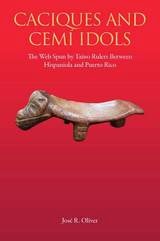
Caciques and Cemi Idols
The Web Spun by Taino Rulers Between Hispaniola and Puerto RicoJose R Oliver
University of Alabama Press, 2009
Cemís are both portable artifacts and embodiments of persons or spirit, which the Taínos and other natives of the Greater Antilles (ca. AD 1000-1550) regarded as numinous beings with supernatural or magic powers. This volume takes a close look at the relationship between humans and other (non-human) beings that are imbued with cemí power, specifically within the Taíno inter-island cultural sphere encompassing Puerto Rico and Hispaniola. The relationships address the important questions of identity and personhood of the cemí icons and their human “owners” and the implications of cemí gift-giving and gift-taking that sustains a complex web of relationships between caciques (chiefs) of Puerto Rico and Hispaniola.
Catholicism and Liberal Democracy
Forgotten Roots and Future ProspectsJames Martin Carr
Catholic University of America Press, 2022
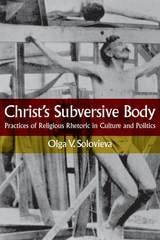
Christ's Subversive Body
Practices of Religious Rhetoric in Culture and PoliticsOlga V. Solovieva; Foreword by Haun Saussy
Northwestern University Press, 2018
Solovieva’s survey includes the iconoclastic polemics of Epiphanius at the moment of struggles for supremacy between the Roman state and the Christian church, the mystical theologico-political alchemy of an anonymous treatise circulated at the Council of Constance, Lavater’s counter-Enlightenment visions of the afterlife expressd through physiognomy, Dostoevsky’s refashioning of ethical communities, Pier Paolo Pasolini’s attempts to provoke the “scandal” of Jesus’s mission once more in the modern world, and the elaboration of a political theology subordinating democratic dissent to the higher unity of a corporately conceived “unitary executive” in early twenty-first-century America.
Solovieva presents her findings not as an entry into theological or Christological debates but rather as a study in comparative discourse analysis. She demonstrates how these uses of Christ’s body are triggered by moments of epistemological, political, and representational crisis in the history of Western civilization.
Christianity and European Culture (Selections from the Work of Christopher Dawson)
Christopher Dawson
Catholic University of America Press, 1998
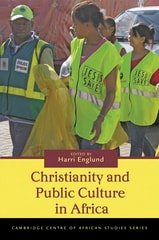
Christianity and Public Culture in Africa
Harri Englund
Ohio University Press, 2011
Christianity and Public Culture in Africa takes readers beyond familiar images of religious politicians and populations steeped in spirituality. It shows how critical reason and Christian convictions have combined in surprising ways as African Christians confront issues such as national constitutions, gender relations, and the continuing struggle with HIV/AIDS.
The wide-ranging essays included here explore rural Africa and the continent’s major cities, colonial and missionary legacies, and mass media images in the twenty-first century. They also reveal the diversity of Pentecostalism in Africa and highlight the region’s remarkable denominational diversity. Scholars and students alike will find these essays timely and impressive.
The contributors demonstrate how the public significance of Christianity varies across time and place. They explore rural Africa and the continent’s major cities, and colonial and missionary situations, as well as mass-mediated ideas and images in the twenty-first century. They also reveal the plurality of Pentecostalism in Africa and keep in view the continent’s continuing denominational diversity. Studentsand scholars will find these topical studies to be impressive in scope.
Contributors: Barbara M. Cooper, Harri Englund, Marja Hinfelaar, Nicholas Kamau-Goro, Birgit Meyer, Michael Perry Kweku Okyerefo, Damaris Parsitau, Ruth Prince, James A. Pritchett, Ilana van Wyk
Christianity, Social Change, and Globalization in the Americas
Peterson, Anna L
Rutgers University Press, 2001
Organized around three central themes-family, youth, and community; democratization, citizenship, and political participation; and immigration and transnationalism-the book argues that, at the local level, religion helps people, especially women and youths, solidify their identities and confront the challenges of the modern world. Religious communities are seen as both peaceful venues for people to articulate their needs, and forums for building participatory democracies in the Americas. Finally, the contributors examine how religion enfranchises poor women, youths, and people displaced by war or economic change and, at the same time, drives social movements that seek to strengthen family and community bonds disrupted by migration and political violence.
Christopher Dawson
A Cultural Mind in the Age of the Great WarJoseph T. Stuart
Catholic University of America Press, 2022
Cosmopolitanism and Solidarity
Studies in Ethnoracial, Religious, and Professional Affiliation in the United StatesDavid A. Hollinger
University of Wisconsin Press, 2006
Building on many of the topics in his highly acclaimed earlier work, these essays treat a number of contentious issues, many of them deeply embedded in America's past and present political polarization. Essays include "Amalgamation and Hypodescent," "Enough Already: Universities Do Not Need More Christianity," "Cultural Relativism," "Why Are Jews Preeminent in Science and Scholarship: The Veblen Thesis Reconsidered," and "The One Drop Rule and the One Hate Rule." Hollinger is at his best in his judicious approach to America's controversial history of race, ethnicity, and religion, and he offers his own thoughtful prescriptions as Americans and others throughout the world struggle with the pressing questions of identity and solidarity.
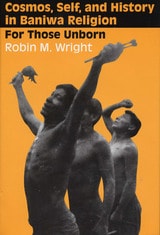
Cosmos, Self, and History in Baniwa Religion
For Those UnbornBy Robin M. Wright
University of Texas Press, 1998
The Baniwa Indians of the Northwest Amazon have engaged in millenarian movements since at least the middle of the nineteenth century. The defining characteristic of these movements is usually a prophecy of the end of this present world and the restoration of the primordial, utopian world of creation. This prophetic message, delivered by powerful shamans, has its roots in Baniwa myths of origin and creation.
In this ethnography of Baniwa religion, Robin M. Wright explores the myths of creation and how they have been embodied in religious movements and social action—particularly in a widespread conversion to evangelical Christianity. He opens with a discussion of cosmogony, cosmology, and shamanism, and then goes on to explain how Baniwa origin myths have played an active role in shaping both personal and community identity and history. He also explores the concepts of death and eschatology and shows how the mythology of destruction and renewal in Baniwa religion has made the Baniwa people receptive to both Catholic and Protestant missionaries.
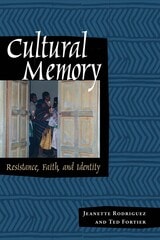
Cultural Memory
Resistance, Faith, and IdentityBy Jeanette Rodriguez and Ted Fortier
University of Texas Press, 2007
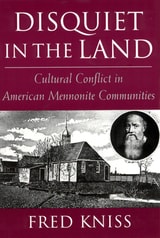
Disquiet in the Land
Cultural Conflict in American Mennonite CommunitiesKniss, Fred
Rutgers University Press, 1997
Mennonites have long referred to themselves as "The Quiet in the Land," but their actual historical experience has been marked by internal disquiet and contention over religious values and cultural practice. As Fred Kniss argues in his impressive study of Mennonite history, the story of this sectarian pacifist group is a story of conflict. How can we understand the ironic phenomenon of Mennonite conflict? How do ideas and symbols-both those of the American mainstream and those that are specifically Mennonite-influence the emergence and course of this conflict? What is the relationship betweenintra-Mennonite conflict and the changing historical context in which Mennonites are situated?
Through a rigorous analysis of a century of disputes over dress codes, congregational authority, and religious practice, Kniss offers the tools both to understand conflict within a specific religious group and to answer larger questions about culture, ideology, and social and historical change.
Encompassing Others
The Magic of Modernity in MelanesiaEdward LiPuma
University of Michigan Press, 2001
Focusing on the Maring people of Highland New Guinea and on the Westerners who interacted with them, Edward LiPuma presents issues from the perspectives of both sides. We hear the voice of the Anglican priest from San Francisco as well as the most powerful Maring shamans. Further, the book seeks to develop a theory of generations that helps explain how change accelerates and societies take on new directions across generations.
Theoretical, descriptive, but almost entirely free of jargon, this book is intended for all those who are interested in how the West's encompassment of other peoples influences how these others conceive of their past, imagine their future, and experience the present. It will have wide appeal for anthropologists and others concerned with colonialism, globalization, and the formation of the nation-state.
Edward LiPuma is Professor and Chair, Department of Anthropology, University of Miami.
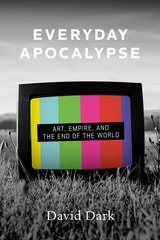
Everyday Apocalypse
Art, Empire, and the End of the WorldDavid Dark
Vanderbilt University Press, 2025
This revised edition of the book includes a foreword by Hanif Abdurraqib, an extensive afterword, updates in light of the passage of time since its publication, and new insights from the author, whose outspokenness has placed him outside of circles in which he was once supported and celebrated.
Feeling the Future at Christian End-Time Performances
Jill Stevenson
University of Michigan Press, 2022
The book’s main focus is contemporary Christian End-Time performances and how they theatrically construct encounters with future time—not just images or ideas of a future, but viscerally and immediately real experiences of future time. Author Jill Stevenson’s examples are Hell Houses and Judgement Houses; Rapture House, a similarly styled “walk through drama” in North Carolina; Hell’s Gates, an “outdoor reality drama” in Dawsonville, Georgia; Ark Encounter, a full-size recreation of Noah’s Ark; and Tribulation Trail, an immersive thirteen-scene drama ministry based on the Book of Revelation. The book’s coda considers similarities between these Christian performances and secular survivalist prepper events, especially with respect to constructions of and language about time. In doing so, the author situates these performances within a larger tradition that challenges traditional secular/sacred distinctions and illuminates how the End Times has been employed in our current social and political moment.
Gathered into a Church
Indigenous-English Congregationalism in Woodland New EnglandLori Rogers-Stokes
University of Massachusetts Press, 2025
Uncovering how and where Indigenous and settler communities found common ground using newly public church records
Puritans in the American colonies created Congregationalism, a Protestant denomination where power rested in each congregation rather than a larger central body. As has often been told, the official Puritan mission included outreach to Indigenous people. This may appear as nothing more than forced conversion under colonization, but church records from Massachusetts—digitized and made public for the first time—reveal the authenticity of this Indigenous religious experience, as evidenced by commonalities between the Congregational way and some aspects of local Native American cultures. The records also show how the decentralized churches stood in contrast to a growing civil government in the colonies.
Lori Rogers-Stokes focuses on the Massachusetts Bay Colony during the decades around the turn of the eighteenth century, a period bookended by King Philip’s War and the First Great Awakening. She uses as her primary source the many records kept by individual Congregational churches of the time. These records, accumulated over generations, have been missing from the historical record, allowing overly simplistic accounts of this religious community to circulate. With church records now available, Rogers-Stokes reveals a more realistic picture of diverse congregations and contrasts their internal workings—which show inherent flexibility and a focus on a shared creation of community—with a developing civil government focused on consolidating power around white landowners. The result is a story that can expand how scholars write about this period, this region, and these communities, both settler and Indigenous.
Hollywood Faith
Holiness, Prosperity, and Ambition in a Los Angeles ChurchMarti, Gerardo
Rutgers University Press, 2008
In Hollywood Faith, Gerardo Marti shows how a multiracial evangelical congregation of 2,000 people accommodates itself to the entertainment industry and draws in many striving to succeed in this harsh and irreverent business. Oasis strategically sanctifies ambition and negotiates social change by promoting a new religious identity as "champion of life"-an identity that provides people who face difficult career choices and failed opportunities a sense of empowerment and endurance.
The first book to provide an in-depth look at religion among the "creative class," Hollywood Faith will fascinate those interested in the modern evangelical movement and anyone who wants to understand how religion adapts to social change.
Invisible Agents
Spirits in a Central African HistoryDavid M. Gordon
Ohio University Press, 2012
Invisible Agents shows how personal and deeply felt spiritual beliefs can inspire social movements and influence historical change. Conventional historiography concentrates on the secular, materialist, or moral sources of political agency. Instead, David M. Gordon argues, when people perceive spirits as exerting power in the visible world, these beliefs form the basis for individual and collective actions. Focusing on the history of the south-central African country of Zambia during the nineteenth and twentieth centuries, his analysis invites reflection on political and religious realms of action in other parts of the world, and complicates the post-Enlightenment divide of sacred and profane.
The book combines theoretical insights with attention to local detail and remarkable historical sweep, from oral narratives communicated across slave-trading routes during the nineteenth century, through the violent conflicts inspired by Christian and nationalist prophets during colonial times, and ending with the spirits of Pentecostal rebirth during the neoliberal order of the late twentieth century. To gain access to the details of historical change and personal spiritual beliefs across this long historical period, Gordon employs all the tools of the African historian. His own interviews and extensive fieldwork experience in Zambia provide texture and understanding to the narrative. He also critically interprets a diverse range of other sources, including oral traditions, fieldnotes of anthropologists, missionary writings and correspondence, unpublished state records, vernacular publications, and Zambian newspapers.
Invisible Agents will challenge scholars and students alike to think in new ways about the political imagination and the invisible sources of human action and historical change.
Mel Gibson's Bible
Religion, Popular Culture, and "The Passion of the Christ"Edited by Timothy K. Beal and Tod Linafelt
University of Chicago Press, 2005
In this volume, biblical scholars Timothy K. Beal and Tod Linafelt—along with an esteemed group of contributors—offer a provocative range of views on The Passion of the Christ. Their book is organized in three parts. The first analyzes the film in terms of its religious foundations, including the Gospels and nonbiblical religious texts: What are the film's literary sources and how does it use them? In what ways does the medium of film require a radically different way of representing gospel narrative? The second group of essays focuses on the ethical and theological implications of the film's presentation of the Christian gospel: What do we make of its representations of female sexuality? What are the implications of focusing on the Passion in terms of atonement rather than social justice? Finally, the third section explores the film as a pop cultural phenomenon: How has the film worked to create a sense of insider status for some and alienated so many others? What can we learn about the religious dimensions of contemporary mass culture from the film's reception?
Whether one is inspired or appalled by The Passion of the Christ, there can be no question that it is a defining moment in the cultural afterlife of the Bible. This volume tries to make sense of that moment and will prove to be a touchstone for adherents and detractors of the film alike.
Native American Catholic Studies Reader
History and TheologyDavid J. Endres
Catholic University of America Press, 2022
Nonreligious Lifeworlds in Egypt
Sense-Making, Emotion, and EmbodimentKarin van Nieuwkerk
University of Texas Press, 2026
An analysis of the growing visibility of nonreligion in Egypt.
Egypt's 2011 Uprising, while often perceived as a failed revolution, nonetheless nonetheless had durable social effects. Among these has been a rise in expressing atheism and agnosticism, especially among educated and affluent youth—the country’s future leaders.
An intimate ethnography, Nonreligious Lifeworlds in Egypt explores the intellectual and emotional transformations of atheists and agnostics inspired by the aspirational freedom-seeking of the Arab Spring. Rejecting both of Egypt’s dominant religious traditions, Islam and Coptic Christianity, nonreligious people are widely viewed as agents of moral outrage. Amid media-driven panics, their sanity is often questioned by their own families as they experiment with new ways of living and relating. Drawing from in-depth fieldwork, interviews, and social media analysis, Karin van Nieuwkerk reveals her interlocutors’ changing perspectives on sex and gender, eating and drinking, and life and death. Above all, she emphasizes the affective experiences of renouncing religion, marked by anxiety and regret—but also liberation and relief. With rigor and compassion, Van Nieuwkerk opens our minds to the arduous process of exchanging established norms for self-determination.
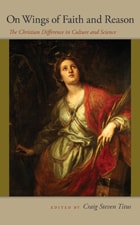
On Wings of Faith and Reason
The Christian Difference in Culture and Science (John Henry Cardinal Newman Lecture)Craig Steven Titus
Catholic University of America Press, 2008
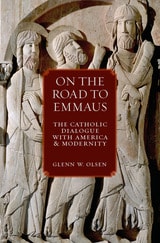
On the Road to Emmaus
The Catholic Dialogue with America and ModernityGlenn W. Olsen
Catholic University of America Press, 2012
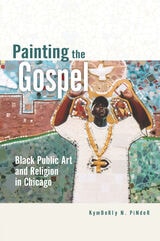
Painting the Gospel
Black Public Art and Religion in ChicagoKymberly Pinder
University of Illinois Press, 2016
Painting the Gospel includes maps and tour itineraries that allow readers to make conceptual, historical, and geographical connections among the works.
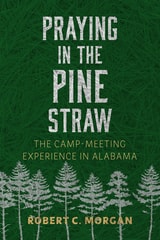
Praying in the Pine Straw
The Camp-Meeting Experience in AlabamaRobert C. Morgan
University of Alabama Press, 2025
Step into the South’s brush arbors and piney woods where faith runs deep, stories run wild, and the old-time camp meeting was anything but quiet.
Praying in Pine Straw immerses readers in the raw, rollicking, and deeply human world of Alabama’s camp meetings—a Southern tradition where fire-and-brimstone preaching echoed through pine forests and where faith was often accompanied by contradiction. From “treeing the Devil” to “holy laughter,” these revivals blended heartfelt worship with all the complications of human nature. Mule-drawn wagons brought the faithful to rustic camps, where gospel fervor mingled with whiskey traders, local politicians, and opportunists of every kind. Preachers thundered against sin—even as they sometimes flirted with it themselves.
Robert C. Morgan offers a textured portrait of camp meetings as both spiritual experience and cultural spectacle, reviving a Southern tradition that flourished from the late nineteenth to mid-twentieth centuries. With a blend of humor and keen insight, Praying in the Pine Straw unveils the enduring contradictions of “old-time religion” and its significant influence on Southern culture and faith—a legacy that is both treasured and complex.
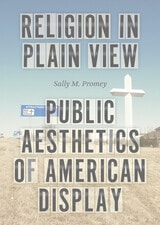
Religion in Plain View
Public Aesthetics of American DisplaySally M. Promey
University of Chicago Press, 2024
In Religion in Plain View, Sally M. Promey analyzes religion’s visible saturation of American public space and the histories that shaped this exhibitionary aesthetics. In street art, vehicle décor, signs, monuments, architecture, zoning policy, and more, Promey exposes American display’s merger of evangelicalism, capitalism, and imperialism. From this convergence, display materializes a distinctly American drive to advertise, claim territory, invalidate competitors, and fabricate a tractable national heritage. Charting this aesthetics’ strategic work as a Protestant technology of White nation formation, Religion in Plain View offers a dynamic critique of the ways public display perpetuates deeply ingrained assumptions about the proper shape of life and land in the United States.
Revivalism and Cultural Change
Christianity, Nation Building, and the Market in the Nineteenth-Century United StatesGeorge M. Thomas
University of Chicago Press, 1989
"Subtle and complex. . . . Fascinating."—Randolph Roth, Pennsylvania History
"[Revivalism and Cultural Change] should be read with interest by those interested in religious movements as well as the connections among religion, economics, and politics."—Charles L. Harper, Contemporary Sociology
"Readers old and new stand to gain much from Thomas's sophisticated study of the macrosociology of religion in the United States during the nineteenth century. . . . He has given the sociology of religion its best quantitative study of revivalism since the close of the 1970s."—Journal for the Scientific Study of Religion
Sea Voyages and Beyond
Emerging Strategies in Socio-Rhetorical InterpretationVernon K. Robbins
SBL Press, 2018
Explore insights, methodologies, and advances in socio-rhetorical interpretation
Essays in this volume from Vernon K. Robbins merge social and rhetorical strategies of interpretation and set the stage for how socio-rhetorical interpretation has developed in the context of research into the rhetoric of religious antiquity. This book contains “By Land and By Sea: The We Passages and Ancient Sea Voyages” (1978), which initially received widespread praise and then became an object of significant criticism. The volume includes Robbins’s varied, detailed responses to both encouragement and critique of his approach.
Features:
- Introduction to the collection by David B. Gowler
- Twelve essays that programmatically study early Christian texts using resources from the social sciences
- Reflections on the future of socio-rhetorical criticism
Secular Faith
How Culture Has Trumped Religion in American PoliticsMark A. Smith
University of Chicago Press, 2015
Mark A. Smith provocatively argues that religion is not nearly the unchanging conservative influence in American politics that we have come to think it is. In fact, in the long run, religion is best understood as responding to changing political and cultural values rather than shaping them. Smith makes his case by charting five contentious issues in America’s history: slavery, divorce, homosexuality, abortion, and women’s rights. For each, he shows how the political views of even the most conservative Christians evolved in the same direction as the rest of society—perhaps not as swiftly, but always on the same arc. During periods of cultural transition, Christian leaders do resist prevailing values and behaviors, but those same leaders inevitably acquiesce—often by reinterpreting the Bible—if their positions become no longer tenable. Secular ideas and influences thereby shape the ways Christians read and interpret their scriptures.
So powerful are the cultural and societal norms surrounding us that Christians in America today hold more in common morally and politically with their atheist neighbors than with the Christians of earlier centuries. In fact, the strongest predictors of people’s moral beliefs are not their religious commitments or lack thereof but rather when and where they were born. A thoroughly researched and ultimately hopeful book on the prospects for political harmony, Secular Faith demonstrates how, over the long run, boundaries of secular and religious cultures converge.
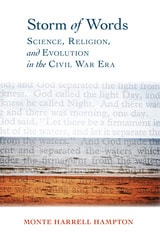
Storm of Words
Science, Religion, and Evolution in the Civil War EraMonte Harrell Hampton
University of Alabama Press, 2014
A study of the ways that southern Presbyterians in the wake of the Civil War contended with a host of cultural and theological questions
Southern Presbyterian theologians enjoyed a prominent position in antebellum southern culture. Respected for both their erudition and elite constituency, these theologians identified the southern society as representing a divine, Biblically ordained order. Beginning in the 1840s, however, this facile identification became more difficult to maintain, colliding first with antislavery polemics, then with Confederate defeat and reconstruction, and later with women’s rights, philosophical empiricism, literary criticisms of the Bible, and that most salient symbol of modernity, natural science.
As Monte Harrell Hampton shows in Storm of Words, modern science seemed most explicitly to express the rationalistic spirit of the age and threaten the Protestant conviction that science was the faithful “handmaid” of theology. Southern Presbyterians disposed of some of these threats with ease. Contemporary geology, however, posed thornier problems. Ambivalence over how to respond to geology led to the establishment in 1859 of the Perkins Professorship of Natural Science in Connexion with Revealed Religion at the seminary in Columbia, South Carolina. Installing scientist-theologian James Woodrow in this position, southern Presbyterians expected him to defend their positions.
Within twenty-five years, however, their anointed expert held that evolution did not contradict scripture. Indeed, he declared that it was in fact God’s method of creating. The resulting debate was the first extended evolution controversy in American history. It drove a wedge between those tolerant of new exegetical and scientific developments and the majority who opposed such openness. Hampton argues that Woodrow believed he was shoring up the alliance between science and scripture—that a circumscribed form of evolution did no violence to scriptural infallibility. The traditionalists’ view, however, remained interwoven with their identity as defenders of the Lost Cause and guardians of southern culture.
The ensuing debate triggered Woodrow’s dismissal. It also capped a modernity crisis experienced by an influential group of southern intellectuals who were grappling with the nature of knowledge, both scientific and religious, and its relationship to culture—a culture attempting to define itself in the shadow of the Civil War and Reconstruction.
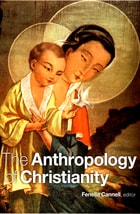
The Anthropology of Christianity
Fenella Cannell, ed.
Duke University Press, 2006
The contributors examine the contours of Christianity among diverse groups: Catholics in India, the Philippines, and Bolivia, and Seventh-Day Adventists in Madagascar; the Swedish branch of Word of Life, a charismatic church based in the United States; and Protestants in Amazonia, Melanesia, and Indonesia. Highlighting the wide variation in what it means to be Christian, the contributors reveal vastly different understandings and valuations of conversion, orthodoxy, Scripture, the inspired word, ritual, gifts, and the concept of heaven. In the process they bring to light how local Christian practices and beliefs are affected by encounters with colonialism and modernity, by the opposition between Catholicism and Protestantism, and by the proximity of other religions and belief systems. Together the contributors show that it not sufficient for anthropologists to assume that they know in advance what the Christian experience is; each local variation must be encountered on its own terms.
Contributors. Cecilia Busby, Fenella Cannell, Simon Coleman, Peter Gow, Olivia Harris, Webb Keane, Eva Keller, David Mosse, Danilyn Rutherford, Christina Toren, Harvey Whitehouse
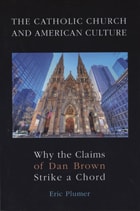
The Catholic Church and American Culture
Why the Claims of Dan Brown Strike a ChordEric A. Plumer
University of Scranton Press, 2009
More than fifty books debunking the religious claims of The Da Vinci Code have been published. Thisis the first book devoted to the fundamentally more interesting question: if those claims are so unfounded and erroneous, why have they resonated so strongly with millions of intelligent readers and filmgoers?
From the sexual abuse scandal that shook the foundations of the Catholic Church to the 9/11 terrorist attacks that cast a cloud over a troubled nation, Eric Plumer’s The Catholic Church and American Culture: Why the Claims of the DaVinci Code Struck a Chord investigates the contemporary events, ideas, and movements that fostered Dan Brown’s unprecedented dominance of best-seller lists and dinner-table conversation. This ambitious book considers the feminist movement, radical individualism, twelve-step programs, the authority of science and psychology, and other cultural developments that paved the way for The Da Vinci Code craze. It also reflects on the recent publication of the Gnostic Gospels, including the Gospel of Mary Magdalene. Plumer’s engaging book is sure to stimulate further discussion about the role of religion in contemporary life.
The Inconstancy of the Indian Soul
The Encounter of Catholics and Cannibals in 16-century BrazilEduardo Viveiros de Castro
Prickly Paradigm Press, 2011
In the mid-sixteenth century, Jesuit missionaries working in what is now Brazil were struck by what they called the inconstancy of the people they met, the indigenous Tupi-speaking tribes of the Atlantic coast. Though the Indians appeared eager to receive the Gospel, they also had a tendency to forget the missionaries’ lessons and “revert” to their natural state of war, cannibalism, and polygamy. This peculiar mixture of acceptance and rejection, compulsion and forgetfulness was incorrectly understood by the priests as a sign of the natives’ incapacity to believe in anything durably.
In this pamphlet, world-renowned Brazilian anthropologist Eduardo Viveiros de Castro situates the Jesuit missionaries’ accounts of the Tupi people in historical perspective, and in the process draws out some startling and insightful implications of their perceived inconstancy in relation to anthropological debates on culture and religion.
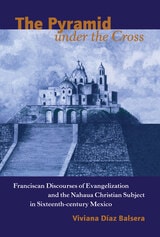
The Pyramid under the Cross
Franciscan Discourses of Evangelization and the Nahua Christian Subject in Sixteenth-century MexicoViviana Díaz Balsera
University of Arizona Press, 2005
The Pyramid under the Cross looks at the epic project of Christianization as well as the limits of the Spanish spiritual colonizers' power to accomplish it. The book focuses on activities of Franciscan missionaries who, as the first religious order to arrive, occupied the most important political and social centers in the Valley of Mexico and set the strategies of evangelization that others would follow. One such activity, the Nahua theater of evangelization, is represented as an exemplary case of the inevitable cultural negotiation involved in the missionary process. The author explores not only the imposition of a Eurocentric worldview upon the Nahua but also the hybridization of this view as the spiritual colonizer attempted to encompass a new non-Western constituency and the latter interpreted Christianity according to its own cultural paradigms.
The book treats a wide range of texts—the Historia eclesiástica indiana, the Confessionario Mayor, the Coloquios de los Doce, and more—both by renowned Franciscan figures such as Gerónimo de Mendieta, Alonso de Molina, Bernardino de Sahagún, and by Nahua grammarians Antonio Valeriano de Azcapotzalco, Andrés Leonardo de Tlatelolco, and others. Díaz Balsera engages the cultural constraints of all the actors in the episodes she relates in order to show how the exchange between them resulted in the appropriation and/or alteration of the Spanish discourses of spiritual domination—sometimes even in their breakdown—and how it brought about the emergence of Nahua Christian subjects that would never fully leave behind their ancient ways of relating to the gods.
The Pyramid under the Cross will be of interest to readers in the areas of Hispanic literatures, history, religion, anthropology, Latin American and cultural studies, and to those working in the field of colonial studies.
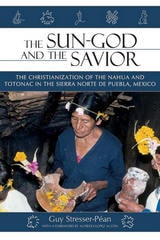
The Sun God and the Savior
The Christianization of the Nahua and Totonac in the Sierra Norte de Puebla, MexicoGuy Stresser-Péan
University Press of Colorado, 2009
The first English translation of Guy Stresser-Péan's tour-de-force presents two decades of fieldwork in the Sierra Norte de Puebla, Mexico, where native pre-Hispanic pagan beliefs blended with traditional Catholic evangelization from the sixteenth century and the more recent intrusion of modernism.
The Indians of the Sierra Norte de Puebla are deeply devoted to Christianity, but their devotion is seamlessly combined with pagan customs, resulting in a hybrid belief system that is not wholly indigenous, yet not wholly Christian. The syncretism practiced here has led the Totonac and Nahua people to identify Christ with the Sun God, a belief expressed symbolically in ritual practices such as the Dance of the Voladores.
Spanning the four centuries from the earliest systematic campaign against Nahua ritual practices - Zumárraga's idolatry trials of 1536-1540 - to the twentieth century, Stresser-Péan contextualizes Nahua and Totonac ritual practices as a series of responses to Christian evangelization and the social reproduction of traditional ritual practices. The Sun God and the Savior is a monumental work on the ethnographic and historical knowledge of the peoples of the Sierra Norte.
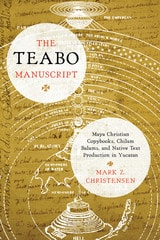
The Teabo Manuscript
Maya Christian Copybooks, Chilam Balams, and Native Text Production in YucatánBy Mark Z. Christensen
University of Texas Press, 2016
Winner, LASA Mexico Humanities Book Prize, 2017
Among the surviving documents from the colonial period in Mexico are rare Maya-authored manuscript compilations of Christian texts, translated and adapted into the Maya language and worldview, which were used to evangelize the local population. The Morely Manuscript is well known to scholars, and now The Teabo Manuscript introduces an additional example of what Mark Z. Christensen terms a Maya Christian copybook. Recently discovered in the archives of Brigham Young University, the Teabo Manuscript represents a Yucatecan Maya recounting of various aspects of Christian doctrine, including the creation of the world, the Fall of Adam and Eve, and the genealogy of Christ.
The Teabo Manuscript presents the first English translation and analysis of this late colonial Maya-language document, a facsimile and transcription of which are also included in the book. Working through the manuscript section by section, Christensen makes a strong case for its native authorship, as well as its connections with other European and Maya religious texts, including the Morely Manuscript and the Books of Chilam Balam. He uses the Teabo Manuscript as a platform to explore various topics, such as the evangelization of the Maya, their literary compositions, and the aspects of Christianity that they deemed important enough to write about and preserve. This pioneering research offers important new insights into how the Maya negotiated their precontact intellectual traditions within a Spanish and Catholic colonial world.
The Turn to Transcendence
The Role of Religion in the Twenty-First CenturyGlenn Olsen
Catholic University of America Press, 2010
Thinking Orthodox in Modern Russia
Culture, History, ContextEdited by Patrick Lally Michelson and Judith Deutsch Kornblatt
University of Wisconsin Press, 2014
Volume editors Patrick Lally Michelson and Judith Deutsch Kornblatt provide a historical overview of Russian Orthodox thought and a critical essay on the current state of scholarship about religious thought in modern Russia. The contributors explore a wide range of topics, including Orthodox claims to a unique religious Enlightenment, contests over authority within the Russian Church, tensions between faith and reason in academic Orthodoxy, the relationship between sacraments and the self, the religious foundations of philosophical and legal categories, and the effect of Orthodox categories in the formation of Russian literature.