Results by title
6 books match the query 'Christianity and justice'
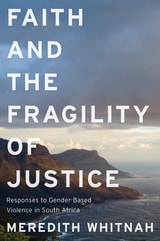
Faith and the Fragility of Justice
Responses to Gender-Based Violence in South AfricaMeredith Whitnah
Rutgers University Press, 2025
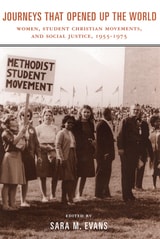
Journeys that Opened up the World
Women, Student Christian Movements, and Social Justice, 1955-1975Evans, Sara M.
Rutgers University Press, 2003
For thousands of young women in the 1950s and 1960s, involvement with the student Christian movement (SCM) changed their worldviews. Religious organizations fostered women’s leadership at a time when secular groups like Students for a Democratic Society, and the Left in general, relegated most female participants to stereotypical roles.
The SCM introduced young women to activism in other parts of the country and around the world. As leaders, thinkers, and organizers, they encountered the social realities of poverty and racial prejudice and worked to combat them. The SCM took women to Selma and Montgomery, to Africa and Latin America, and to a lifelong commitment to work for social justice.
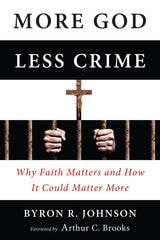
More God, Less Crime
Why Faith Matters and How It Could Matter MoreByron Johnson
Templeton Press, 2012
In More God, Less Crime renowned criminologist Byron R. Johnson proves that religion can be a powerful antidote to crime. The book describes how faith communities, congregations, and faith-based organizations are essential in forming partnerships necessary to provide the human and spiritual capital to effectively address crime, offender rehabilitation, and the substantial aftercare problems facing former prisoners. There is scattered research literature on religion and crime but until now, there has never been one publication that systematically and rigorously analyzes what we know from this largely overlooked body of research in a lay-friendly format. The data shows that when compared to current strategies, faith-based approaches to crime prevention bring added value in targeting those factors known to cause crime: poverty, lack of education, and unemployment. In an age of limited fiscal resources, Americans can’t afford a criminal justice system that turns its nose up at volunteer efforts that could not only work better than the abysmal status quo, but also save billions of dollars at the same time. This book provides readers with practical insights and recommendations for a faith-based response that could do just that.
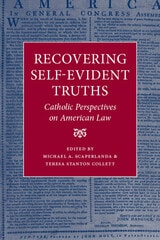
Recovering Self-Evident Truths
Catholic Perspectives on American LawMichael A. Scaperlanda
Catholic University of America Press, 2007
Religion and Social Justice For Immigrants
Hondagneu-Sotelo, Pierrette
Rutgers University Press, 2006
Religion has jumped into the sphere of global and domestic politics in ways that few would have imagined a century ago. Some expected that religion would die as modernity flourished. Instead, it now stares at us almost daily from the front pages of newspapers and television broadcasts. Although it is usually stories about the Christian Right or conservative Islam that grab headlines, there are many religious activists of other political persuasions that are working quietly for social justice. This book examines how religious immigrants and religious activists are working for equitable treatment for immigrants in the United States.
The essays in this book analyze the different ways in which organized religion provides immigrants with an arena for mobilization, civic participation, and solidarity. Contributors explore topics including how non-Western religious groups such as the Vietnamese Caodai are striving for community recognition and addressing problems such as racism, economic issues, and the politics of diaspora; how interfaith groups organize religious people into immigrant civil rights activists at the U.S.–Mexican border; and how Catholic groups advocate governmental legislation and policies on behalf of refugees.

What Does the Lord Require?
How American Christians Think about Economic JusticeHart, Stephen
Rutgers University Press, 1996