Results by title
4 books match the query 'Church controversies'
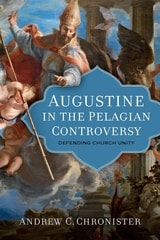
Augustine in the Pelagian Controversy
Defending Church UnityAndrew Chronister
Catholic University of America Press, 2024
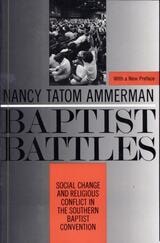
Baptist Battles
Social Change and Religious Conflict in the Southern Baptist ConventionNancy Tatom Ammerman
Rutgers University Press, 1990
Since 1979 Southern Baptists have been noisily struggling to agree on symbols, beliefs, and practices as they attempt to make sense of their changing social world. Nancy Ammerman has carefully documented their struggle. She tells the story of the Baptist reversal from a moderate to a fundamentalist outlook and speculates on the future of the denomination.
Ammerman places change among the Southern Baptists in the context of the cultural and economic changes that have transformed the South from its rural past into an urbanizing, culturally diverse region. Not only did the South change; Southern Baptists did as well. Reflecting this diversity, the Southern Baptist bureaucracy was relatively progressive. During the 1960s and 1970s, moderate sentiments prevailed, while fundamentalists remained on the margins. These two were, however, becoming increasingly divergent in what they considered important about being a Baptist, in their views about the Bible, in their attitudes on the origination of women, on Christian morals, and on national politics.
Late in the 1970s, a fundamentalist coalition emerged, followed by unsuccessful efforts by moderates to oppose it. The battles escalated until 1985, when 45,000 Baptists gathered in Dallas to decide between contending presidential candidates. That dramatic event illustrated the extent to which organized political resources were determining the course of the conflict. Ammerman studies these strategies and resources as well.
Examining how this tension affected Baptists, Ammerman begins with case studies of the change it is producing in Baptist agencies. But she also brings us back to the local churches and individual believers who are renegotiating their relationships within their denomination. She asks whether the denomination’s polity can accommodate an increasingly diverse group of Baptists, of whether the only way dissidents can have a voice is through schism.
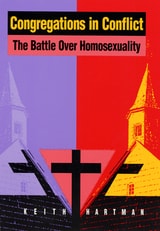
Congregations in Conflict
The Battle over HomosexualityHartman, Keith
Rutgers University Press, 1996
A Methodist church puts its minister on trial after he marches in a gay rights parade. A Quaker meeting struggles to decide whether to marry a lesbian couple. An entire congregation is thrown out of the Southern Baptist Convention for deciding that a gay divinity student had a sincere calling to the ministry, and an order of celibate monks comes out of the closet. An Episcopal priest blesses two same-sex relationships--then a closeted gay lawyer leads the charge to have him fired.
Homosexuality is the most divisive issue facing churches today. Like the issue of slavery 150 years ago, it is a matter that ignites passionate convictions on both sides, a matter that threatens to turn members of the same faith against each other, to divide congregations, and possibly even to fragment several denominations. Like slavery, it is an issue that calls up basic questions about what it means to be a Christian. How does one know right from wrong? Is the Bible fallible? Do good Christians always follow their church's teachings, or are they allowed to think for themselves on moral issues? And to what source does one finally look to determine what God really wants?
While many books have been written analyzing the scriptural and theological dimensions of the conflict, none has yet shown how it is being played out in the pews. Congregations in Conflict examines nine churches that were split by disagreements over gay and lesbian issues, and how the congregations resolved them.
Hartman explores in very readable prose how different denominations have handled their conflicts and what it says about the nature of their faith. He shows some churches coming through their struggles stronger and more unified, while others irrevocably split. Most importantly, he illuminates how people with a passionate clash of beliefs can still function together as a community of faith.
The New Crusades, the New Holy Land
Conflict in the Southern Baptist Convention, 1969-1991David T. Morgan
University of Alabama Press, 1996
Examines the conflict between modern-day Southern Baptists and “liberal” Southern Baptists over control of the Southern Baptist Convention
David Morgan captures the essence of the conflict between some modern-day Southern Baptists, who saw themselves as crusaders for truth, as they sought to redeem a new holy land--the Southern Baptist Convention-- from the control of other Southern Baptists they viewed as "liberals." To the so-called liberals, the crusaders were "fundamentalists" on a mission, not to reclaim the SBC in the name of theological truth but to gain control and redirect its activities according to their narrow political, social, and theological perspectives. The New Crusades provides a comprehensive history of the conflict, taking the reader through the bitter and divisive struggles of the late 1980s, that culminated in the 1991 emergence of a moderate faction within the SBC. The fundamentalists had won.