Results by title
4 books match the query 'Church work with the poor'
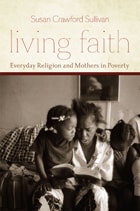
Living Faith
Everyday Religion and Mothers in PovertySusan Crawford Sullivan
University of Chicago Press, 2012
Scholars have made urban mothers living in poverty a focus of their research for decades. These women’s lives can be difficult as they go about searching for housing and decent jobs and struggling to care for their children while surviving on welfare or working at low-wage service jobs and sometimes facing physical or mental health problems. But until now little attention has been paid to an important force in these women’s lives: religion.
Based on in-depth interviews with women and pastors, Susan Crawford Sullivan presents poor mothers’ often overlooked views. Recruited from a variety of social service programs, most of the women do not attend religious services, due to logistical challenges or because they feel stigmatized and unwanted at church. Yet, she discovers, religious faith often plays a strong role in their lives as they contend with and try to make sense of the challenges they face. Supportive religious congregations prove important for women who are involved, she finds, but understanding everyday religion entails exploring beyond formal religious organizations.
Offering a sophisticated analysis of how faith both motivates and at times constrains poor mothers’ actions, Living Faith reveals the ways it serves as a lens through which many view and interpret their worlds.
[more]

Piety and Charity in Late Medieval Florence
John Henderson
University of Chicago Press, 1997
John Henderson examines the relationship between religion and society in late medieval Florence through the vehicle of the religious confraternity, one of the most ubiquitous and popular forms of lay association throughout Europe. This book provides a fascinating account of the development of confraternities in relation to other communal and ecclesiastical institutions in Florence. It is one of the most detailed analyses of charity in late medieval Europe.
"[A] long-awaited book. . . . [It is] the most complete survey of confraternities and charity, not only for Florence, but for any Italian city state to date. . . . This book recovers more vividly than other recent works what it meant to be a member of a confraternity in the late middle ages."—Samuel K. Cohn, Jr., Economic History Review
"Henderson offers new and fascinating information. . . . A stimulating and suggestive book that deserves a wide readership." —Gervase Rosser, Times Higher Education Supplement
[more]
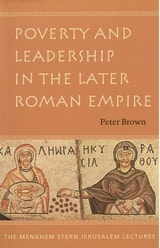
Poverty and Leadership in the Later Roman Empire
Peter Brown
Brandeis University Press, 2001
In three magisterial essays, Peter Brown, one of the world's foremost scholars of the society and culture of late antiquity, explores the emergence in late Roman society of "the poor" as a distinct social class, one for which the Christian church claimed a special responsibility. It is the story of how a society came to see itself as responsible for the care of a particular class of people -- a class that had not previously been cared for -- and of who benefited from that shift in interests. In his characteristically elegant and lucid prose, Brown seeks to recover the pre-Christian status of poor people, the actual nature of the relations between the Christian church and the poor, and the true motivations -- sometimes sincere, sometimes self-serving -- behind Christian rhetoric of love for the poor. He draws not only on the standard Greek and Latin sources for the later Roman Empire, but also on Jewish sources to document the interactions between Middle Eastern provincial societies and classical Roman traditions. Brown gracefully illuminates a crucial transition from classical to Christian culture: the emergence of a new understanding of what society -- and the Church -- owes to the poor that continues to resonate.
[more]
Sustainability for the Forgotten
Gary E. Machlis
University of Utah Press, 2024
Opening with the extraordinary story of a young French priest working in 1968 amongst impoverished villages of northeast Brazil, struggling to bring sustenance, sustainability, and hope to these disregarded and willfully ignored communities, this book asks a broad and far-reaching question that challenges the contemporary sustainability movement: What about sustainability for the forgotten?
Sustainability for the Forgotten is an incendiary book that confronts the history, policies, and practices of sustainability. It interrogates the usefulness of current sustainability approaches for the poorest of the poor, the chronic underclass, victims of natural disasters, refugees, the oppressed, and asks, how can we do better? With examples that range from the coffeelands of El Salvador to the coal country of American Appalachia, from the streets of Detroit to refugee camps in Greece and the upscale metro centers of the affluent, sustainability is examined with a critical eye and with an emphasis on insuring that the forgotten are heard.
At once well-researched and passionate, wide-ranging and sharply focused, Sustainability for the Forgotten is unlike any other book on the sustainability movement. Written with a distinctive voice that is reasoned, unflinching, and often poetic, the book challenges the sustainability movement to follow "a just and necessary path." The result is a provocative statement on the future of sustainability and a call to action that is ultimately hopeful.
[more]