Results by title
9 books match the query 'Cities and towns in motion pictures'
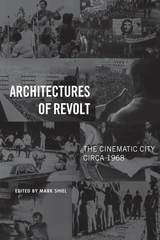
Architectures of Revolt
The Cinematic City circa 1968Mark Shiel
Temple University Press, 2018
Coinciding with the fiftieth anniversary of the worldwide mass protest movements of 1968—against war, imperialism, racism, poverty, misogyny, and homophobia—the exciting anthology Architectures of Revolt explores the degree to which the real events of political revolt in the urban landscape in 1968 drove change in the attitudes and practices of filmmakers and architects alike.
In and around 1968, as activists and filmmakers took to the streets, commandeering public space, buildings, and media attention, they sought to re-make the urban landscape as an expression of utopian longing or as a dystopian critique of the established order. In Architectures of Revolt, the editor and contributors chronicle city-specific case studies from Paris, Berlin, Milan, and Chicago to New York, Los Angeles, Mexico City, and Tokyo. The films discussed range from avant-garde and agitprop shorts to mainstream narrative feature films. All of them share a focus on the city and, often, particular streets and buildings as places of political contestation and sometimes violence, which the medium of cinema was uniquely equipped to capture.
Contributors include: Stephen Barber, Stanley Corkin, Jesse Lerner, Jon Lewis, Gaetana Marrone, Jennifer Stob, Andrew Webber, and the editor.

Filming the City
Urban Documents, Design Practices and Social Criticism through the LensEdited by Edward Clift, Mirko Guaralda, and Ari Mattes
Intellect Books, 2016
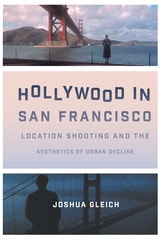
Hollywood in San Francisco
Location Shooting and the Aesthetics of Urban DeclineBy Joshua Gleich
University of Texas Press, 2018
One of the country’s most picturesque cities and conveniently located just a few hours’ drive from Hollywood, San Francisco became the most frequently and extensively filmed American city beyond the production hubs of Los Angeles and New York in the three decades after World War II. During those years, the cinematic image of the city morphed from the dreamy beauty of Vertigo to the nightmarish wasteland of Dirty Harry, although San Francisco itself experienced no such decline. This intriguing disconnect gives impetus to Hollywood in San Francisco, the most comprehensive study to date of Hollywood’s move from studio to location production in the postwar era.
In this thirty-year history of feature filmmaking in San Francisco, Joshua Gleich tracks a sea change in Hollywood production practices, as location shooting overtook studio-based filming as the dominant production method by the early 1970s. He shows how this transformation intersected with a precipitous decline in public perceptions of the American city, to which filmmakers responded by developing a stark, realist aesthetic that suited America’s growing urban pessimism and superseded a fidelity to local realities. Analyzing major films set in San Francisco, ranging from Dark Passage and Vertigo to The Conversation, The Towering Inferno, and Bullitt, as well as the TV show The Streets of San Francisco, Gleich demonstrates that the city is a physical environment used to stage urban fantasies that reveal far more about Hollywood filmmaking and American culture than they do about San Francisco.
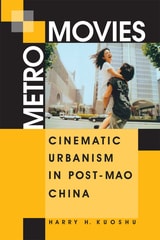
Metro Movies
Cinematic Urbanism in Post-Mao ChinaHarry H. Kuoshu
Southern Illinois University Press, 2010
Metro Movies: Cinematic Urbanism in Post-Mao China takes readers on a comprehensive tour of the urbanization of Chinese cinema. Focusing primarily on movies from the end of the twentieth century, it is the first single-authored work to explore the relationship between the changes in Chinese society—caused in part by the advent of postsocialism, the growth of cities, and globalization—and the transformation of Chinese cinema. Author Harry H. Kuoshu examines such themes as displacement, cinematic representation, youth subculture, the private emotional lives of emerging urbanites, raw urban realism, and the allegorical contrast of the city and the countryside to illustrate the artistic richness and cultural diversity of this cinematic genre.
Kuoshu discusses the work of director Huang Jianxin, whose films follow and critique China’s changing urban political culture. He dedicates a chapter to filmmakers who followed Huang and attempted to redefine the concept of art films to regain the local audience. These directors address Chinese moviegoers’ disappointment with the international adoption of Chinese art films, their lack of interest in conventional Chinese films, and their fascination with emerging audio-video media. A considerable amount of attention is given to films of the 1990s, which focus on the social changes surfacing in China, from the trend of hooliganism and the Beijing rock scene to the arrival of an urban pop culture lifestyle driven by expansionist commerce and materialism. Kuoshu also explores recent films that confront the seedier aspects of city life, as well as films that demonstrate how urbanization has touched every fiber of Chinese living.
Metro Movies illustrates how cinematic urbanism is no longer a genre indicator but is instead an era indicator, revealing the dominance of metropolitan living on modern Chinese culture. It gives new insight into contemporary Chinese politics and culture and provides readers with a better understanding of China’s urban cinema. This book will be an excellent addition to college film courses and will fascinate any reader with an interest in film studies or Chinese culture.
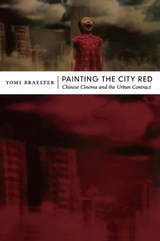
Painting the City Red
Chinese Cinema and the Urban ContractYomi Braester
Duke University Press, 2010
Drawing on extensive archival research, interviews with leading filmmakers and urban planners, and close readings of scripts and images, Braester describes how films and stage plays have promoted and opposed official urban plans and policies as they have addressed issues such as demolition-and-relocation plans, the preservation of vernacular architecture, and the global real estate market. He shows how the cinematic rewriting of historical narratives has accompanied the spatial reorganization of specific urban sites, including Nanjing Road in Shanghai; veterans’ villages in Taipei; and Tiananmen Square, centuries-old courtyards, and postmodern architectural landmarks in Beijing. In Painting the City Red, Braester reveals the role that film and theater have played in mediating state power, cultural norms, and the struggle for civil society in Chinese cities.

Taking Place
Location and the Moving ImageJohn David Rhodes
University of Minnesota Press, 2011
Taking Place argues that the relation between geographical location and the moving image is fundamental and that place grounds our experience of film and media. Its original essays analyze film, television, video, and installation art from diverse national and transnational contexts to rethink both the study of moving images and the theorization of place. Through its unprecedented—and at times even obsessive— attention to actual places, this volume traces the tensions between the global and the local, the universal and the particular, that inhere in contemporary debates on global cinema, television, art, and media.
Contributors: Rosalind Galt, U of Sussex; Frances Guerin, U of Kent; Ji-hoon Kim; Hugh S. Manon, Clark U; Ara Osterweil, McGill U; Brian Price, U of Toronto; Linda Robinson, U of Wisconsin–Whitewater; Michael Siegel; Noa Steimatsky, U of Chicago; Meghan Sutherland, U of Toronto; Mark W. Turner, Kings College London; Aurora Wallace, New York U; Charles Wolfe, U of California, Santa Barbara.
The Divided City and Its New Cinemas, 1920-1980
Amy Murphy
University of Illinois Press, 2026
The Urban Generation
Chinese Cinema and Society at the Turn of the Twenty-First CenturyZhen Zhang, ed.
Duke University Press, 2007
The contributors analyze the historical and social conditions that gave rise to the Urban Generation, its aesthetic innovation, and its ambivalent relationship to China’s mainstream film industry and the international film market. Focusing attention on the Urban Generation’s sense of social urgency, its documentary impulses, and its representations of gender and sexuality, the contributors highlight the characters who populate this new urban cinema—ordinary and marginalized city dwellers including aimless bohemians, petty thieves, prostitutes, postal workers, taxi drivers, migrant workers—and the fact that these “floating urban subjects” are often portrayed by non-professional actors. Some essays concentrate on specific films (such as Shower and Suzhou River) or filmmakers (including Jia Zhangke and Zhang Yuan), while others survey broader concerns. Together the thirteen essays in this collection give a multifaceted account of a significant, ongoing cinematic and cultural phenomenon.
Contributors. Chris Berry, Yomi Braester, Shuqin Cui, Linda Chiu-han Lai, Charles Leary, Sheldon H. Lu, Jason McGrath, Augusta Palmer, Bérénice Reynaud, Yaohua Shi, Yingjin Zhang, Zhang Zhen, Xueping Zhong
Urban Horror
Neoliberal Post-Socialism and the Limits of VisibilityErin Y. Huang
Duke University Press, 2020