Results by title
3 books match the query 'Citron, Marcia J.'
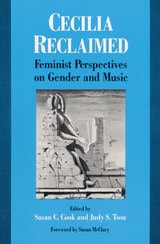
Cecilia Reclaimed
Feminist Perspectives on Gender and MusicEdited by Susan C. Cook and Judy S. Tsou
University of Illinois Press, 1994
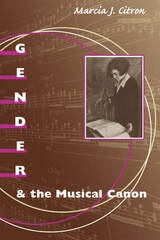
Gender and the Musical Canon
Marcia J. Citron
University of Illinois Press, 2000
A classic in gender studies in music
Marcia J. Citron's comprehensive, balanced work lays a broad foundation for the study of women composers and their music. Drawing on a diverse body of feminist and interdisciplinary theory, Citron shows how the western art canon is not intellectually pure but the result of a complex mixture of attitudes, practices, and interests that often go unacknowledged and unchallenged.
Winner of the Pauline Alderman Prize from the International Alliance of Women in Music, Gender and the Musical Canon explores important elements of canon formation, such as notions of creativity, professionalism, and reception. Citron surveys the institutions of power, from performing organizations and the academy to critics and the publishing and recording industries, that affect what goes into the canon and what is kept out. She also documents the nurturing role played by women, including mothers, in cultivating female composers. In a new introduction, she assesses the book's reception by composers and critics, especially the reactions to her controversial reading of Cécile Chaminade's sonata for piano.
A key volume in establishing how the concepts and assumptions that form the western art music canon affect female composers and their music, Gender and the Musical Canon also reveals how these dynamics underpin many of the major issues that affect musicology as a discipline.
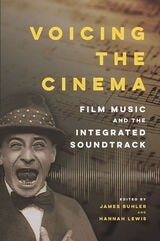
Voicing the Cinema
Film Music and the Integrated SoundtrackEdited by James Buhler and Hannah Lewis
University of Illinois Press, 2020
The collection is divided into four sections. The first explores historical approaches to technology in the silent film, French cinema during the transition era, the films of the so-called New Hollywood, and the post-production sound business. The second investigates the practice of the singing voice in diverse repertories such as Bergman's films, Eighties teen films, and girls' voices in Brave and Frozen. The third considers the auteuristic voice of the soundtrack in works by Kurosawa, Weir, and others. A last section on narrative and vococentrism moves from The Martian and horror film to the importance of background music and the state of the soundtrack at the end of vococentrism.
Contributors: Julie Brown, James Buhler, Marcia Citron, Eric Dienstfrey, Erik Heine, Julie Hubbert, Hannah Lewis, Brooke McCorkle, Cari McDonnell, David Neumeyer, Nathan Platte, Katie Quanz, Jeff Smith, Janet Staiger, and Robynn Stilwell