Results by title
14 books match the query 'City Life'
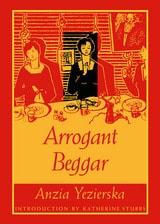
Arrogant Beggar
Anzia Yezierska
Duke University Press, 1996
The second half of the novel takes Adele back to her ghetto origins as she explores an alternative model of philanthropy by opening a restaurant that combines the communitarian ideals of Old World shtetl tradition with the contingencies of New World capitalism. Within the context of this radical message, Yezierska revisits the themes that have made her work famous, confronting complex questions of ethnic identity, assimilation, and female self-realization.
Katherine Stubbs’s introduction provides a comprehensive and compelling historical, social, and literary context for this extraordinary novel and discusses the critical reaction to its publication in light of Yezierska’s biography and the once much-publicized and mythologized version of her life story. Unavailable for over sixty years, Arrogant Beggar will be enjoyed by general readers of fiction and be of crucial importance for feminist critics, students of ethnic literature. It will also prove an exciting and richly rewarding text for students and scholars of Jewish studies, immigrant literature, women’s writing, American history, and working-class fiction.
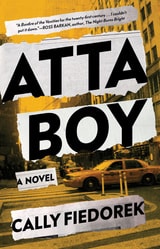
Atta Boy
Cally Fiedorek
University of Iowa Press, 2024
A Vulture Best Book of 2024
In December 2018, we meet Rudy Coyle, a bar owner’s son from Flushing, Queens, in the throes of a major quarter-life crisis. Cut out of the family business, he gets a Hail Mary job as a night doorman in a storied Park Avenue apartment building, where he comes under the wing of the family in 4E, the Cohens.
Jacob “Jake” Cohen, the fast-talking patriarch, is one of a generation of financiers who made hundreds of millions of dollars in the cutthroat taxi medallion industry in the early 2000s, largely by preying on the hopes and dreams of impoverished immigrant drivers. As Jake tries to stop the bleed from the debt crisis now plaguing his company, clawing back his assets from an increasingly dangerous coterie of Russian American associates, Rudy gets promoted from doorman to errand boy to bodyguard to something like Jake’s right-hand man.
By turns a gripping portrait of corruption and a tender family dramedy, Atta Boy combines the urban cool of Richard Price with the glossy, uptown charm of Taffy Brodesser-Akner. Here is a novel richly attuned to its time and place, but with something for everyone—high-wire prose and a story wedding ripped from the headlines, social realism with the warmth, angst, and humor of its indelible voices.
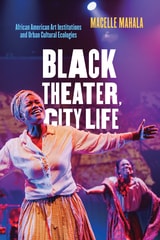
Black Theater, City Life
African American Art Institutions and Urban Cultural EcologiesMacelle Mahala
Northwestern University Press, 2022
Black Theater, City Life looks at Karamu House Theatre, the August Wilson African American Cultural Center, Pittsburgh Playwrights’ Theatre Company, the Lorraine Hansberry Theatre, the African American Shakespeare Company, the Atlanta Black Theatre Festival, and Kenny Leon’s True Colors Theatre Company to demonstrate how each organization articulates the cultural specificities, sociopolitical realities, and histories of African Americans. These companies have faced challenges that mirror the larger racial and economic disparities in arts funding and social practice in America, while their achievements exemplify such institutions’ vital role in enacting an artistic practice that reflects the cultural backgrounds of their local communities. Timely, significant, and deeply researched, this book spotlights the artistic and civic import of Black theaters in American cities.
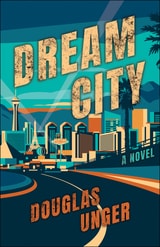
Dream City
A NovelDouglas Unger
University of Nevada Press, 2024
As the story progresses, C. D. comes to understand how his personal losses and the losses of his cohort of hard driving executives on the make—especially the tragic life of his work partner, Greta Olsson, the only woman to break through into their male dominated world—are a result of the make-believe environment he has helped to create, a world where representation replaces reality. Hoping to piece together his faltering marriage and family relationships, C. D. must find a new path as he struggles to hold onto his dreams.
In this fictionalized version of the city of glittering lights, author Douglas Unger pits the ideologies of marketing and consumerism in the casino economy of America against the erosion of individual and humane values that success in that world demands. Unger reveals the hard truth that Las Vegas, a blue-collar town considered by many to be “the most honest city,” can be a temple for self-deceptions, emblematic of a service economy that knows the price of everything and too often the value of little else. Dream City becomes both a love song and an elegy for Las Vegas that sets it apart from any other literary novel previously written about this global entertainment attraction that in so many ways represents postmodern America. Sooner or later, the challenge that faces everyone is to discover what matters most, and to learn how to bet on the better angels of our natures.
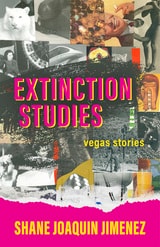
Extinction Studies
Vegas StoriesShane Joaquin Jimenez
University of Nevada Press, 2027
Welcome to Las Vegas. Hope you like it here. You aren’t leaving.
It’s a Las Vegas of outcasts, outsiders, obsessives, and oddballs—a place seen through the eyes of those who call it home in Extinction Studies.
In these stories, a young genius from a troubled home becomes obsessed with solving an infamous atomic-era murder. Twin brothers exploring subterranean tunnels beneath the Strip encounter a stranger who claims he can show them the future. A nonverbal boy devises a daring scheme to revive his punch-drunk prizefighter father’s fading glory. And in the title story, a teenager struggling in the aftermath of a traumatic event finds healing in B monster movies and a TV host who’s a cross between Dracula and Elvis.
Shane Joaquin Jimenez’s short stories deliver you far beyond the glitz and neon of the Strip. Across ten haunting tales, Jimenez takes a whirlwind tour of dark stage magic, macabre murder, moonlit desert graves, and the city’s unknown, unlucky underdogs fighting to the bitter end, no matter the odds.
Told with brutal honesty that is at turns uncanny and unsettling, nightmarish and psychedelic, exhilarating and moving, Extinction Studies uncovers the ineradicable hope at the heart of the strange neon city, shining out in the middle of nowhere.
How We See the Gray
A NovelRachel León
Northwestern University Press, 2026
A riveting story about parenthood, substance abuse, and the strength it takes to come back from our mistakes
Foster care is a disaster in Rockford, Illinois. Meredith, a social worker and single mom, is stretched beyond thin but determined to protect her kids: not only her son, but those on her caseload too. When the stress of the job has her breaking her sobriety, the foundations of her life begin to tremble. After drinking too much, she makes a mistake that puts her preschooler in jeopardy, and Meredith finds herself in a situation that mirrors her clients’ as she loses custody of her son. In her fight to get him back, Meredith experiences the system from the outside—while still working for the kids inside of it. Set over the course of a year, this riveting documentary-esque novel is told from multiple perspectives, including those of case workers, birth parents, foster parents, and foster children. Written with the working-class humor and heart that defines the Midwest, How We See the Gray is a story about mistakes, second chances, and trying to do better in a system that seems doomed to fail.
Let the Soil Rest
A NovelAmy Fladeboe
Northwestern University Press, 2027
Reaching across miles and memory to deconstruct the American Dream in the Midwest Rust Belt
Arjan, a teen refugee from postcommunist Albania, and Jess, a Midwestern high schooler, strike up an unlikely friendship working a seasonal job on a farm in Michigan. Now in their thirties, the two have taken different paths—he chasing the American Dream with a running rotation of day-labor gigs, and she living on the road and off the grid, trying to escape the very same ideal. When Jess lands in Hamtramck, just a few miles from her suburban Detroit upbringing after years wandering, they find themselves trudging the same unplowed sidewalks, spinning loads at the same laundromat, and picking the same jukebox songs at the local dive. Both are haunted by the ghosts of childhood traumas, a chorus of the collective unconscious that takes us from the Albanian coast to the Rust Belt heartland. So near one another and yet so far apart, they must reach across miles and memories to discover that the most important voice in our heads is our own.
Overheard
Dominik Barta, Translated by Gary Schmidt
University of Wisconsin Press, 2025
Overheard is set in Vienna in the mid-2010s, a time of significant social change and political conflict, with tens of thousands of Middle Eastern refugees arriving and protests taking place over a café’s expulsion of two women who greeted each other with a kiss. Kurt is gay, but his best friend is not. He’s a sympathetic listener, leading him—and the reader—to revisit and reevaluate assumptions.
Originally published as Tür an Tür, Dominik Barta’s novel is a page-turner filled with humor, insight, and a suspenseful plot. Overheard combines visions of an idealized past and a longed-for future to create a present that we all want to inhabit.
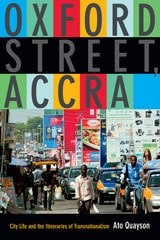
Oxford Street, Accra
City Life and the Itineraries of TransnationalismAto Quayson
Duke University Press, 2014
Secure the Shadow
A NovelMichael Henson
Ohio University Press, 2021
An interconnected web of lives in one midwestern city captures the surprising humanity of people searching for their authentic selves amid the 1990s drug crisis.
Amy Taylor finds the inner-city streets around her high school vibrant and animated compared to the bland middle-class neighborhood where she lives with her career-driven mother. In these streets, she meets the people of the city, among them a wayward boy named Jonathan, a struggling drug dealer, and Paul Lewis, a documentary photographer who becomes Amy’s mentor. Under his inspiration, she attempts to capture their world through the lens of her camera.
From the multiple perspectives of Amy and the expansive group of people she meets, award-winning novelist Michael Henson presents a heartbreaking portrait of the effects the Reagan-initiated drug war had on the young.
Street Archives and City Life
Popular Intellectuals in Postcolonial TanzaniaEmily Callaci
Duke University Press, 2017
That May Not Mean What You Think
StoriesElizabeth Crane
Northwestern University Press, 2026
A visionary and profound new collection from innovative author Elizabeth Crane
Throughout her body of work, Elizabeth Crane’s literary vision has always been singular and innovative, twisting form and bending reality into new universes. Her latest collection, That May Not Mean What You Think, explores themes of aging and youth, gender and discrimination, and sex and love. In “Training Module,” Crane takes the structure and protocol of workplace harassment prevention training and turns it on its head; “The Box” tells the story of a woman trying to recover from divorce with the help of a literal unicorn; and “The Youngs” follows a group of teenagers experiencing loss for the first time, clinging to the belief that they’ll live forever. Across these delightfully weird and disarmingly truthful stories, American culture is refracted through humor and heart, asking readers to consider their complicity and to imagine new possibilities of participating in a better future.
The Luck of the Fall
Jim Ray Daniels
Michigan State University Press, 2023
The Taxi-Dance Hall
A Sociological Study in Commercialized Recreation and City LifePaul Goalby Cressey
University of Chicago Press, 1932
Taxi-dance halls, as the introduction notes, were social centers where men could come and pay to dance with “a bevy of pretty, vivacious, and often mercenary” women. Ten cents per dance was the usual fee, with half the proceeds going to the dancer and the other half to the owner of the taxi-hall. Cressey’s study includes detailed maps of the taxi-dance districts, illuminating interviews with dancers, patrons, and owners, and vivid analyses of local attempts to reform the taxi-dance hall and its attendees.
Cressey’s study reveals these halls to be the distinctive urban consequence of tensions between a young, diverse, and economically independent population at odds with the restrictive regulations of Prohibition America. Thick with sexual vice, ethnic clashes, and powerful undercurrents of class, The Taxi-Dance Hall is a landmark example of Chicago sociology, perfect for scholars and history buffs alike.