Results by title
14 books match the query 'Civil Law'
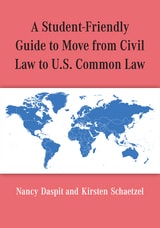
A Student-Friendly Guide to Move from Civil Law to U.S. Common Law
Nancy Daspit and Kirsten Schaetzel
University of Michigan Press, 2025
To help students who may feel overwhelmed adjusting to a new approach to legal education, this book focuses on these key differences between civil law and common law jurisdictions. It defines and demonstrates the application of key concepts with examples, illustrations, and exercises. While relatively brief, it provides numerous references to the other texts and sources for students wanting or needing more depth for some of the topics. The book also includes numerous examples illustrating the differences, with an emphasis on common law examples, of key documents and processes used in the practice of law. Further, it includes student-focused exercises and questions on the analytical and rhetorical skills needed for a successful law practice, whether the student will continue in a common law jurisdiction or merely needs to understand the common law for continued practice in their civil law jurisdiction.
Within this book, students will find
- a brief historical background regarding the development of the common law system;
- a description of the US government structure, with an emphasis on the judicial branch;
- key rhetorical and analytical differences between civil law and common law;
- numerous examples of differences between the two systems, with an emphasis on common law requirements;
- and exercises for practice with key concepts and terminology.
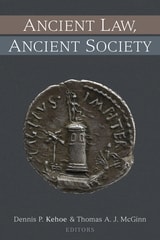
Ancient Law, Ancient Society
Dennis P. Kehoe and Thomas A. J. McGinn, editors
University of Michigan Press, 2017
Essays cover topics such as using collective sanctions to enforce legal norms; the Greek elite’s marriage strategies for amassing financial resources essential for a public career; defenses against murder charges under Athenian criminal law, particularly in cases where the victim put his own life in peril; the interplay between Roman law and provincial institutions in regulating water rights; the Severan-age Greek author Aelian’s notions of justice and their influence on late-classical Roman jurisprudence; Roman jurists’ approach to the contract of mandate in balancing the changing needs of society against respect for upper-class concepts of duty and reciprocity; whether the Roman legal authorities developed the law exclusively to serve the Roman elite’s interests or to meet the needs of the Roman Empire’s broader population as well; and an analysis of the Senatus Consultum Claudianum in the Code of Justinian demonstrating how the late Roman government adapted classical law to address marriage between free women and men classified as coloni bound to their land.
In addition to volume editors Dennis P. Kehoe and Thomas A. J. McGinn, contributors include Adriaan Lanni, Michael Leese, David Phillips, Cynthia Bannon, Lauren Caldwell, Charles Pazdernik, and Clifford Ando.
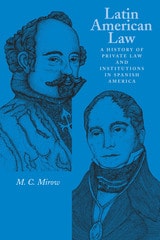
Latin American Law
A History of Private Law and Institutions in Spanish AmericaBy M. C. Mirow
University of Texas Press, 2004
Private law touches every aspect of people's daily lives—landholding, inheritance, private property, marriage and family relations, contracts, employment, and business dealings—and the court records and legal documents produced under private law are a rich source of information for anyone researching social, political, economic, or environmental history. But to utilize these records fully, researchers need a fundamental understanding of how private law and legal institutions functioned in the place and time period under study.
This book offers the first comprehensive introduction in either English or Spanish to private law in Spanish Latin America from the colonial period to the present. M. C. Mirow organizes the book into three substantial sections that describe private law and legal institutions in the colonial period, the independence era and nineteenth century, and the twentieth century. Each section begins with an introduction to the nature and function of private law during the period and discusses such topics as legal education and lawyers, legal sources, courts, land, inheritance, commercial law, family law, and personal status. Each section also presents themes of special interest during its respective time period, including slavery, Indian status, codification, land reform, and development and globalization.
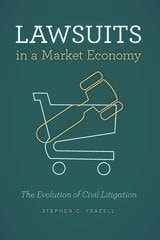
Lawsuits in a Market Economy
The Evolution of Civil LitigationStephen C. Yeazell
University of Chicago Press, 2018
Lawsuits in a Market Economy explains how contemporary civil litigation in the United States works and how it has changed over the past century. The book corrects common misconceptions—some of which have proved remarkably durable even in the face of contrary evidence—and explores how our constitutional structure, an evolving economy, and developments in procedural rules and litigation financing systems have moved us from expecting that lawsuits end in trial and judgments to expecting that they will end in settlements. Yeazell argues that today’s system has in some ways overcome—albeit inconsistently—disparities between the rich and poor in access to civil justice. Once upon a time, might regularly triumphed over right. That is slightly less likely today—even though we continue to witness enormous disparities in wealth and power.
The book concludes with an evaluation of recent changes and their possible consequences.
Mass Torts in a World of Settlement
Richard A. Nagareda
University of Chicago Press, 2007
The traditional definition of torts involves bizarre, idiosyncratic events where a single plaintiff with a physical impairment sues the specific defendant he believes to have wrongfully caused that malady. Yet public attention has focused increasingly on mass personal-injury lawsuits over asbestos, cigarettes, guns, the diet drug fen-phen, breast implants, and, most recently, Vioxx. Richard A. Nagareda’s Mass Torts in a World of Settlement is the first attempt to analyze the lawyer’s role in this world of high-stakes, multibillion-dollar litigation.
These mass settlements, Nagareda argues, have transformed the legal system so acutely that rival teams of lawyers operate as sophisticated governing powers rather than litigators. His controversial solution is the replacement of the existing tort system with a private administrative framework to address both current and future claims. This book is a must-read for concerned citizens, policymakers, lawyers, investors, and executives grappling with the changing face of mass torts.
Northern Lights
Essays in Private Law in Memory of Professor David Carey MillerDouglas Bain, Roderick R.M. Paisley, Andrew R. Simpson and Nikola J.M. Tait
Aberdeen University Press, 2018
Restitution
Civil Liability for Unjust EnrichmentWard Farnsworth
University of Chicago Press, 2014
In Restitution, Ward Farnsworth presents a guide to this body of law that is compact, lively, and insightful—the first treatment of its kind that the American law of restitution has received. The book explains restitution doctrines, remedies, and defenses with unprecedented clarity and illustrates them with vivid examples. Farnsworth demonstrates that the law of restitution is guided by a manageable and coherent set of principles that have remarkable versatility and power. Restitution makes a complex and important area of law accessible, understandable, and interesting to any reader.
Second-Best Justice
The Virtues of Japanese Private LawJ. Mark Ramseyer
University of Chicago Press, 2015
With Second-Best Justice, J. Mark Ramseyer offers a more compelling, better-grounded explanation: the low rate of lawsuits in Japan results not from distrust of a dysfunctional system but from trust in a system that works—that sorts and resolves disputes in such an overwhelmingly predictable pattern that opposing parties rarely find it worthwhile to push their dispute to trial. Using evidence from tort claims across many domains, Ramseyer reveals a court system designed not to find perfect justice, but to “make do”—to adopt strategies that are mostly right and that thereby resolve disputes quickly and economically.
An eye-opening study of comparative law, Second-Best Justice will force a wholesale rethinking of the differences among alternative legal systems and their broader consequences for social welfare.
Secrets, Sex, and Spectacle
The Rules of Scandal in Japan and the United StatesMark D. West
University of Chicago Press, 2006
A leader of a global superpower is betrayed by his mistress, who makes public the sordid details of their secret affair. His wife stands by as he denies the charges. Debates over definitions of moral leadership ensue. Sound familiar? If you guessed Clinton and Lewinsky, try again. This incident involved former Japanese prime minister Sosuke Uno and a geisha.
In Secrets, Sex, and Spectacle, Mark D. West organizes the seemingly random worlds of Japanese and American scandal—from corporate fraud to baseball cheaters, political corruption to celebrity sexcapades—to explore well-ingrained similarities and contrasts in law and society. In Japan and the United States, legal and organizational rules tell us what kind of behavior is considered scandalous. When Japanese and American scandal stories differ, those rules—rules that define what’s public and what’s private, rules that protect injuries to dignity and honor, and rules about sex, to name a few—often help explain the differences. In the cases of Clinton and Uno, the rules help explain why the media didn’t cover Uno’s affair, why Uno’s wife apologized on her husband’s behalf, and why Uno—and not Clinton—resigned.
Secrets, Sex, and Spectacle offers a novel approach to viewing the phenomenon of scandal—one that will be applauded by anyone who has obsessed over (or ridiculed) these public episodes.
State of Segregation
America’s Freedom Rights Struggles as Told by AlabamaMark J. Tenhundfeld
University of Alabama Press, 2026
A revealing legal journey through Alabama’s civil rights battles, exposing systemic discrimination and the enduring fight for justice via landmark Supreme Court cases
State of Segregation: America’s Freedom Rights Struggles, as Told by Alabama by Mark J. Tenhundfeld offers a compelling exploration of Alabama’s civil rights and civil liberties history through the lens of thirty-two pivotal US Supreme Court cases. Each case, rooted in Alabama’s social and legal conflicts, reveals the persistent struggle to fulfill the Constitution’s promises of equal protection and due process. From early twentieth-century challenges to the Alabama Constitution of 1901 to contemporary battles over gerrymandering, Tenhundfeld traces how discrimination was embedded in the state’s institutions—and how it was contested.
State of Segregation uniquely blends legal analysis, historical narrative, and social commentary to expose the deep-rooted systems of racial, gender, and class-based discrimination in Alabama. Tenhundfeld argues that while discrimination is the most defining feature of Alabama’s past, it remains the most difficult to confront. By illuminating the legal strategies used to uphold and dismantle injustice, State of Segregation contributes to the broader understanding of how historical inequities continue to shape modern society.
Accessible to general readers and scholars alike, this work stands apart by combining Alabama history, civil rights struggles, and Supreme Court jurisprudence into a single, powerful narrative. It offers both cautionary tales about the fragility of freedom and enduring lessons for today’s social justice advocates.
The Failure of Corporate Law
Fundamental Flaws and Progressive PossibilitiesKent Greenfield
University of Chicago Press, 2007
When used in conjunction with corporations, the term “public” is misleading. Anyone can purchase shares of stock, but public corporations themselves are uninhibited by a sense of societal obligation or strict public oversight. In fact, managers of most large firms are prohibited by law from taking into account the interests of the public in decision making, if doing so hurts shareholders. But this has not always been the case, as until the beginning of the twentieth century, public corporations were deemed to have important civic responsibilities.
With The Failure of Corporate Law, Kent Greenfield hopes to return corporate law to a system in which the public has a greater say in how firms are governed. Greenfield maintains that the laws controlling firms should be much more protective of the public interest and of the corporation’s various stakeholders, such as employees. Only when the law of corporations is evaluated as a branch of public law—as with constitutional law or environmental law—will it be clear what types of changes can be made in corporate governance to improve the common good. Greenfield proposes changes in corporate governance that would enable corporations to meet the progressive goal of creating wealth for society as a whole rather than merely for shareholders and executives.
The Harmonization of Civil and Commercial Law in Europe
Gian Antonio Benacchio
Central European University Press, 2005
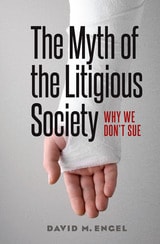
The Myth of the Litigious Society
Why We Don't SueDavid M. Engel
University of Chicago Press, 2016
With this book, David M. Engel demolishes the myth that America is a litigious society. The sobering reality is that the vast majority of injury victims—more than nine out of ten—rely on their own resources, family and friends, and government programs to cover their losses. When real people experience serious injuries, they don’t respond as rational actors. Trauma and pain disrupt their thoughts, and potential claims are discouraged by negative stereotypes that pervade American television and popular culture. (Think Saul Goodman in Breaking Bad, who keeps a box of neck braces in his office to help clients exaggerate their injuries.) Cultural norms make preventable injuries appear inevitable—or the victim’s fault. We’re taught to accept setbacks stoically and not blame someone else. But this tendency to “lump it” doesn’t just hurt the victims; it hurts us all. As politicians continue to push reforms that miss the real problem, we risk losing these claims as a way to quickly identify unsafe products and practices. Because injuries disproportionately fall on people with fewer resources, the existing framework creates a social underclass whose needs must be met by government programs all citizens shoulder while shielding those who cause the harm.
It’s time for America to have a more responsible, blame-free discussion about injuries and the law. With The Myth of the Litigious Society, Engel takes readers clearly and powerfully through what we really know about injury victims and concludes with recommendations for how we might improve the situation.
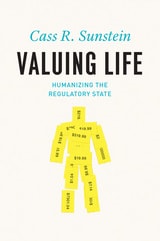
Valuing Life
Humanizing the Regulatory StateCass R. Sunstein
University of Chicago Press, 2014
As OIRA Administrator, Sunstein helped oversee regulation in a broad variety of areas, including highway safety, health care, homeland security, immigration, energy, environmental protection, and education. This background allows him to describe OIRA and how it works—and how it can work better—from an on-the-ground perspective. Using real-world examples, many of them drawn from today’s headlines, Sunstein makes a compelling case for improving cost-benefit analysis, a longtime cornerstone of regulatory decision-making, and for taking account of variables that are hard to quantify, such as dignity and personal privacy. He also shows how regulatory decisions about health, safety, and life itself can benefit from taking into account behavioral and psychological research, including new findings about what scares us, and what does not. By better accounting for people’s fallibility, Sunstein argues, we can create regulation that is simultaneously more human and more likely to achieve its goals.
In this highly readable synthesis of insights from law, policy, economics, and psychology, Sunstein breaks down the intricacies of the regulatory system and offers a new way of thinking about regulation that incorporates human dignity– and an insistent focus on the consequences of our choices.