Results by title
5 books match the query 'Civil service reform'
Civil Service Reform in Brazil
Principles Versus PracticeBy Lawrence S. Graham
University of Texas Press, 1968
In the 1930s, during the authoritarian government of Getúlio Vargas, the Brazilian civil service reform movement began. Thirty-five years later, the actual administrative practices of the country did not adequately reflect the philosophy underlying this movement, a philosophy drawn from the reform experience and public administration theories of the United States and Western Europe. This book examines why these ideas, when transplanted to another cultural setting, did not take root and, further, why they unexpectedly proved to be most applicable in Brazil during periods of autocratic rule.
These questions are highly relevant not only to Brazil, but equally to other developing countries struggling to create more effective national administrative systems. For this reason, and in order to evaluate the Brazilian reform experience within its total context (social, economic, and political), Lawrence S. Graham develops a broad conceptual framework. His focus is on the years between 1945 and 1964, a period which allowed a relatively free play of political forces but, ironically, produced a diminution in the success of the reform efforts when compared with the authoritarian governments which preceded and followed it. After a comparative consideration of the public administration theories behind the reform movement, Graham examines this period in terms of the political environment, the functions of political patronage, and the influences of a nascent national party. Finally, he juxtaposes the conditions and course of the Brazilian reform experience with those of the United States and Great Britain.
Graham’s study of the Brazilian example, which does not pass judgment on the prevailing public personnel system, reveals the importance of understanding the total cultural context within which administrative principles are put into practice. Such an approach, wider than generally held in the field of public administration, may prove to be the most vital factor in the future of the civil service in Brazil and several other countries facing the same problems.
Doing Meritocracy Right
How Business Leaders Can Turn an American Aspiration into Reality (and Why They Should)Thomas A. Cole
University of Chicago Press, 2025
As America’s most vaunted cultural value, meritocracy is celebrated by some as an institution and derided by others as a myth—or even a trap. Thomas A. Cole argues in Doing Meritocracy Right that if meritocracy is to persist as an institution—and it must—it requires structural support in the private sector. For America to achieve a version of meritocracy that more closely matches our aspirations, our business leaders must first offer equity of opportunity for individuals to demonstrate and develop their talents on equal terms.
Drawing on his decades of experience in advising CEOs and corporate boards, personally serving on the boards of major not-for-profits, and leading a large global law firm, Cole cites elite professional-service institutions—consultancies and law firms especially—as improbable laboratories for equity of opportunity. These workplaces, out of self-interest, are laser-focused on the quality of their professionals, seeking out talent and representation and then judging these individuals on (ideally) equal terms once they’re in place. Here, Cole sees an opportunity that no public initiative or platitudes can deliver: if workplaces seek out representational diversity by applying, with thought and care, a single standard of merit—one that emphasizes character—and by providing training and mentoring on an equitable basis, then they will offer a ladder to social and economic mobility that serves both individuals and society.
Cole argues that a meritocratic society is achieved in two interrelated stages: access to education; and post-education promotion to membership in the elite. The latter, he says, is the domain of business. Cole argues that the private sector is better positioned to effect reform and he encourages leaders in the private sector to pursue reform both in their organizations, in government, and in the universities and communities where they have influence.
Meritocracy in the private sector can’t control the many American inequities that exist on the ground of American society. But it can do social good by serving as a reliable, merit-determined path to the highest echelons of business and industry. Cole sets the stage for the discussion of reforms with a “brief history of our imperfect meritocracy,” and rounds out the book with a to-do list for business leaders.
Public Management Reform and Innovation
Research, Theory, and ApplicationH. George Frederickson
University of Alabama Press, 1999
A foundational examination of how research, theory, and innovation shape effective public management and democratic governance.
The subject of reform in the public sector is not new; indeed, its latest rubric, reinventing government, has become good politics. Still, as the contributors ask in this volume, is good politics necessarily good government?
Given the growing desire to reinvent government, there are hard questions to be asked: Is the private sector market model suitable and effective when applied to reforming public and governmental organizations? What are the major political forces affecting reform efforts in public management? How is public management reform accomplished in a constitutional democratic government? How do the values of responsiveness, professionalism, and managerial excellence shape current public management reforms? In this volume, editors H. George Frederickson and Jocelyn M. Johnston bring together scholars with a shared interest in empirical research to confront head-on the toughest questions public managers face in their efforts to meet the demands of reform and innovation.
Throughout the book, the authors consider the bureaucratic resistance that results when downsizing and reinvention are undertaken simultaneously, the dilemma public managers face when elected executives set a reform agenda that runs counter to the law, and the mistaken belief that improved management can remedy flawed policy.
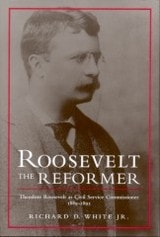
Roosevelt the Reformer
Theodore Roosevelt as Civil Service Commissioner, 1889-1895Richard D. White Jr
University of Alabama Press, 2003
Discover the overlooked years that forged Theodore Roosevelt’s reforming spirit, revealing how bureaucratic battles shaped a future president and transformed American government forever
Roosevelt the Reformer is a compelling scholarly biography that uncovers a neglected chapter of Theodore Roosevelt’s life: his six-year tenure as U.S. Civil Service Commissioner from 1889 to 1895. Rather than focusing on his presidency or battlefield exploits, the book reveals how Roosevelt’s administrative work shaped his reformist zeal, political skills, and enduring impact on American governance. Through vivid narrative and careful analysis, it shows how this “quiet” period contributed directly to the modernization of the federal government and the emergence of the merit-based civil service.
Structured chronologically, the book traces each year of Roosevelt’s commissionership while weaving together political events, personal life, and broader social context. It draws on rich primary sources—letters, speeches, and contemporary accounts—and includes scholarly features such as notes, bibliography, and index. Richard D. White Jr., a historian of American political development, combines narrative storytelling with rigorous research to illuminate Roosevelt’s battles with patronage politics, his reform strategies, and his growing administrative expertise.
This book will appeal to historians, political scientists, and general readers interested in the Gilded Age, the Progressive Era, and the origins of modern government. It is especially valuable for readers seeking fresh perspectives on Theodore Roosevelt, public administration, or reform movements, offering both an engaging biography and a nuanced study of how institutions and leaders are transformed.
The Pursuit of Absolute Integrity
How Corruption Control Makes Government IneffectiveFrank Anechiarico and James B. Jacobs
University of Chicago Press, 1996