Results by title
55 books match the query 'Civil society' and 5 start with a
A Civil Economy
Transforming the Marketplace in the Twenty-First CenturySeveryn T. Bruyn
University of Michigan Press, 2000

African American Fraternal Associations and the History of Civil Society in the United States, Volume 28
Katherine A. Lynch, ed.
Duke University Press, 0
The contributors construct a historical portrait of black fraternal orders during the nineteenth and twentieth centuries. They argue that African Americans were more likely than whites to form fraternal orders and to sustain them, using them to guard members against unemployment and other misfortunes. They examine the ritual life of fraternal organizations, paying particular attention to rites of initiation and to the values they reflected about collective identity, gender relations, equality, and collective action. Finally, they show how social networks that black fraternal organizations fostered led to successful legal battles for the right to assemble and to the later civil rights movement of the twentieth century.
Contributors. Bayliss J. Camp, Marshall Ganz, Orit Kent, Ariane Liazos, Jennifer Lynn Oser, Theda Skocpol, Joe W. Trotter
After the Public Turn
Composition, Counterpublics, and the Citizen BricoleurFrank Farmer
Utah State University Press, 2013
Farmer examines two very different kinds of publics, cultural and disciplinary, and discusses two counterpublics within those broad categories: zine discourses and certain academic discourses. By juxtaposing these two significantly different kinds of publics, Farmer suggests that each discursive world can be seen, in its own distinct way, as a counterpublic, an oppositional social formation that has a stake in widening or altering public life as we know it.
Drawing on major figures in rhetoric and cultural theory, Farmer builds his argument about composition teaching and its relation to the public sphere, leading to a more sophisticated understanding of public life and a deeper sense of what democratic citizenship means for our time.
American Creed
Philanthropy and the Rise of Civil Society, 1700-1865Kathleen D. McCarthy
University of Chicago Press, 2003
The market revolution, participatory democracy, and voluntary associations have all been closely linked since the birth of the United States. American Creed explores the relationships among these three institutions, showing how charities and reform associations forged partnerships with government, provided important safety valves for popular discontent, and sparked much-needed economic development. McCarthy also demonstrates how the idea of philanthropy became crucially wedded to social activism during the Jacksonian era. She explores how acts of volunteerism and charity became involved with the abolitionist movement, educational patronage, the struggle against racism, and female social justice campaigns. What resulted, she contends, were heated political battles over the extent to which women and African Americans would occupy the public stage.
Tracing, then, the evolution of civil society and the pivotal role of philanthropy in the search for and exercise of political and economic power, this book will prove essential to anyone interested in American history and government.
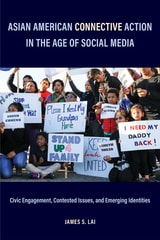
Asian American Connective Action in the Age of Social Media
Civic Engagement, Contested Issues, and Emerging IdentitiesJames S. Lai
Temple University Press, 2022
Social media provides ethno-racial immigrant groups—especially those who cannot vote due to factors such as lack of citizenship and limited English proficiency—the ability to mobilize and connect around collective issues. Online spaces and discussion forums have encouraged many Asian Americans to participate in public policy debates and take action on social justice issues. This form of digital group activism serves as an adaptive political empowerment strategy for the fastest-growing and largest foreign-born population in America. Asian American Connective Action in the Age of Social Media illuminates how associating online can facilitate and amplify traditional forms of political action.
James Lai provides diverse case studies on contentious topics ranging from affirmative action debates to textbook controversies to emphasize the complexities, limitations, and challenges of connective action that is relevant to all racial groups. Using a detailed multi-methods approach that includes national survey data and Twitter hashtag analysis, he shows how traditional immigrants, older participants, and younger generations create online consensus and mobilize offline to foment political change. In doing so, Lai provides a nuanced glimpse into the multiple ways connective action takes shape within the Asian American community.