Results by title
3 books match the query 'Civilization, Assyro-Babylonian'
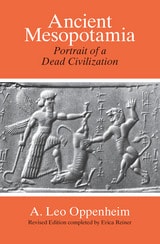
Ancient Mesopotamia
Portrait of a Dead CivilizationA. Leo Oppenheim
University of Chicago Press, 1977
Ancient Mesopotamia—the area now called Iraq—has always received less attention from scholars and the general public than ancient Egypt and other long-extinct and more spectacular civilizations. But numerous small clay tablets buried in the desert soil for thousands of years make it possible for us to know more about the people of ancient Mesopotamia than any other land in the early Near East.
A. Leo Oppenheim, who studied these tablets for more than thirty years, used his intimate knowledge of long-dead languages to put together a distinctively personal picture of the Mesopotamians of some three thousand years ago. At the time of his death in 1974, Oppenheim was working on revisions of the manuscript that, with the help of Erica Reiner, who used the author's revision outline, completed the work that became this book. In the decades since, it has become the definitive work on Ancient Mesopotamia.
The Library of Ancient Wisdom
Mesopotamia and the Making of the Modern WorldSelena Wisnom
University of Chicago Press, 2025
The library of Ashurbanipal, Assyria’s last great king, held an astonishing collection at the forefront of knowledge in its day, from ancient traditions in religion and literature to the latest developments in magic and medicine. When the Assyrian empire fell, the library burned to the ground, and its contents, clay tablets inscribed with cuneiform writing, lay buried for thousands of years until a team of Victorian archaeologists discovered the remnants in modern-day Iraq. The clay had baked and hardened; the very fire that consumed the library had helped its texts to survive for millennia.
In The Library of Ancient Wisdom, scholar Selena Wisnom, one of only a few hundred experts able to read cuneiform script today, guides us inside this important collection and, through its contents, brings ancient Mesopotamia and its people to life. Introducing us to Ashurbanipal and his family, scribes, astrologers, physicians, and more, Wisnom explores the library’s tablets and the details they divulge about how these ancient people thought about the world. Like us, they had concerns about job security, jealous rivalries, and profound friendships, and questions about the meaning of life. Wisnom ushers us into a world where magic was commonplace, where the gods spoke to you in dreams, and where the secrets of the universe were revealed through puns—taking us to the heart of what it means to be human.
Offering a close look at a major historical landmark as well as a readable account of the world’s earliest civilizations, The Library of Ancient Wisdom lays bare the ideas, hopes, fears, and desires that survive on humble clay.
Writing, Law, and Kingship in Old Babylonian Mesopotamia
Dominique Charpin
University of Chicago Press, 2010
Ancient Mesopotamia, the fertile crescent between the Tigris and Euphrates rivers in what is now western Iraq and eastern Syria, is considered to be the cradle of civilization—home of the Babylonian and Assyrian empires, as well as the great Code of Hammurabi. The Code was only part of a rich juridical culture from 2200–1600 BCE that saw the invention of writing and the development of its relationship to law, among other remarkable firsts.
Though ancient history offers inexhaustible riches, Dominique Charpin focuses here on the legal systems of Old Babylonian Mesopotamia and offers considerable insight into how writing and the law evolved together to forge the principles of authority, precedent, and documentation that dominate us to this day. As legal codes throughout the region evolved through advances in cuneiform writing, kings and governments were able to stabilize their control over distant realms and impose a common language—which gave rise to complex social systems overseen by magistrates, judges, and scribes that eventually became the vast empires of history books. Sure to attract any reader with an interest in the ancient Near East, as well as rhetoric, legal history, and classical studies, this book is an innovative account of the intertwined histories of law and language.