Results by title
23 books match the query 'Classical period, 1500-1700'
Amphion
Lyre, Poetry, and Politics in ModernityLeah Middlebrook
University of Chicago Press, 2024
Amphion is the figure in Greek mythology who played so skillfully on a lyre that stones moved of their own accord to build walls for Thebes. While Amphion still presides over music and architecture, he was once fundamental to the concept of lyric poetry. Amphion figured the human power to inspire action, creating and undoing polities by means of language. In contrast to the individual inspiration we associate with the better-known Orpheus, Amphion represents the relentless, often violent, play of harmony and disorder in human social life.
In this wide-ranging study, Leah Middlebrook introduces readers to Amphion-inspired poetics and lyrics and traces the tradition of the Amphionic from the Renaissance through modernist and postmodern poetry and translation from the Hispanic, Anglophone, French, Italian, and ancient Roman worlds. Amphion makes a significant contribution to scholarship on the connection between poetry and politics and the history of the lyric, offering an account well-suited to our times.
An Erotic Philology of Golden Age Spain
Adrienne Laskier Martin
Vanderbilt University Press, 2007
By utilizing theories of deviance, sexuality, and gender; the rhetoric of eroticism; and textual criticism, An Erotic Philology of Golden Age Spain historicizes and analyzes the particular ways in which classical Spanish writers assign symbolic meaning to non-normative sexual practices and their practitioners. It shows how prostitutes, homosexuals, transvestites, women warriors, and female tricksters were stigmatized and marginalized as part of an ordering principle in the law, society, and in literature. It is against these sexual outlaws that early modern orthodoxy establishes and identifies itself during the Golden Age of Spanish letters.
These eroticized figures are recurring objects of contemplation and fascination for Spain's most canonical as well as lesser known writers of the period, in a variety of poetic, prose and dramatic genres. They ultimately reveal attitudes towards sexual behavior that are far more complex than was previously thought. An Erotic Philology of Golden Age Spain thoughtfully anatomizes the interdisciplinary systems at the heart of the varied sexual behaviors depicted in early modern Spanish literature.
Archipelagoes
Insular Fictions from Chivalric Romance to the NovelSimone Pinet
University of Minnesota Press, 2010
Pinet looks closely at Amadís de Gaula and the Liber insularum archipelagi as the first examples of these genres. Both isolario and chivalric romance (libros de caballerías) make of the island a flexible yet cohesive framework that becomes intrinsic to the construction of their respective genres. The popularity of these forms throughout the seventeenth century in turn bears witness to the numerous possibilities the archipelagic structure offered, ultimately taken up by the grand genres of each discipline—the atlas and the novel.
Moving from verbal descriptions to engravings and tapestry weavings, and from the chivalric politics and ethics proposed in the Amadís de Gaula to the Insula Barataria episode in Don Quixote, Pinet’s analysis of insularity and the use of the island structure reveals diverging roles for fiction, illuminating both the emergence of the novel and contemporary philosophical discussion on fiction.
Baroque Horrors
Roots of the Fantastic in the Age of CuriositiesDavid R. Castillo
University of Michigan Press, 2011
"David Castillo takes us on a tour of some horrific materials that have rarely been considered together. He sheds a fantastical new light on the baroque."
---Anthony J. Cascardi, University of California Berkeley
"Baroque Horrors is a textual archeologist's dream, scavenged from obscure chronicles, manuals, minor histories, and lesser-known works of major artists. Castillo finds tales of mutilation, mutation, monstrosity, murder, and mayhem, and delivers them to us with an inimitable flair for the sensational that nonetheless rejects sensationalism because it remains so grounded in historical fact."
---William Egginton, Johns Hopkins University
"Baroque Horrors is a major contribution to baroque ideology, as well as an exploration of the grotesque, the horrible, the fantastic. Castillo organizes his monograph around the motif of curiosity, refuting the belief that Spain is a country incapable of organized scientific inquiry."
---David Foster, Arizona State University
Baroque Horrors turns the current cultural and political conversation from the familiar narrative patterns and self-justifying allegories of abjection to a dialogue on the history of our modern fears and their monstrous offspring. When life and death are severed from nature and history, "reality" and "authenticity" may be experienced as spectator sports and staged attractions, as in the "real lives" captured by reality TV and the "authentic cadavers" displayed around the world in the Body Worlds exhibitions. Rather than thinking of virtual reality and staged authenticity as recent developments of the postmodern age, Castillo looks back to the Spanish baroque period in search for the roots of the commodification of nature and the horror vacui that accompanies it. Aimed at specialists, students, and readers of early modern literature and culture in the Spanish and Anglophone traditions as well as anyone interested in horror fantasy, Baroque Horrors offers new ways to rethink broad questions of intellectual and political history and relate them to the modern age.
David Castillo is Associate Professor and Director of Graduate Studies in the Department of Romance Languages and Literatures at the University at Buffalo, SUNY.
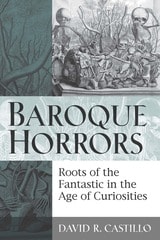
Jacket art: Frederick Ruysch's anatomical diorama. Engraving reproduction "drawn from life" by Cornelius Huyberts. Image from the Zymoglyphic Museum.
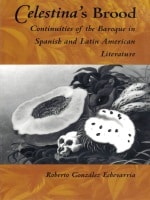
Celestina's Brood
Continuities of the Baroque in Spanish and Latin American LiteratureRoberto González-Echevarría
Duke University Press, 1993
Roberto González Echevarría, one of the most eminent and influential critics of Hispanic literature writing today, uses Rojas' text as his starting point to offer an exploration of modernity in the Hispanic literary tradition, and of the Baroque as an expression of the modern. His analysis of Celestina reveals the relentless probing of the limits of language and morality that mark the work as the beginning of literary modernity in Spanish, and the start of a tradition distinguished by a penchant for the excesses of the Baroque. González Echevarría pursues this tradition and its meaning through the works of major figures such as Cervantes, Lope de Vega, Calderón de la Barca, Alejo Carpentier, Carlos Fuentes, Gabriel García Márquez, Nicolás Guillén, and Severo Sarduy, as well as through the works of lesser-known authors.
By revealing continuities of the Baroque, Celestina's Brood cuts across conventional distinctions between Spanish and Latin American literary traditions to show their profound and previously unimagined affinity.
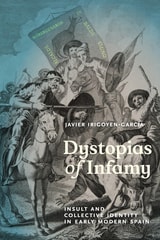
Dystopias of Infamy
Insult and Collective Identity in Early Modern SpainJavier Irigoyen-García
Bucknell University Press, 2022
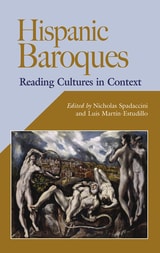
Hispanic Baroques
Reading Cultures in ContextNicholas Spadaccini
Vanderbilt University Press, 2005

Literature Among Discourses
The Spanish Golden AgeWlad Godzich and Nicholas Spadaccini, EditorsIntroduction by Wlad Godzich and Nicholas Spadaccini
University of Minnesota Press, 1986
Literature Among Discourses was first published in 1986. Minnesota Archive Editions uses digital technology to make long-unavailable books once again accessible, and are published unaltered from the original University of Minnesota Press editions.
Literature in the High Middle Ages referred to anything written. Those who institutionalized the study of literature in the eighteenth and nineteenth centuries ignored this medieval meaning, and literary history, especially in the hands of teachers, became what Wlad Godzich and Nicholas Spadaccini call a peregrination from one masterpiece to another. In Spanish literature, a cluster of such masterpieces came to be identified quite early, constituting a siglo de oro,a Golden Age. These outstanding works of the sixteenth and seventeenth centuries became a paradigm of achievement for the German romantics who formulated the project of literary history; for this reason, the authors of Literature among Discourses have chosen to begin their own exploratory voyage with the Spanish Golden Age.
Their intent is not simply to complete the historical record by studying "popular" texts alongside the canonical works, nor is it to establish these texts as a treasure trove of raw materials awaiting entry into and transformation by the masterpiece. They ask, rather, why the masterpiece came to occupy its place—how specific texts (or classes of texts) came to be differentiated from other discursive entities and labeled "literature." Taken together, their essays reveal an era in which literature is never a given, but is instead constantly being forged in a manner as complex as the social dynamic itself.
Contributors include: the editors, José Antonio Maravall, Michael Nerlich, Ronald Sousa, Constance Sullivan, Jenaro Talens, José Luís Canet, and Javier Herrero. Wlad Godzich is director of the Center for Humanistic Studies, and Nicholas Spadaccini, professor of Spanish and Portuguese, at the University of Minnesota.
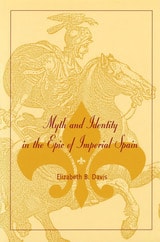
Myth and Identity in the Epic of Imperial Spain
Elizabeth B. Davis
University of Missouri Press, 2026
The first in-depth analysis of some of the most important epic poems of the Spanish Golden Age, Myth and Identity in the Epic of Imperial Spain breathes new life into five of these long- neglected texts. Elizabeth Davis demonstrates that the epic must not be overlooked, for doing so creates a significant gap in one's ability to appraise not only the cultural practice of the imperial age, but also the purest expression of its ideology.
Davis's study focuses on heroic poetry written from 1569 to 1611, including Alonso de Ercilla's La Araucana, undeniably the most significant epic poem of its time. Also included are Diego de Hojeda's La Christiada, Juan Rufo's La Austriada,. Lope de Vega's Jerusalén Conquistada, and Cristóbal de Virués's Historia del Monserrate.
Examining these epics as the major site for the construction of cultural identities and Renaissance nationalist myths, Davis analyzes the means by which the epic constructs a Spanish sense of self. Because this sense of identity is not easily susceptible to direct representation, it is often derived in opposition to an "other," which serves to reaffirm Spanish cultural superiority. The Spanish Christian caballeros are almost always pitted against Amerindians, Muslims, Jews, or other adversaries portrayed as backward or heathen for their cultural and ethnic differences.
The pro-Castilian elite of sixteenth-century Spain faced the daunting task of constructing unity at home in the process of expansion and conquest abroad, yet ethnic and regional differences in the Iberian Peninsula made the creation of an imperial identity particularly difficult. The epic, as Davis shows, strains to convey the overriding image of a Spain that appears more unified than the Spanish empire ever truly was.
An important reexamination of the Golden Age canon, Myth and Identity in the Epic of Imperial Spain brings a new twist to the study of canon formation. While Davis does not ignore more traditional approaches to the literary text, she does apply recent theories, such as deconstruction and feminist criticism, to these poems, resulting in an innovative examination of the material.
Confronting such issues as canonicity, gender, the relationship between literature and Golden Age culture, and that between art and power, this publication offers scholars a new perspective for assessing Golden Age and Transatlantic studies.
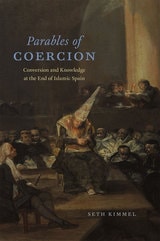
Parables of Coercion
Conversion and Knowledge at the End of Islamic SpainSeth Kimmel
University of Chicago Press, 2015
In its careful examination of how Spanish authors transformed the history of scholarship through debate about forced religious conversion, Parables of Coercion makes us rethink what we mean by tolerance and intolerance, and shows that debates about forced conversion and assimilation were also disputes over the methods and practices that demarcated one scholarly discipline from another.

Persephone's Girdle
Narratives of Rape in Seventeenth-Century Spanish LiteratureMarcia L. Welles
Vanderbilt University Press, 2000
Marcia Welles applies her extensive knowledge of Spanish Golden Age literature and her insightful grasp of current literary theory to synthesize a wide range of material into a uniquely engaging and refreshing interpretation of well-known texts. While the subject of rape and violence has been studied in other European literatures, Persephone's Girdle is the first to do so in the field of early modern Spanish literature.
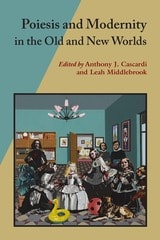
Poiesis and Modernity in the Old and New Worlds
Anthony J. Cascardi
Vanderbilt University Press, 2012
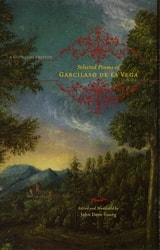
Selected Poems of Garcilaso de la Vega
A Bilingual EditionGarcilaso de la Vega
University of Chicago Press, 2009
Garcilaso de la Vega (ca. 1501–36), a Castilian nobleman and soldier at the court of Charles V, lived a short but glamorous life. As the first poet to make the Italian Renaissance lyric style at home in Spanish, he is credited with beginning the golden age of Spanish poetry. Known for his sonnets and pastorals, gracefully depicting beauty and love while soberly accepting their passing, he is shown here also as a calm student of love’s psychology and a critic of the savagery of war.
This bilingual volume is the first in nearly two hundred years to fully represent Garcilaso for an Anglophone readership. In facing-page translations that capture the music and skill of Garcilaso’s verse, John-Dent Young presents the sonnets, songs, elegies, and eclogues that came to influence generations of poets, including San Juan de la Cruz, Luis de Leon, Cervantes, and Góngora. The Selected Poems of Garcilaso de la Vega will help to explain to the English-speaking public this poet’s preeminence in the pantheon of Spanish letters.
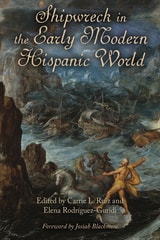
Shipwreck in the Early Modern Hispanic World
Carrie L. Ruiz
Bucknell University Press, 2022
Subtle Subversions
Reading Golden Age Sonnets by Iberian WomenGwyn Fox
Catholic University of America Press, 2008
The Inner Sea
Maritime Literary Culture in Early Modern PortugalJosiah Blackmore
University of Chicago Press, 2022
In this book, Josiah Blackmore considers how the sea and seafaring shaped literary creativity in early modern Portugal during the most active, consequential decades of European overseas expansion. Blackmore understands “literary” in a broad sense, including a diverse archive spanning genres and disciplines—epic and lyric poetry, historical chronicles, nautical documents, ship logs, shipwreck narratives, geographic descriptions, and reference to texts of other seafaring powers and literatures of the period—centering on the great Luís de Camões, arguably the sea poet par excellence of early modern Europe.
Blackmore shows that the sea and nautical travel for Camões and his contemporaries were not merely historical realities; they were also principles of cultural creativity that connected to larger debates in the widening field of the maritime humanities. For Blackmore, the sea, ships, and nautical travel unfold into a variety of symbolic dimensions, and the oceans across the globe that were traversed in the fifteenth and sixteenth centuries correspond to vast reaches within the literary self. The sea and seafaring were not merely themes in textual culture but were also principles that created individual and collective subjects according to oceanic modes of perception. Blackmore concludes with a discussion of depth and sinking in shipwreck narratives as metaphoric and discursive dimensions of the maritime subject, foreshadowing empire’s decline.
The Literature of Jealousy in the Age of Cervantes
Steven Wagschal
University of Missouri Press, 2007
Frequent and complex representations of jealousy in early modern Spanish literature offer symbolically rich and often contradictory images. Steven Wagschal examines these occurrences by illuminating the theme of jealousy in the plays of Lope de Vega, the prose of Miguel de Cervantes, and the complex poetry of Luis de Góngora. Noting the prevalence of this emotion in their work, he reveals what jealousy offered these writers at a time when Spain was beginning its long decline.
The Refracted Muse
Literature and Optics in Early Modern SpainEnrique Garcia Santo-Tomas
University of Chicago Press, 2017
While Spain is often thought to have taken little notice of the Scientific Revolution, García Santo-Tomás tells a different story, one that reveals Golden Age Spanish literature to be in close dialogue with the New Science. Drawing on the work of writers such as Cervantes, Lope de Vega, Calderón de la Barca, and Quevedo, he helps us trace the influence of science and discovery on the rapidly developing and highly playful genre of the novel. Indeed, García Santo-Tomás makes a strong case that the rise of the novel cannot be fully understood without taking into account its relationship to the scientific discoveries of the period.
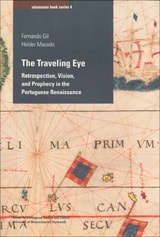
The Traveling Eye
Retrospection, Vision, and Prophecy in the Portuguese RenaissanceFernando Gil
Tagus Press, 2009
The idea for The Traveling Eye came as a new departure in an old dialogue between the two authors, one a literary scholar, the other a philosopher. Our focus was initially centered on a philosophical hypothesis concerning evidence, with specific reference to the prophetic writings of Father António Vieira, but it occurred to us that this perspective could be applied to literary works, particularly those of the Portuguese Renaissance. The studies that one of us had dedicated to the initiatory aspects of The Lusiads and to the codification of esoteric meanings in the work of Bernardim Ribeiro suggested a possible convergence of our two lines of research. But there are other issues raised by the Portuguese Renaissance: voyages, the new, the encounter with difference and how to understand it. The most obvious and direct expression of these issues is found in the chronicles of voyage and empire, whose importance is duly noted in the study by Luís de Sousa Rebelo included in Chapter III of this book. The literary treatment of this material seems to us no less revealing. Seeing ("seeing clearly seen" as Camões says in The Lusiads) poses the problem of simultaneously seeing "what is there" and of how what is there could be seen. This questioning from the outside by "the traveling eye" went hand in hand with new ways of relating to oneself and to others. Three key Renaissance authors, Luís de Camões (1525?-1580), Francisco de Sá de Miranda (1481?-1558?) and Bernardim Ribeiro (b.1480s?), address the human subject's relationship as a perplexing issue. Their works transform the feeling of love into a multifaceted investigation that questions the identity of the individual. A recurring theme in this book is the metamorphoses of the self brought about by love.
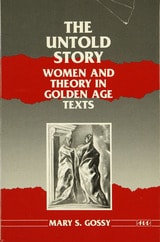
The Untold Story
Women and Theory in Golden Age TextsMary S. Gossy
University of Michigan Press, 1990
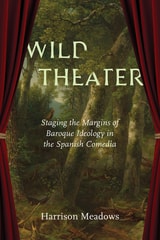
Wild Theater
Staging the Margins of Baroque Ideology in the Spanish ComediaHarrison Meadows
Vanderbilt University Press, 2025
In five compelling chapters, Meadows argues that a major shift occurred during the Baroque period, whereby the largely positive quality of previous iterations in the genealogy of wildness take on a negative character in the cultural ethos—and that this fundamental shift was representative of the influence of Spanish colonialism on racial thinking and a larger set of changes in how early modern people viewed gender and class. In this way, the book identifies the wild figure’s dramatic roots in the carnivalesque as an indispensable point of departure to plot the trajectory of wild representation in the theater of the Hispanic Baroque. From this guiding premise, Meadows traces the carryovers, transformations, and negations of the carnivalesque into early modern dramaturgy, specifically the Spanish comedia, which are emblematic of the poetic and ideological features of the emerging commercial theater in Iberia.
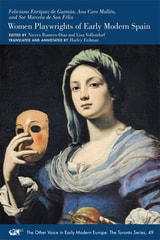
Women Playwrights of Early Modern Spain
Feliciana Enríquez de Guzmán, Ana Caro Mallén, and Sor Marcela de San Félix
Iter Press, 2016
This volume presents ten plays by three leading women playwrights of Spain’s Golden Age. Included are four bawdy and outrageous comic interludes; a full-length comedy involving sorcery, chivalry, and dramatic stage effects; and five short religious plays satirizing daily life in the convent. A critical introduction to the volume positions these women and their works in the world of seventeenth-century Spain.
Women Warriors in Early Modern Spain
A Tribute to Barbara MujicaSusan L. Fischer
University of Delaware Press, 2019
Published by University of Delaware Press. Distributed worldwide by Rutgers University Press.