Results by title
9 books match the query 'Classicism'
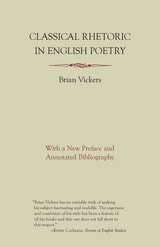
Classical Rhetoric in English Poetry
Brian Vickers
Southern Illinois University Press, 1989
Back in print after 17 years, this is a concise history of rhetoric as it relates to structure, genre, and style, with special reference to English literature and literary criticism from Ancient Greece to the end of the 18th century.
The core of the book is a quite original argument that the figures of rhetoric were not mere mechanical devices, were not, as many believed, a "nuisance, a quite sterile appendage to rhetoric to which (unaccountably) teachers, pupils, and writers all over the world devoted much labor for over 2,000 years." Rather, Vickers demonstrates, rhetoric was a stylized representation of language and human feelings.
Vickers supplements his argument through analyses of the rhetorical and emotional structure of four Renaissance poems. He also defines 16 of the most common figures of rhetoric, citing examples from the classics, the Bible, and major English poets from Chaucer to Pope.
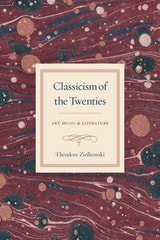
Classicism of the Twenties
Art, Music, and LiteratureTheodore Ziolkowski
University of Chicago Press, 2014
In Classicism of the Twenties, Theodore Ziolkowski offers a compelling account of that movement. Giving equal attention to music, art, and literature, and focusing in particular on the works of Stravinsky, Picasso, and T. S. Eliot, he shows how the turn to classicism manifested itself. In reaction both to the excesses of neoromanticism and early modernism and to the horrors of World War I—and with respectful detachment—artists, writers, and composers adapted themes and forms from the past and tried to imbue their own works with the values of simplicity and order that epitomized earlier classicisms.
By identifying elements common to all three arts, and carefully situating classicism within the broader sweep of modernist movements, Ziolkowski presents a refreshingly original view of the cultural life of the 1920s.
Commerce with the Classics
Ancient Books and Renaissance ReadersAnthony Grafton
University of Michigan Press, 1997
Complacency
Classics and Its Displacement in Higher EducationJohn T. Hamilton
University of Chicago Press, 2022
In response to philosopher Simon Blackburn’s portrayal of complacency as a vice that impairs university study at its core, John T. Hamilton examines the history of complacency in classics and its implications for our contemporary moment.
The subjects, philosophies, and literatures of ancient Greece and Rome were once treated as the foundation of learning, with everything else devolving from them. Hamilton investigates what this model of superiority, derived from the golden age of the classical tradition, shares with the current hegemony of mathematics and the natural sciences. He considers how the qualitative methods of classics relate to the quantitative positivism of big data, statistical reasoning, and presumably neutral abstraction, which often dismiss humanist subjectivity, legitimize self-sufficiency, and promote a fresh brand of academic complacency. In acknowledging the reduced status of classics in higher education today, he questions how scholarly striation and stagnation continue to bolster personal, ethical, and political complacency in our present era.
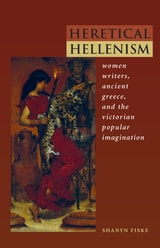
Heretical Hellenism
Women Writers, Ancient Greece, and the Victorian Popular ImaginationShanyn Fiske
Ohio University Press, 2008
The prevailing assumption regarding the Victorians’ relationship to ancient Greece is that Greek knowledge constituted an exclusive discourse within elite male domains. Heretical Hellenism: Women Writers, Ancient Greece, and the Victorian Popular Imagination challenges that theory and argues that while the information women received from popular sources was fragmentary and often fostered intellectual insecurities, it was precisely the ineffability of the Greek world refracted through popular sources and reconceived through new fields of study that appealed to women writers’ imaginations.
Examining underconsidered sources such as theater history and popular journals, Shanyn Fiske uncovers the many ways that women acquired knowledge of Greek literature, history, and philosophy without formal classical training. Through discussions of women writers such as Charlotte Brontë, George Eliot, and Jane Harrison, Heretical Hellenism demonstrates that women established the foundations of a heretical challenge to traditional humanist assumptions about the uniformity of classical knowledge and about women’s place in literary history.
Heretical Hellenism provides a historical rationale for a more expansive definition of classical knowledge and offers an interdisciplinary method for understanding the place of classics both in the nineteenth century and in our own time.
Latin Classics in Medieval Hungary
Eleventh CenturyElod Nemerkényi
Central European University Press, 2004
Matthew Arnold and the Classical Tradition
Warren D. Anderson
University of Michigan Press, 1988
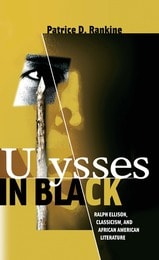
Ulysses in Black
Ralph Ellison, Classicism, and African American LiteraturePatrice D. Rankine
University of Wisconsin Press, 2008
In this groundbreaking work, Patrice D. Rankine asserts that the classics need not be a mark of Eurocentrism, as they have long been considered. Instead, the classical tradition can be part of a self-conscious, prideful approach to African American culture, esthetics, and identity. Ulysses in Black demonstrates that, similar to their white counterparts, African American authors have been students of classical languages, literature, and mythologies by such writers as Homer, Euripides, and Seneca.
Ulysses in Black closely analyzes classical themes (the nature of love and its relationship to the social, Dionysus in myth as a parallel to the black protagonist in the American scene, misplaced Ulyssean manhood) as seen in the works of such African American writers as Ralph Ellison, Toni Morrison, and Countee Cullen. Rankine finds that the merging of a black esthetic with the classics—contrary to expectations throughout American culture—has often been a radical addressing of concerns including violence against blacks, racism, and oppression. Ultimately, this unique study of black classicism becomes an exploration of America’s broader cultural integrity, one that is inclusive and historic.
Outstanding Academic Title, Choice Magazine
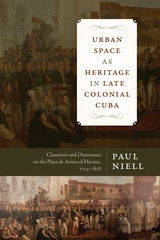
Urban Space as Heritage in Late Colonial Cuba
Classicism and Dissonance on the Plaza de Armas of Havana, 1754-1828By Paul Niell
University of Texas Press, 2015
According to national legend, Havana, Cuba, was founded under the shade of a ceiba tree whose branches sheltered the island’s first Catholic mass and meeting of the town council (cabildo) in 1519. The founding site was first memorialized in 1754 by the erection of a baroque monument in Havana’s central Plaza de Armas, which was reconfigured in 1828 by the addition of a neoclassical work, El Templete. Viewing the transformation of the Plaza de Armas from the new perspective of heritage studies, this book investigates how late colonial Cuban society narrated Havana’s founding to valorize Spanish imperial power and used the monuments to underpin a local sense of place and cultural authenticity, civic achievement, and social order.
Paul Niell analyzes how Cubans produced heritage at the site of the symbolic ceiba tree by endowing the collective urban space of the plaza with a cultural authority that used the past to validate various place identities in the present. Niell’s close examination of the extant forms of the 1754 and 1828 civic monuments, which include academic history paintings, neoclassical architecture, and idealized sculpture in tandem with period documents and printed texts, reveals a “dissonance of heritage”—in other words, a lack of agreement as to the works’ significance and use. He considers the implications of this dissonance with respect to a wide array of interests in late colonial Havana, showing how heritage as a dominant cultural discourse was used to manage and even disinherit certain sectors of the colonial population.