Results by title
3 books match the query 'Clearcutting'

Edge Effects
Notes From An Oregon ForestChris Anderson
University of Iowa Press, 1993
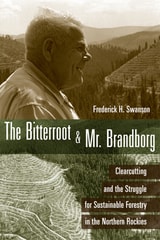
The Bitterroot and Mr. Brandborg
Clearcutting and the Struggle for Sustainable Forestry in the Northern RockiesFrederick H. Swanson
University of Utah Press, 2011
Winner of the Wallace Stegner Prize in American Environmental or Western History
Fredrick Swanson tells the story of Guy M. Brandborg and his impact on the practices of the U.S. Forest Service. As supervisor of Montana’s Bitterroot National Forest from 1935 to 1955, Brandborg engaged in a management style that promoted not only the well-being of the forest community but also the social and economic welfare of the local people. By relying on selective cutting, his goal was to protect the watersheds and wildlife habitats that are devastated by clear-cutting, and to prevent the job losses that follow such practices. Following his retirement, he became concerned that his agency was deviating from the practice of sustained-yield management of the forest’s timber lands, and led a highly visible public outcry that became known as the Bitterroot controversy. Brandborg’s behind-the-scenes lobbying contributed materially to the passage of the National Forest Management Act of 1976, the single most important law affecting public forestry since the creation of the Forest Service.
Winner of the Western Writers of America Spur Award for Best Western Nonfiction-Contemporary.
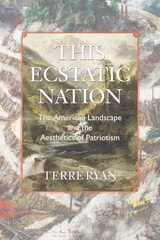
This Ecstatic Nation
The American Landscape and the Aesthetics of PatriotismTerre Ryan
University of Massachusetts Press, 2011
Terre Ryan examines this phenomenon by exploring the overlapping trails of national mythology, landscape aesthetics, patriotic discourse, and public policy. Tracing her journeys around bombing grounds in Nevada, logging sites in Oregon, and energy fields in Wyoming, she argues that business and government agencies often frame commercial projects and national myths according to nineteenth-century beliefs about landscape and bounty. Advertisements and political promotional materials following this aesthetic framework perpetuate frontier-era ideas about the environment as commodity, scenery, and cultural trashlands. Transmitted through all types of media, nineteenth-century perspectives on landscape continue to inform mainstream perceptions of the environment, environmental policies, and representations of American patriotism.
Combining personal narrative with factual reportage, political and cultural critique, and historical analysis, Ryan reframes the images we see every day and places them into a larger national narrative.