Results by title
5 books match the query 'Closet'

Against the Closet
Black Political Longing and the Erotics of RaceAliyyah I. Abdur-Rahman
Duke University Press, 2012
Abdur-Rahman brings black feminist, psychoanalytic, critical race, and poststructuralist theories to bear on literary genres from slave narratives to science fiction. Analyzing works by African American writers, including Frederick Douglass, Pauline Hopkins, Harriet Jacobs, James Baldwin, and Octavia Butler, she shows how literary representations of transgressive sexuality expressed the longings of African Americans for individual and collective freedom. Abdur-Rahman contends that those representations were fundamental to the development of African American forms of literary expression and modes of political intervention and cultural self-fashioning.

Before the Closet
Same-Sex Love from "Beowulf" to "Angels in America"Allen J. Frantzen
University of Chicago Press, 1998
With its ambitious scope and elegant style, Before the Closet sets same-sex relations in Anglo-Saxon sources in relation to the sexual themes of contemporary opera, dance, and theatre. Frantzen offers a comprehensive analysis of sources from the seventh to the twelfth century and traces Anglo-Saxon same-sex behavior through the age of Chaucer and into the Renaissance.
"Frantzen's marvelous book . . . opens up a world most readers will never have even known was there. It's a difficult topic, but Frantzen's comprehensive, readable and even wryly funny treatment makes this an unexpected pleasure."—Publishers Weekly, starred review
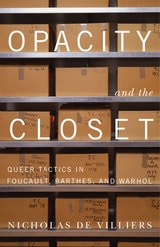
Opacity and the Closet
Queer Tactics in Foucault, Barthes, and WarholNicholas de Villiers
University of Minnesota Press, 2012
Opacity and the Closet interrogates the viability of the metaphor of “the closet” when applied to three important queer figures in postwar American and French culture: the philosopher Michel Foucault, the literary critic Roland Barthes, and the pop artist Andy Warhol. Nicholas de Villiers proposes a new approach to these cultural icons that accounts for the queerness of their works and public personas.
Rather than reading their self-presentations as “closeted,” de Villiers suggests that they invent and deploy productive strategies of “opacity” that resist the closet and the confessional discourse associated with it. Deconstructing binaries linked with the closet that have continued to influence both gay and straight receptions of these intellectual and pop celebrities, de Villiers illuminates the philosophical implications of this displacement for queer theory and introduces new ways to think about the space they make for queerness.
Using the works of Foucault, Barthes, and Warhol to engage each other while exploring their shared historical context, de Villiers also shows their queer appropriations of the interview, the autobiography, the diary, and the documentary—forms typically linked to truth telling and authenticity.

Rocking the Closet
How Little Richard, Johnnie Ray, Liberace, and Johnny Mathis Queered Pop MusicVincent Stephens
University of Illinois Press, 2019
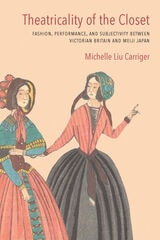
Theatricality of the Closet
Fashion, Performance, and Subjectivity between Victorian Britain and Meiji JapanMichelle Liu Carriger
Northwestern University Press, 2023
Clothing matters. This basic axiom is both common sense and, in another way, radical. It is from this starting point that Michelle Liu Carriger elucidates the interconnected ways in which gender, sexuality, class, and race are created by the everyday act of getting dressed. Theatricality of the Closet: Fashion, Performance, and Subjectivity between Victorian Britain and Meiji Japan examines fashion and clothing controversies of the nineteenth century, drawing on performance theory to reveal how the apparently superficial or frivolous deeply affects the creation of identity.
By interrogating a set of seemingly disparate examples from the same period but widely distant settings—Victorian Britain and Meiji-era Japan—Carriger disentangles how small, local, ordinary practices became enmeshed in a global fabric of cultural and material surfaces following the opening of trade between these nations in 1850. This richly illustrated book presents an array of media, from conservative newspapers and tabloids to ukiyo-e and early photography, that locate dress as a site where the individual and the social are interwoven, whether in the 1860s and 1870s or the twenty-first century.