Results by title
25 books match the query 'Clothing trade'
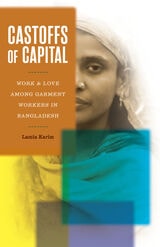
Castoffs of Capital
Work and Love among Garment Workers in BangladeshLamia Karim
University of Minnesota Press, 2022
FINALIST FOR THE GREGORY BATESON PRIZE FROM THE AMERICAN ANTHROPOLOGICAL ASSOCIATION
Dispelling stereotypes about garment workers in the global apparel industry
Castoffs of Capital examines how female garment workers experience their work and personal lives within the stranglehold of global capital. Drawing on fieldwork in Bangladesh, anthropologist Lamia Karim focuses attention onto the lives of older women aged out of factory work, heretofore largely ignored, thereby introducing a new dimension to the understanding of a female-headed workforce that today numbers around four million in Bangladesh.
Bringing a feminist labor studies lens, Castoffs of Capital foregrounds these women not only as workers but as mothers, wives, sisters, lovers, friends, and political agents. Focusing on relations among work, gender, and global capital’s targeting of poor women to advance its market penetration, Karim shows how women navigate these spaces by adopting new subject formations. She locates these women’s aspirations for the “good life” not only in material comforts but also in their longings for love and sexual fulfillment that help them momentarily forget the precarity of their existence under the shadow of capital.
Through richly detailed ethnographic studies, this innovative and beautifully written book examines the making and unmaking of these women’s wants and desires, loves and tribulations, hopes and despairs, and triumphs and struggles.

Clean Clothes
A Global Movement to End SweatshopsLiesbeth Sluiter
Pluto Press, 2009
The Clean Clothes Campaign is a worldwide movement that aims to improve the wages and conditions of sweatshop workers. This is the story of their struggle.
Large retailers such as Tesco, Walmart and Carrefour lure shoppers in with prices that seem too good to be true. This book shows that they're too good to be fair. All along the industry's supply chain, workers, often children, are exploited through poverty wages, unpaid overtime and harsh anti-union measures. The campaign urges those in charge of the garment industry's supply lines to protect their workers and treat them fairly.
This dynamic account of direct engagement by concerned consumers is a must read for those that see globalisation differently and want their shopping choices to support the most vulnerable people involved in the clothing industry.
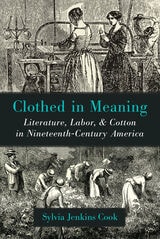
Clothed in Meaning
Literature, Labor, and Cotton in Nineteenth-Century AmericaSylvia Jenkins Cook
University of Michigan Press, 2020
Cloth and clothing provide potent tropes not only for physical but also for intellectual forms of self-expression. Drawing on sources ranging from fugitive slave narratives, newspapers, manifestos, and mill workers’ magazines to fiction, poetry, and autobiographies, Clothed in Meaning examines the significant part played by mill workers and formerly enslaved people, many of whom still worked picking cotton, in this revolution of literary self-expression. They created a new literature from their palpable daily intimacy with cotton, cloth, and clothing, as well as from their encounters with grimly innovative modes of work. In the materials of their labor they discovered vivid tropes for formulating their ideas and an exotic and expert language for articulating them. The harsh conditions of their work helped foster in their writing a trenchant irony toward the demeaning reduction of human beings to “hands” whose minds were unworthy of interest. Ultimately, Clothed in Meaning provides an essential examination of the intimate connections between oppression and luxury as recorded in the many different voices of nineteenth-century labor.

Couture and Consensus
Fashion and Politics in Postcolonial ArgentinaRegina A. Root
University of Minnesota Press, 2010

Emily Dickinson and the Labor of Clothing
Daneen Wardrop
University of New Hampshire Press, 2009
Fabricating Transnational Capitalism
A Collaborative Ethnography of Italian-Chinese Global FashionLisa Rofel and Sylvia J. Yanagisako
Duke University Press, 2018
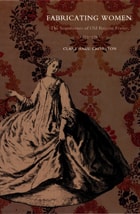
Fabricating Women
The Seamstresses of Old Regime France, 1675–1791Clare Haru Crowston
Duke University Press, 2001
Fabricating Women examines the social institution of the seamstresses’ guild in France from the time of Louis XIV to the Revolution. In contrast with previous scholarship on women and gender in the early modern period, Clare Haru Crowston asserts that the rise of the absolute state, with its centralizing and unifying tendencies, could actually increase women’s economic, social, and legal opportunities and allow them to thrive in corporate organizations such as the guild. Yet Crowston also reveals paradoxical consequences of the guild’s success, such as how its growing membership and visibility ultimately fostered an essentialized femininity that was tied to fashion and appearances.
Situating the seamstresses’ guild as both an economic and political institution, Crowston explores in particular its relationship with the all-male tailors’ guild, which had dominated the clothing fabrication trade in France until women challenged this monopoly during the seventeenth century. Combining archival evidence with visual images, technical literature, philosophical treatises, and fashion journals, she also investigates the techniques the seamstresses used to make and sell clothing, how the garments reflected and shaped modern conceptions of femininity, and guild officials’ interactions with royal and municipal authorities. Finally, by offering a revealing portrait of these women’s private lives—explaining, for instance, how many seamstresses went beyond traditional female boundaries by choosing to remain single and establish their own households—Crowston challenges existing ideas about women’s work and family in early modern Europe.
Although clothing lay at the heart of French economic production, social distinction, and cultural identity, Fabricating Women is the first book to investigate this immense and archetypal female guild in depth. It will be welcomed by students and scholars of French and European history, women’s and labor history, fashion and technology, and early modern political economy.
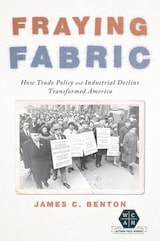
Fraying Fabric
How Trade Policy and Industrial Decline Transformed AmericaJames C. Benton
University of Illinois Press, 2022
Free Trade & Uneven Development
North American Apparel Industry After Naftaedited by Gary Gereffi, David Spener and Jennifer Bair
Temple University Press, 2002
Global Production
The Apparel Industry in the Pacific Rimedited by Edna Bonacich, Lucie Cheng, Norma Chinchilla, Nora Hamilton and Paul Ong
Temple University Press, 1994
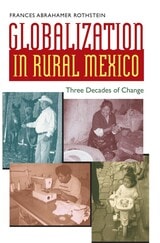
Globalization in Rural Mexico
Three Decades of ChangeBy Frances Abrahamer Rothstein
University of Texas Press, 2007
Winner, Society of the Anthropology of Work Book Prize, 2010
When the ever-intensifying global marketplace "modernizes" rural communities, who stands to gain? Can local residents most impacted by changes to their social fabric ever recover or even identify what has been lost?
Frances Abrahamer Rothstein uses thirty years of sustained anthropological fieldwork in the rural Mexican community of San Cosme Mazatecochco to showcase globalization's complexities and contradictions.
Rothstein's lucid work chronicles the changes in production, consumption, and social relations during three distinct periods: the Mexican "miracle," when economic development fueled mobility for a large segment of the population, including San Cosme's worker-peasants; the lost decade of the 1980s, when much of what had been gained was lost; and the recent period of trade liberalization and globalization, considered by many in Mexico and beyond as a panacea and a disaster at the same time.
After Mexico's textile industry decline in the late 1980s, some families of former textile workers in San Cosme opened home workshops—talleres—and a small-scale, textile-based economy took root. These families, who managed to prosper through their own trade and industry, demonstrate that those who rely on consumer demand for their livelihood need not always follow the dictate of the marketplace, but rather can position themselves assertively to influence alternative economic possibilities held close to their culture.
Employing rich ethnography and broad analysis, Rothstein focuses on how everyday life has been transformed by these processes, but shows also how important continuities with the past persist. She strikes a delicate balance between firmly grounded scientific study and a deep compassion for the subjects of her work, while challenging contemporary views of globalization and consumption.

Levi Strauss
The Man Who Gave Blue Jeans to the WorldLynn Downey
University of Massachusetts Press, 2016
Blue jeans are globally beloved and quintessentially American. They symbolize everything from the Old West to the hippie counter-culture; everyone from car mechanics to high-fashion models wears jeans. And no name is more associated with blue jeans than Levi Strauss & Co., the creator of this classic American garment.
As a young man Levi Strauss left his home in Germany and immigrated to America. He made his way to San Francisco and by 1853 had started his company. Soon he was a leading businessman in a growing commercial city that was beginning to influence the rest of the nation. Family-centered and deeply rooted in his Jewish faith, Strauss was the hub of a wheel whose spokes reached into nearly every aspect of American culture: business, philanthropy, politics, immigration, transportation, education, and fashion.
But despite creating an American icon, Levi Strauss is a mystery. Little is known about the man, and the widely circulated "facts" about his life are steeped in mythology. In this first full-length biography, Lynn Downey sets the record straight about this brilliant businessman. Strauss's life was the classic American success story, filled with lessons about craft and integrity, leadership and innovation.
Making It at Any Cost
Aspirations and Politics in a Counterfeit Clothing MarketplaceBy Matías Dewey
University of Texas Press, 2020
La Salada is South America’s largest marketplace for fraudulently labeled clothing, a sprawling and dangerous bazaar on the fringes of Buenos Aires where counterfeit goods are bought and sold, armed thieves roam the nearby streets, and corrupt police and politicians turn a blind eye to widespread unlawful behaviors. Despite conditions traditionally considered inhospitable to economic growth—including acute interpersonal distrust, pervasive personal insecurity, and rampant violence—business in La Salada is booming under an established order completely detached from the state.
Matías Dewey dives deep into the world of La Salada to examine how market exchanges function outside the law and how agreements and norms develop in the economy for counterfeit clothing. Drawing on seven months of ethnographic research and more than a hundred interviews, Dewey argues that aspirations for a better future shape garment workers’ everyday practices, from their home-based sweatshops to the market stalls. The book unearths a new configuration of garment production and commercialization detached from global supply chains, submerged in the shadows of informality and illegality, and rooted in aspiration and opportunity.
Monitoring Sweatshops
Workers, Consumers, And TheJill Esbenshade
Temple University Press, 2004
Salaula
The World of Secondhand Clothing and ZambiaKaren Tranberg Hansen
University of Chicago Press, 2000
Essential for the African economy, the secondhand clothing business is wildly popular, to the point of threatening the indigenous textile industry. But, Hansen shows, wearing secondhand clothes is about much more than imitating Western styles. It is about taking a garment and altering it to something entirely local, something that adheres to current cultural norms of etiquette. By unraveling how these garments becomes entangled in the economic, political, and cultural processes of contemporary Zambia, Hansen also raises provocative questions about environmentalism, charity, recycling, and thrift.
Slaves to Fashion
Poverty and Abuse in the New SweatshopsRobert J. S. Ross
University of Michigan Press, 2004
---Tom Hayden
"Slaves to Fashion is a remarkable achievement, several books in one: a gripping history of sweatshops, explaining their decline, fall, and return; a study of how the media portray them; an analysis of the fortunes of the current anti-sweatshop movement; an anatomy of the global traffic in apparel, in particular the South-South competition that sends wages and working conditions plummeting toward the bottom; and not least, a passionate declaration of faith that humanity can find a way to get its work done without sweatshops. This is engaged sociology at its most stimulating."
---Todd Gitlin
". . . unflinchingly portrays the reemergence of the sweatshop in our dog-eat-dog economy."
---Los Angeles Times
Just as Barbara Ehrenreich's Nickel and Dimed uncovered the plight of the working poor in America, Robert J. S. Ross's Slaves to Fashion exposes the dark side of the apparel industry and its exploited workers at home and abroad. It's both a lesson in American business history and a warning about one of the most important issues facing the global capital economy-the reappearance of the sweatshop.
Vividly detailing the decline and tragic rebirth of sweatshop conditions in the American apparel industry of the twentieth century, Ross explains the new sweatshops as a product of unregulated global capitalism and associated deregulation, union erosion, and exploitation of undocumented workers. Using historical material and economic and social data, the author shows that after a brief thirty-five years of fair practices, the U.S. apparel business has once again sunk to shameful abuse and exploitation.
Refreshingly jargon-free but documented in depth, Slaves to Fashion is the only work to estimate the size of the sweatshop problem and to systematically show its impact on apparel workers' wages. It is also unique in its analysis of the budgets and personnel used in enforcing the Fair Labor Standards Act.
Anyone who is concerned about this urgent social and economic topic and wants to go beyond the headlines should read this important and timely contribution to the rising debate on low-wage factory labor.
Strategizing against Sweatshops
The Global Economy, Student Activism, and Worker EmpowermentMatthew S. Williams
Temple University Press, 2020
For the past few decades, the U.S. anti-sweatshop movement was bolstered by actions from American college students. United Students Against Sweatshops (USAS) effectively advanced the cause of workers’ rights in sweatshops around the world. Strategizing against Sweatshops chronicles the evolution of student activism and presents an innovative model of how college campuses are a critical site for the advancement of global social justice.
Matthew Williams shows how USAS targeted apparel companies outsourcing production to sweatshop factories with weak or non-existent unions. USAS did so by developing a campaign that would support workers organizing by leveraging their college’s partnerships with global apparel firms like Nike and Adidas to abide by pro-labor codes of conduct.
Strategizing against Sweatshops exemplifies how organizations and actors cooperate across a movement to formulate a coherent strategy responsive to the conditions in their social environment. Williams also provides a model of political opportunity structure to show how social context shapes the chances of a movement’s success—and how movements can change that political opportunity structure in turn. Ultimately, he shows why progressive student activism remains important.
The Anti-Capitalist Book of Fashion
Tansy E.
Pluto Press, 2022
The award-winning classic on why we must revolutionise the fashion industry
*Selected by Emma Watson for her Ultimate Book List*
Fashion is political. From the red carpets of the Met Gala to online fast fashion, clothes tell a story of inequality, racism, and climate crisis. In The Anti-Capitalist Book of Fashion, Tansy E. Hoskins unpicks the threads of capitalist industry to reveal the truth about our clothes.
Fashion brands entice us to consume more by manipulating us to feel ugly, poor and worthless, sentiments that line the pockets of billionaires exploiting colonial supply chains. Garment workers on poverty pay risk their lives in dangerous factories, animals are tortured, fossil fuels extracted and toxic chemicals spread just to keep this season's collections fresh.
We can do better than this. Moving between Karl Lagerfeld and Karl Marx, The Anti-Capitalist Book of Fashion goes beyond ethical fashion and consumer responsibility showing that if we want to feel comfortable in our clothes, we need to reshape the system and ensure this is not our last season.
The Needle's Eye
Women and Work in the Age of RevolutionMarla R. Miller
University of Massachusetts Press, 2006
In this book, Marla R. Miller illuminates the significance of women's work in the clothing trades of the early Republic. Drawing on diaries, letters, reminiscences, ledgers, and material culture, she explores the contours of working women's lives in rural New England, offering a nuanced view of their varied ranks and roles—skilled and unskilled, black and white, artisanal and laboring—as producers and consumers, clients and craftswomen, employers and employees. By plumbing hierarchies of power and skill, Miller explains how needlework shaped and reflected the circumstances of real women's lives, at once drawing them together and setting them apart.
The heart of the book brings into focus the entwined experiences of six women who lived in and around Hadley, Massachusetts, a thriving agricultural village nestled in a bend in the Connecticut River about halfway between the Connecticut and Vermont borders. Miller's examination of their distinct yet overlapping worlds reveals the myriad ways that the circumstances of everyday lives positioned women in relationship to one another, enlarging and limiting opportunities and shaping the trajectories of days, years, and lifetimes in ways both large and small. The Needle's Eye reveals not only how these women thought about their work, but how they thought about their world.

The Texture of Change
Dress, Self-Fashioning, and History in Western Africa, 1700–1850Jody Benjamin
Ohio University Press, 2024
Jody Benjamin analyzes a range of archival, visual, oral, and material sources drawn from three continents to illuminate entanglements between local textile industries and global commerce and between the politics of Islamic reform and encroaching European colonial power. The study highlights the roles of a diverse range of historical actors mentioned only glancingly in core-periphery or Atlantic-centered framings: women indigo dyers, maroon cotton farmers, petty traveling merchants, caravan guides, and African Diaspora settlers. It argues that their combined choices within a set of ecological, political, and economic constraints structured networks connecting the Atlantic and Indian Ocean perimeters.

The Triangle Fire, Protocols Of Peace
And Industrial Democracy In ProgressiveRichard A. Greenwald
Temple University Press, 2005
Threads
Gender, Labor, and Power in the Global Apparel IndustryJane L. Collins
University of Chicago Press, 2003
To dispel these misunderstandings, Jane L. Collins visited two very different apparel firms and their factories in the United States and Mexico. Moving from corporate headquarters to factory floors, her study traces the diverse ties that link First and Third World workers and managers, producers and consumers. Collins examines how the transnational economics of the apparel industry allow firms to relocate or subcontract their work anywhere in the world, making it much harder for garment workers in the United States or any other country to demand fair pay and humane working conditions.
Putting a human face on globalization, Threads shows not only how international trade affects local communities but also how workers can organize in this new environment to more effectively demand better treatment from their distant corporate employers.
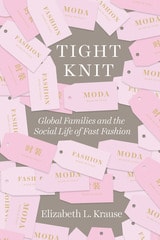
Tight Knit
Global Families and the Social Life of Fast FashionElizabeth L. Krause
University of Chicago Press, 2018
Krause offers a revelatory look into how families involved in the fashion industry are coping with globalization based on longterm research in Prato, the historic hub of textile production in the heart of metropolitan Tuscany. She brings to the fore the tensions—over value, money, beauty, family, care, and belonging—that are reaching a boiling point as the country struggles to deal with the same migration pressures that are triggering backlash all over Europe and North America. Tight Knit tells a fascinating story about the heterogeneity of contemporary capitalism that will interest social scientists, immigration experts, and anyone curious about how globalization is changing the most basic of human conditions—making a living and making a life.
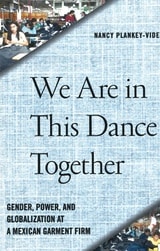
We Are in This Dance Together
Gender, Power, and Globalization at a Mexican Garment FirmPlankey-Videla, Nancy
Rutgers University Press, 2012
Changes in the global economy have real and contradictory outcomes for the everyday lives of women workers. In 2001, Nancy Plankey-Videla had a rare opportunity to witness these effects firsthand. Having secured access to one of Latin America's top producers of high-end men's suits in Mexico for participant-observer research, she labored as a machine operator for nine months on a shop floor made up, mostly, of women. The firm had recently transformed itself from traditional assembly techniques, to lean, cutting-edge, Japanese-style production methods. Lured initially into the firm by way of increased wages and benefits, workers had helped shoulder the company's increasing debts. When the company's plan for successful expansion went awry and it reneged on promises it had made to the workforce, women workers responded by walking out on strike.
Building upon in-depth interviews with over sixty workers, managers, and policy makers, Plankey-Videla documents and analyzes events leading up to the female-led factory strike and its aftermath—including harassment from managers, corrupt union officials and labor authorities, and violent governor-sanctioned police actions. We Are in This Dance Together illustrates how the women's shared identity as workers and mothers—deserving of dignity, respect, and a living wage—became the basis for radicalization and led to further civic organizing against the state, the company, and the corrupt union to demand justice.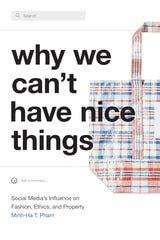
Why We Can't Have Nice Things
Social Media’s Influence on Fashion, Ethics, and PropertyMinh-Ha T. Pham
Duke University Press, 2022