Results by title
13 books match the query 'Côte d'Ivoire'
African Miracle, African Mirage
Transnational Politics and the Paradox of Modernization in Ivory CoastAbou B. Bamba
Ohio University Press, 2016
Throughout the 1960s and 1970s, Ivory Coast was touted as an African miracle, a poster child for modernization and the ways that Western aid and multinational corporations would develop the continent. At the same time, Marxist scholars—most notably Samir Amin—described the capitalist activity in Ivory Coast as empty, unsustainable, and incapable of bringing real change to the lives of ordinary people. To some extent, Amin’s criticisms were validated when, in the 1980s, the Ivorian economy collapsed.
In African Miracle, African Mirage, Abou B. Bamba incorporates economics, political science, and history to craft a bold, transnational study of the development practices and intersecting colonial cultures that continue to shape Ivory Coast today. He considers French, American, and Ivorian development discourses in examining the roles of hydroelectric projects and the sugar, coffee, and cocoa industries in the country’s boom and bust. In so doing, he brings the agency of Ivorians themselves to the fore in a way not often seen in histories of development. Ultimately, he concludes that the “maldevelopment” evident by the mid-1970s had less to do with the Ivory Coast’s “insufficiently modern” citizens than with the conflicting missions of French and American interests within the context of an ever-globalizing world.
An Intimate Rebuke
Female Genital Power in Ritual and Politics in West AfricaLaura S. Grillo
Duke University Press, 2018
Braided Worlds
Alma Gottlieb and Philip Graham
University of Chicago Press, 2012
Hunting the Ethical State
The Benkadi Movement of Côte d'IvoireJoseph Hellweg
University of Chicago Press, 2011
In the 1990s a nationwide crime wave overtook Côte d’Ivoire. The Ivoirian police failed to control the situation, so a group of poor, politically marginalized, and mostly Muslim men took on the role of the people’s protectors as part of a movement they called Benkadi. These men were dozos—hunters skilled in ritual sacrifice—and they applied their hunting and occult expertise, along with the ethical principles implicit in both forms of knowledge, to the tracking and capturing of thieves. Meanwhile, as Benkadi emerged, so too did the ethnic, regional, and religious divisions that would culminate in Côte d’Ivoire’s 2002–07 rebellion.
Hunting the Ethical State reveals how dozos worked beyond these divisions to derive their new roles as enforcers of security from their ritual hunting ethos. Much as they used sorcery to shape-shift and outwit game, they now transformed into unofficial police, and their ritual networks became police bureaucracies. Though these Muslim and northern-descended men would later resist the state, Joseph Hellweg demonstrates how they briefly succeeded at making a place for themselves within it. Ultimately, Hellweg interprets Benkadi as a flawed but ingenious and thoroughly modern attempt by non-state actors to reform an African state.
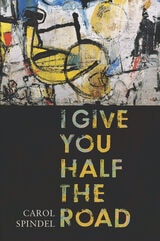
I Give You Half the Road
Carol Spindel
University of Wisconsin Press, 2021
Once considered the most stable country in West Africa, Ivory Coast was split by an armed rebellion in 2002 and endured a decade of instability and a violent conflict. Spindel provides an intimate glimpse into this turbulent period by weaving together the daily lives and paths of five neighbors. Their stories reveal Ivorians determined to reunite a divided country through reliance on mutual respect and obligation even while power-hungry politicians pursued xenophobic and anti-immigrant platforms for personal gain. Illuminating democracy as a fragile enterprise that must be continually invented and reinvented, I Give You Half the Road emphasizes the importance of connection, generosity, and forgiveness.
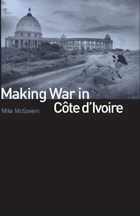
Making War in Côte d'Ivoire
Mike McGovern
University of Chicago Press, 2011
After a brief period of active combat in 2002, the conflict in Côte d’Ivoire settled into a pattern of neither war nor peace until the 2010 elections led to a new phase of direct conflict. During these taut years, short bursts of intense violence alternated with long periods of standoff. When things were peaceful, the Ivorian political elite and the press produced inflammatory rhetoric while soldiers and militias used the state of emergency as an excuse to shake down civilians at roadblocks. What kept this perpetually tense, dismal, and destructive situation simmering? In this groundbreaking book, Mike McGovern suggests the answer lies in understanding war as a process, not a series of events, and that rather than focusing on the role of political institutions, we should be paying attention to the flawed and unpredictable people within them.
McGovern argues that only deep knowledge of a region—its history, languages, literature, and popular culture—can yield meaningful insights into political decision making. Putting this theory into action, he examines an array of issues from the micro to the macro, including land tenure disputes, youth boredom, organized crime, and the international cocoa trade. Drawn from McGovern’s academic research and experience working for a conflict resolution think tank and the political access that position gave him, Making War in Côte D’Ivoire will be the definitive work on the Ivorian conflict and an innovative example of how anthropology can address the complexities of politics.
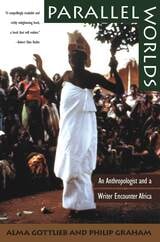
Parallel Worlds
An Anthropologist and a Writer Encounter AfricaAlma Gottlieb and Philip Graham
University of Chicago Press, 1994
"A remarkable look at a remote society [and] an engaging memoir that testifies to a loving partnership . . . compelling."—James Idema, Chicago Tribune
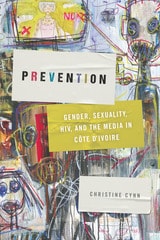
Prevention
Gender, Sexuality, HIV, and the Media in Côte d'IvoireChristine Cynn
The Ohio State University Press, 2018
More specifically, Cynn argues that through the bolstering of normative conceptions of gendered sexualities and families, HIV prevention media campaigns seek to actively create proper subjects, a goal corresponding with nation-building projects and reproducing their terms of belonging. During periods of increasingly virulent political and economic struggles in Côte d’Ivoire, such HIV prevention messages have lent support to lender- and state-mandated structural adjustment policies and to the exclusionary logic that casts some—such as those suffering from AIDS-related illnesses, those labeled as “homosexual,” sex workers, intravenous drug users, and the HIV-positive child—as implicitly unassimilable to the community and nation. Deeply interdisciplinary, Prevention brings to light new forms of exclusion and expands scholarship on gender and sexual normativities as it intersects with that on public health, neoliberalism, and film and media.
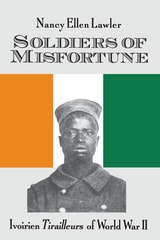
Soldiers Of Misfortune
lvoirien Tirailleurs of World War IINancy Ellen Lawler
Ohio University Press, 1992
This is a study of the African veterans of a European war. It is a story of men from the Cote d‘Ivoire, many of whom had seldom traveled more than a few miles from their villages, who served France as tirailleurs (riflemen) during World War II.
Thousands of them took part in the doomed attempt to hold back the armies of the Third Relch in 1940; many were to spend the rest of the war as prisoners in Germany or Occupied France.
Others more fortunate came under the authority of Vichy France, and were deployed in the Defense of the “Motherland” and its overseas possessions against the threat posed by the Allies. By 1943, the tirailleur regiments had passed into the service of de Gaulle’s free French and under Allied command, played a significant role in the liberation of Europe.
In describing these complex events, Dr. Lawler draws upon archives in both France and the Cote d’Ivoire. She also carried out an extensive series of interviews with Ivoirien veterans principally, but not exclusively, from the Korhogo region. The vividness of their testimony gives this study a special character. They talk freely not only of their wartime exploits, but also of their experiences after repatriation.
Lawler allows them to speak for themselves. They express their hatred of forced labor and military conscription, which were features of the colonial system, yet at the same time reveal a pride in having come to the defense of France. They describe their role in the nationalist struggle, as foot soldiers of Felix Houphouet-Boigny, but also convey their sense of having become a lost generation. They recognize that their experiences as French soldiers had become sadly irrelevant in a new nation in quest of its history.
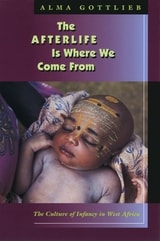
The Afterlife Is Where We Come From
Alma Gottlieb
University of Chicago Press, 2003
In this unique and engaging ethnography of babies, Alma Gottlieb explores how religious ideology affects every aspect of Beng childrearing practices—from bathing infants to protecting them from disease to teaching them how to crawl and walk—and how widespread poverty limits these practices. A mother of two, Gottlieb includes moving discussions of how her experiences among the Beng changed the way she saw her own parenting. Throughout the book she also draws telling comparisons between Beng and Euro-American parenting, bringing home just how deeply culture matters to the way we all rear our children.
All parents and anyone interested in the place of culture in the lives of infants, and vice versa, will enjoy The Afterlife Is Where We Come From.
"This wonderfully reflective text should provide the impetus for formulating research possibilities about infancy and toddlerhood for this century." — Caren J. Frost, Medical Anthropology Quarterly
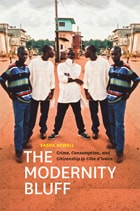
The Modernity Bluff
Crime, Consumption, and Citizenship in Côte d’IvoireSasha Newell
University of Chicago Press, 2012
In Côte d’Ivoire, appearing modern is so important for success that many young men deplete their already meager resources to project an illusion of wealth in a fantastic display of Western imitation, spending far more than they can afford on brand name clothing, accessories, technology, and a robust nightlife. Such imitation, however, is not primarily meant to deceive—rather, as Sasha Newell argues in The Modernity Bluff, it is an explicit performance so valued in Côte d’Ivoire it has become a matter of national pride.
Called bluffeurs, these young urban men operate in a system of cultural economy where reputation is essential for financial success. That reputation is measured by familiarity with and access to the fashionable and expensive, which leads to a paradoxical state of affairs in which the wasting of wealth is essential to its accumulation. Using the consumption of Western goods to express their cultural mastery over Western taste, Newell argues, bluffeurs engage a global hierarchy that is profoundly modern, one that values performance over authenticity—highlighting the counterfeit nature of modernity itself.
Under the Kapok Tree
Identity and Difference in Beng ThoughtAlma Gottlieb
University of Chicago Press, 1996
explores ideology and social practices among the Beng people of Côte
d'Ivoire. Employing symbolic and postmodern perspectives, she highlights
the dynamically paired notions of identity and difference, symbolized by
the kapok tree planted at the center of every Beng village.
"This book merits a number of readings. . . . An experiment in
ethnography that future projects might well emulate." —Clarke K. Speed,
American Anthropologist
"[An] evocative, rich ethnography. . . . Gottlieb does anthropology a
real service." —Misty L. Bastian, American Ethnologist
"Richly detailed. . . . This book offers a nuanced descriptive analysis
which commands authority." —Elizabeth Tonkin, Man
"Exemplary. . . . Gottlieb's observations on identity and difference are
not confined to rituals or other special occasions; rather she shows
that these principles emerge with equal force during daily social life."
—Monni Adams, Journal of African Religion
"[An] excellent study." —John McCall, Journal of Folklore
Research
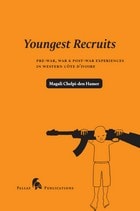
Youngest Recruits
Pre-War, War & Post-War Experiences in Western Côte d’IvoireMagali Chelpi-den Hamer
Amsterdam University Press, 2011
Youngest Recruits is an unflinching examination of the complex motivations that drive Ivoirian children in and out of armed groups. Drawing on firsthand experience with child soldiers, Magali Chelpi-Den Hamer argues that the popular narrative about children’s limited agency is insufficient to explain their participation in violent conflicts. Rather she explores in detail the pre- to postwar trajectories of child and adolescent recruits in order to show that even the youngest exercise some degree of reflection and agency when enlisting into the armed forces. In addition to shedding light on an area of great cultural concern, the author invites readers to reflect on the mixed impact of humanitarian interventions that attempt to reintegrate these children into society.